The United States Department of State has formally removed Ethiopia from the list of countries subject to a policy of denial for American arms exports, deleting the Ethiopia entry from the International Traffic in Arms Regulations (ITAR) in a final rule that took effect on 18 September 2026. The rule went on public inspection on 17 September and was published in the Federal Register the following day, ending five years in which licences for defence equipment and services bound for Ethiopia’s security forces were refused as a matter of policy.
The final rule, signed by Thomas G. DiNanno, Under Secretary of State for Arms Control and International Security, removes the entry for Ethiopia from paragraph (n) of ITAR Section 126.1, the part of the regulations that lists prohibited exports, imports and sales to and from certain countries, and leaves the paragraph reserved. The State Department said the change implements a 5 February 2026 policy determination by the Secretary of State, Marco Rubio, terminating the policy of denial for exports of defence articles and defence services to Ethiopia’s armed forces, police, intelligence services and other internal security forces.
In practical terms, requests to export American weapons, military equipment and defence services to these Ethiopian entities will no longer be turned down on principle. They will instead go through the standard procedure that applies to most countries: an exporter must apply for a licence and obtain approval from the State Department’s Directorate of Defense Trade Controls (DDTC) before any transfer takes place.
From licensing announcement to formal rule
September’s rule formalises a decision that had been in effect for four months. On 11 May 2026, the DDTC announced that it had terminated the arms embargo on Ethiopia and would review all Ethiopia licence applications for ITAR-controlled activities on a case-by-case basis, according to law firms Arnold & Porter and Holland & Knight, which advise defence exporters. ITAR licence exemptions also became available again for Ethiopia, subject to their usual conditions. Each request is now weighed against national security, foreign policy, regional stability and human rights considerations, and exporters remain responsible for screening end users and preparing applications carefully.
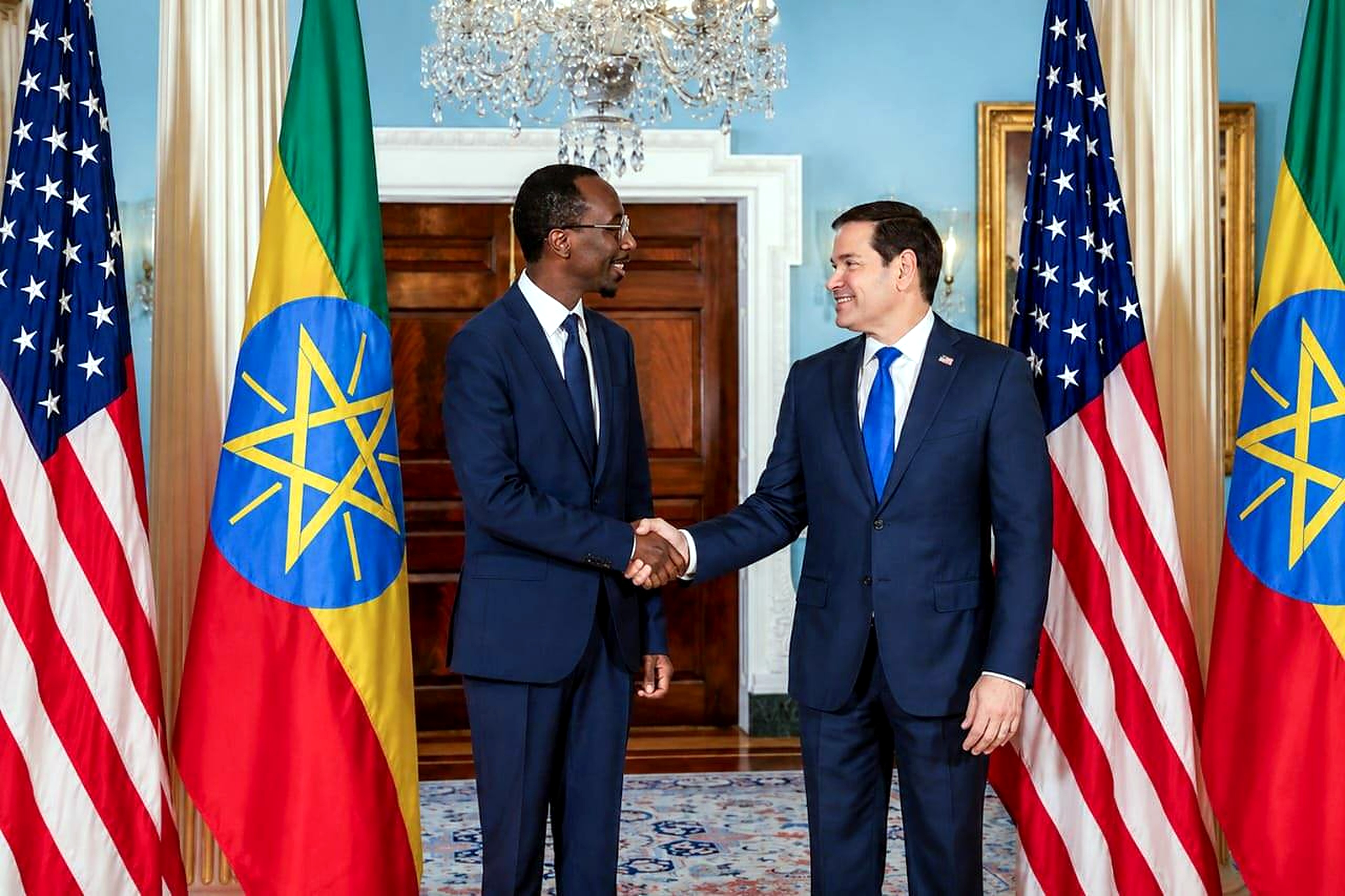
The May announcement coincided with an Ethiopian diplomatic push in Washington. On the same day, Rubio met Ethiopian Foreign Minister Gedion Timothewos to discuss the US-Ethiopia security partnership and the steps both sides had taken to advance commercial opportunities, according to a State Department statement. Gedion and Allison Hooker, the Under Secretary of State for Political Affairs, also signed a Bilateral Structured Dialogue framework covering three areas: trade and investment, defence and security cooperation, and regional peace and stability, The Reporter Ethiopia reported. “The document renews and strengthens the relationship between the two countries,” Hooker said, according to the Ethiopian News Agency, adding that it was “instrumental in expanding U.S. commercial access to Africa while setting the stage for future engagements.” Ethiopia’s delegation included Redwan Hussein, head of the National Intelligence and Security Service, one of the agencies covered by the old denial policy.
Why Ethiopia was on the list
Washington placed Ethiopia under the Section 126.1 policy of denial in November 2021, a year into the war in the northern Tigray region. The State Department cited “the ongoing crisis in northern Ethiopia” and the denial of civilian access to humanitarian relief by the Ethiopian and Eritrean militaries. Two months earlier, on 17 September 2021, President Joe Biden had signed Executive Order 14046, which created a targeted sanctions programme over the humanitarian and human rights crisis in Ethiopia.
The war drew in drones and air power on a large scale. Military Africa reported at the time on the drones Ethiopia used in the Tigray war, on reported support from Emirati drones, on the Ethiopian Air Force’s air offensive in Tigray and on the loss of an Ethiopian C-130E transport, one of the American-built Hercules aircraft the force had received from the United States in 2018. The fighting ended with the Pretoria peace agreement of November 2022, although analysts quoted by The Reporter say fears of a new round of conflict between the Tigray People’s Liberation Front and the federal government have been growing.
Restrictions have been unwinding on several fronts at once. On 18 September 2026, the day the ITAR rule took effect, the Treasury Department’s Office of Foreign Assets Control (OFAC) announced that the national emergency declared under Executive Order 14046 had expired. It removed six parties designated under the programme from its Specially Designated Nationals list, all of them Eritrean: the ruling People’s Front for Democracy and Justice, the Eritrean Defence Forces, the Red Sea Trading Corporation, Hidri Trust and two officials, Hagos Ghebrehiwet W Kidan and Abraha Kassa Nemariam, according to Baker McKenzie. The Ethiopia-related sanctions programme has been moved to OFAC’s inactive and archived programmes. Eritrea’s own security forces, however, remain under a separate ITAR policy of denial, Mesob Journal noted.
What else the rule changed
Ethiopia’s removal came in a wider package of ITAR amendments. The same rule clarifies the Section 126.1 entries for three other African states that remain under a policy of denial. The South Sudan entry now explicitly covers both exports and imports. The Libya entry received several clarifications, including replacing “technical assistance or training” with “defense services”, and a punctuation change in the Somalia entry clarifies an exclusion for case-by-case licensing. The rule also adds Saudi Arabia and Peru to the list of major non-NATO allies, revises sections covering re-exports, retransfers and temporary imports, and removes a conflicting certificate requirement for Canadian exemptions. A separate correction notice followed on 23 September.
Ethiopia is the second country to leave the list in under a year. In November 2025, the DDTC removed Cambodia, citing its “diligent pursuit of peace and security, including through renewed engagement with the United States on defense cooperation”, Holland & Knight noted. The State Department has not published a similar explanation for Ethiopia.
Leaving the list does not mean an open market. Ethiopia now joins the large group of countries whose buyers need an approved licence for every ITAR-controlled transfer, and larger sales also remain subject to congressional review under the Arms Export Control Act. What has changed is the starting point: an Ethiopian request is now judged on its merits rather than refused by default.
A defence relationship back in motion
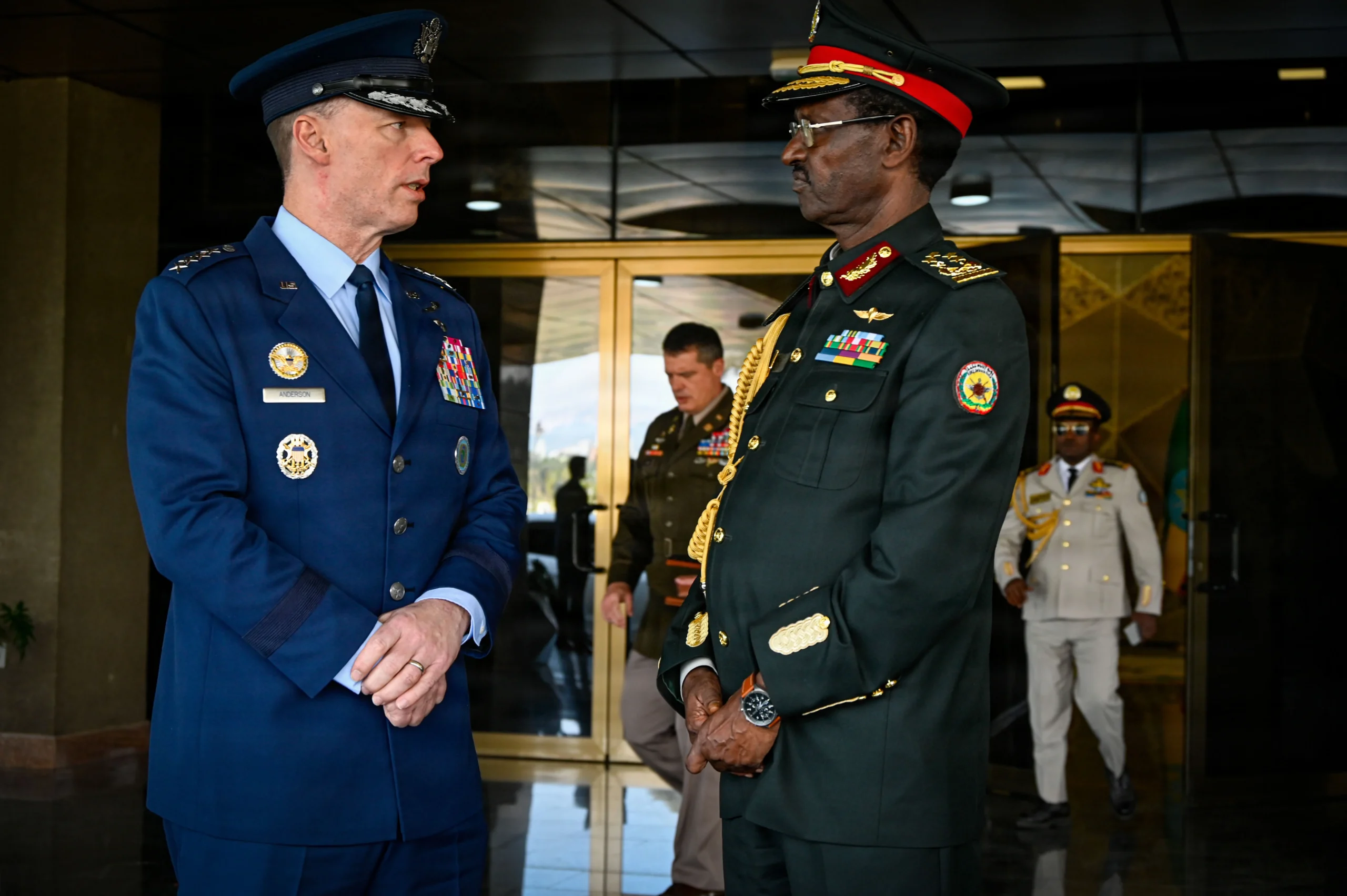
Military contact between the two countries has picked up since late 2025. The commander of United States Africa Command (AFRICOM), Air Force General Dagvin Anderson, met the Ethiopian National Defence Force (ENDF) chief of staff, Field Marshal Birhanu Jula Gelelcha, in Addis Ababa in November 2025 to discuss strengthening partner forces against regional threats. In July 2026, AFRICOM and the ENDF co-hosted the African Logistics and Communications Symposium (ALCS26) in Addis Ababa, which combined the Africa Logistics Conference and the Africa Endeavor communications exercise and brought together delegates from nearly 40 African nations, according to the Defense Visual Information Distribution Service (DVIDS).
An Ethiopian defence delegation led by Major General Teshome Gemechu then held consultations at the Pentagon on 19 and 20 August 2026 with Brian J. Ellis, the deputy assistant secretary for African affairs, and other American officials. According to Ethiopia’s Foreign Ministry, both sides agreed to raise relations to “comprehensive strategic cooperation in defence and security” and to implement the agreed frameworks quickly, The Rio Times reported. No equipment deal, training programme or funding has been announced publicly.
Ethiopia also matters to Washington beyond its borders. The ENDF is among the largest troop contributors in Somalia, where foreign forces are taking a bigger role against al-Shabaab alongside American airstrikes, and Rubio stressed Ethiopia’s role in conflict resolution and de-escalation across East Africa during his May meeting with Gedion.
Competing suppliers already in Addis Ababa
American companies return to a market that has filled up in their absence. During the years of the embargo, Addis Ababa built its forces largely on Russian, Chinese, Turkish and Emirati equipment. Military Africa reported this month that Ethiopia has received its first twelve Russian Su-35 fighters a year early, with four S-400 air defence batteries expected to follow, a deal first exposed in leaked Rostec files. The Ethiopian Air Force also operates Yak-130 trainers and Orion-E drones from Russia, unveiled Su-30 fighters and Turkish Akinci combat drones in 2024, and showed off its expanding fleet at the Black Lion air show in January 2026.
Other partners are deepening ties too. Ethiopia and China pledged deeper military cooperation, including technology transfer and training, and the Ethiopian Defence University has opened an artificial intelligence (AI) defence research laboratory with UAE backing. Ethiopia’s ambassador to Pakistan has visited Global Industrial and Defence Solutions (GIDS) to explore cooperation. Across the continent, Russia is widening its military reach and China is expanding arms sales, which gives the American move a competitive edge as well as a diplomatic one.
The change also sits awkwardly with tensions in the region. Relations between Ethiopia and Eritrea have deteriorated over Prime Minister Abiy Ahmed’s push for access to the Red Sea, at the same time as Ethiopia fields new Su-35 fighters and prepares for S-400 air defence systems. Washington’s case-by-case reviews, with their stated focus on regional stability and human rights, will show how far the United States is prepared to arm Ethiopia in that environment.
Washington’s Return to the Ethiopian Market
The first test of the rule will be the licences themselves. With the denial policy gone, the defence and security frameworks agreed in May and August can move from talks to transactions, whether in training, communications, surveillance, transport aircraft support or spare parts for the American equipment Ethiopia already flies. Any major sale will also need to clear congressional review. For now, Ethiopia has moved from the short list of countries Washington will not arm to the much larger group it will consider, and the coming licence decisions will show how much of the Ethiopian market American industry can win back from suppliers that filled the gap over the past five years.