

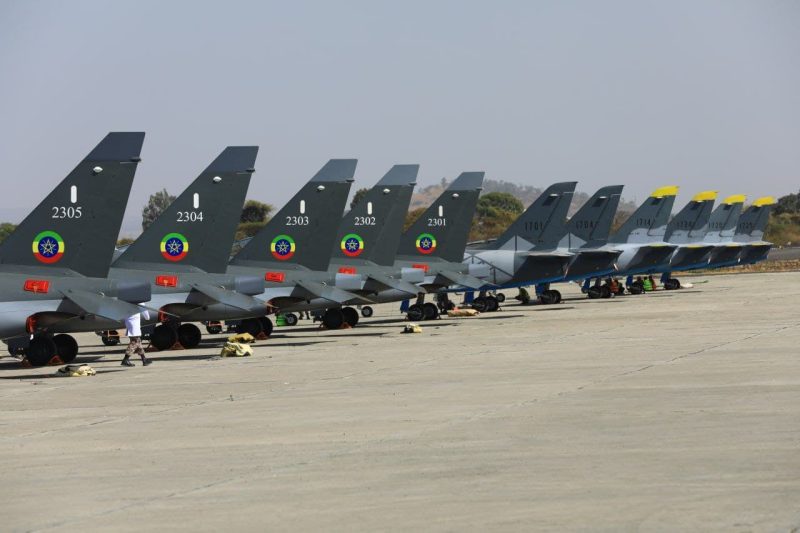
The Ethiopian Air Force (EtAF) marked its 90th anniversary in January 2026 with a dramatic display of modernisation, unveiling the induction of Russian-made Yak-130 advanced jet trainers and Orion-E unmanned aerial vehicles (UAVs). These acquisitions, revealed during the Black Lion and Aviation Expo held in Bishoftu, represent a core component of Prime Minister Abiy Ahmed’s strategy to double the nation’s air capacity and transition to fifth-generation combat aircraft by 2030. The event, themed “Flying Forward, Building a Shared Future,” functioned as a high-stakes signal of Ethiopia’s evolving military doctrine, which increasingly prioritises high-performance, networked assets over the quantity-heavy models of the Cold War era.
The arrival of the Yakovlev Yak-130 represents a notable shift in the EtAF training pipeline. During the televised aerial display on January 23, 2026, four Yak-130s with Ethiopian markings were seen performing for the public. A brief moment of confusion occurred when the commentator initially identified the aircraft as Yak-120s before correcting himself. Visual evidence from the event and subsequent videos released by the Prime Minister’s office showed aircraft bearing tail numbers 2301, 2302, 2303, 2305, and 2306. This numbering sequence suggests that at least six aircraft have been delivered to the Bishoftu airbase. Satellite imagery analysis confirms the recent nature of these deliveries; while no Yak-130s were visible on January 4, 2026, three were present by January 9, 2026.
Technically, the Yak-130 is an advanced jet trainer designed to mimic the flight characteristics of 4th+ and 5th generation fighters. Its integrated glass cockpit and reconfigurable flight control systems allow pilots to train for high-performance aircraft like the Su-27 and Su-30 without the prohibitive operational costs of flying frontline multirole fighters. Beyond its role as a trainer, the Yak-130 possesses a formidable light-attack capability. It features nine hardpoints capable of carrying up to 3,000 kilograms of weaponry, including guided bombs, rockets, and air-to-air missiles. For a nation facing domestic insurgencies, the ability to deploy a trainer in a secondary ground-attack role provides substantial operational flexibility. These jets will likely serve as the primary training platform for pilots transitioning to Ethiopia’s Sukhoi Flanker fleet, which currently includes eighteen Su-27P/SK and six Su-27UB models, as well as the newly acquired Su-30K multirole fighters.
The 90th-anniversary celebrations also served as the first public appearance of the exported Orion-E Medium Altitude, Long Endurance (MALE) UAV. Developed by the Russian Kronstadt Group, the Orion-E is the first confirmed export of this system, making Ethiopia its inaugural foreign operator. The aircraft features a 16-meter wingspan and an endurance of 24 hours, depending on the mission profile and payload configuration. It can carry up to 250 kilograms of varied weaponry, typically consisting of small precision-guided munitions and electro-optical sensors for intelligence, surveillance, and reconnaissance (ISR) missions.
While Russia has utilised the Orion type operationally in Syria and Ukraine, where some units were lost to layered air defence systems, the export variants are believed to feature improved avionics and encrypted datalinks to enhance survivability. The Orion-E joins an already diverse Ethiopian drone inventory that includes the Turkish Bayraktar TB2 and Akinci, the Chinese Wing Loong, and the Iranian Qods Mohajer-6. These platforms have seen active service against the Tigray People’s Liberation Forces, and the addition of the Orion-E adds another layer to Ethiopia’s persistent surveillance and precision-strike architecture. By diversifying its suppliers, Addis Ababa reduces its strategic vulnerability to individual international sanctions or supply chain disruptions.
The modernisation of the rotary and fixed-wing fleet extends beyond trainers and drones. During the 2026 air show, the EtAF displayed two Su-30K multirole fighters, bearing tail numbers 2401 and 2402. These aircraft, originally delivered in January 2024, were part of a batch of eighteen fighters manufactured for the Indian Air Force and later returned to Russia. While twelve of these were sold to Angola in 2017, the remaining six had remained in storage. Although there was speculation that Ethiopia might receive the remaining four ex-Indian Su-30Ks, only the original two from the 2024 delivery were observed in the 2026 aerial display. These Su-30K models act as a bridging platform, providing Ethiopia with advanced air-to-air and strike capabilities that exceed the older Su-27 variants.
A parallel development in Ethiopia’s defence sector is the deepening technical cooperation with Belarus. The State Military-Industrial Committee of Belarus recently reported that its unmanned systems and electronic warfare equipment have undergone testing within Ethiopia and are currently performing combat duties in the region. During the Aviation Expo 2026, Dzmitry Pantus, Chairman of the Committee, personally demonstrated these technologies to Prime Minister Abiy Ahmed. These systems appear to have successfully transitioned from testing to active deployment, bolstering Ethiopia’s capacity to secure its borders and interests in a volatile regional environment. There are ongoing plans to establish joint assembly facilities for this equipment, which aligns with Ethiopia’s goal of achieving greater self-sufficiency in military production.
Prime Minister Abiy Ahmed emphasised that these technological advancements are backed by a clear fiscal plan and an economy growing at approximately 10% annually. He stated that the government has identified specific funding sources to support the ambitious 2030 roadmap. However, the Prime Minister noted that hardware alone does not constitute a capable force; the true value lies in human capital and professional training. This philosophy explains the investment in the Yak-130, which ensures that the next generation of Ethiopian pilots will be capable of handling the high-tech sensors and flight dynamics of future fifth-generation assets.
The Black Lion Air Show 2026 was more than a ceremonial event; it was a strategic communiqué. By hosting the Future African Air Forces Forum (FAAFF) alongside the expo, Ethiopia drew in 38 air force commanders from across the continent to discuss regional security, counter-terrorism, and collaborative peacekeeping. Attendees from nations such as Botswana, Namibia, and Gabon observed Ethiopia’s self-reliance in aircraft maintenance and its successful integration of varied international technologies. This positioning demonstrates Ethiopia’s intent to lead the continent in aviation and defence diplomacy, providing a counterweight to both state and non-state threats in the Horn of Africa and the Red Sea corridor.
Ethiopia’s move to modernise its air wing demonstrates a calculated realignment. By integrating Russian jet trainers and MALE drones alongside Turkish and Chinese systems, and by fostering industrial ties with Belarus and the Czech Republic, Addis Ababa is creating a multi-layered defence ecosystem. This approach enhances the nation’s deterrence posture while promoting regional stability through technological superiority. As the 90th-anniversary celebrations conclude, the focus shifts to the practical integration of these systems into active service, ensuring that the “Lions” continue to rule the Ethiopian skies with modern, effective tools.