

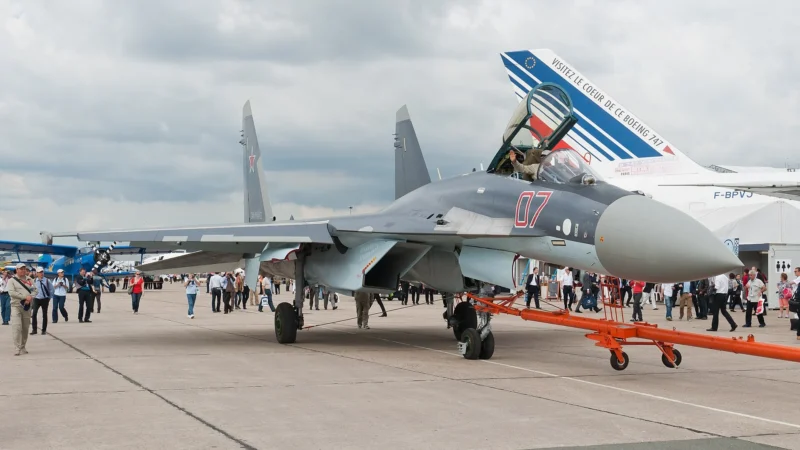
Ethiopia has received its first twelve Russian-built Sukhoi Su-35 fighter jets, Prime Minister Abiy Ahmed announced on social media on 28 October 2026. Four batteries of the S-400 long-range surface-to-air missile system are expected to follow.
Abiy made the announcement while in Moscow for the third Russia-Africa Summit, held on 28 and 29 October. He posted photographs and video showing him alongside Ethiopian and Russian officials beside two of the jets. Reports placed that handover at Zhukovsky Airport outside the Russian capital, and Ethiopian state-affiliated broadcaster Fana Media Corporation reported that the prime minister witnessed the official ceremony.
“In accordance with our prior agreement with the Russian government, we have today taken delivery of the first twelve Su-35 4++ Generation fighter jets,” Abiy said in the statement. He thanked Russian President Vladimir Putin for advancing the schedule and said the jets had arrived a year ahead of the originally agreed timeline.
Abiy did not disclose the contract’s value, its full terms or the expected arrival date of the S-400 batteries. He described the delivery as a major boost to the Ethiopian National Defense Force (ENDF) and said it places the country at the forefront of sub-Saharan African air power. Basing locations for the new fighters have not been announced.
From Leaked Files to Delivery
Ethiopia’s interest in the Su-35 became public a year before the aircraft were handed over. As Military Africa reported in October 2025, a hacker group calling itself Black Mirror published internal files from Rostec, the Russian state defence conglomerate. The files showed that its subsidiary KRET (Concern Radio-Electronic Technologies) had received a 2022 order to build control and display systems for six Su-35s destined for Ethiopia. Algeria and Iran appeared in the same leaked documents with larger orders. Neither Rostec nor the Ethiopian government commented at the time.
The twelve jets delivered this week are twice the six listed in the leak. Abiy’s reference to the “first twelve” suggests that more aircraft may follow, although he did not disclose the total number ordered. In January 2026, sources told Military Africa during the Black Lion Air Show in Bishoftu, which marked the Ethiopian Air Force’s 90th anniversary, that the first Su-35s had already been shipped, though no airframe was shown at the event. The War Zone has speculated that the Ethiopian aircraft could come from the batch of 24 originally built for Egypt, a deal that collapsed under the threat of United States sanctions. That link has not been confirmed.
A Quarter Century of Flankers
The jets join an air force that has operated Sukhoi fighters for more than 25 years. Ethiopia received Su-27s in the late 1990s and used them against Eritrea during the 1998 to 2000 border war, where they reportedly won all four known air engagements against Eritrean MiG-29s. The fleet has since suffered non-combat losses, including a fatal Su-27 crash in 2019, and the Ethiopian Air Force has scrambled its fighters during border tensions with Sudan.
In January 2024, Ethiopia unveiled Su-30 fighters alongside Turkish Bayraktar Akinci drones. The aircraft, reported to be two Su-30Ks, were originally built for the Indian Air Force and spent years in storage in Belarus before being refurbished. The two-seat jets are expected to serve as conversion trainers for the new Su-35 fleet.
A Short List of Export Customers
Export customers for the Su-35 remain few. China took delivery of 24 aircraft between 2016 and 2018, and Algeria reportedly received its first aircraft in early 2025. Russia’s own Su-35 inventory exceeded 120 airframes by 2025, with several delivery batches that year and further deliveries in April 2026. Ethiopia now becomes the second confirmed African operator.
The S-400 is already in service with China, India and Turkey. Turkey’s purchase led the United States to sanction its defence procurement agency in December 2020 under the Countering America’s Adversaries Through Sanctions Act (CAATSA), a law targeting major arms deals with Russia. Whether Washington applies the same measure to Ethiopia would require a separate US determination, and none has been reported.
What the Su-35 Brings
The Su-35, known by the NATO reporting name Flanker-E, is a single-seat, twin-engine multirole fighter and the most advanced Russian fighter in export service after the stealth-capable Su-57. Sukhoi markets it as a “4++ generation” design, a heavily modernised development of the fourth-generation Su-27 airframe that does not incorporate fifth-generation stealth shaping. The first prototype was rolled out in 2007 at the KnAAPO (Komsomolsk-on-Amur Aircraft Plant) facility, now part of United Aircraft Corporation (UAC). The aircraft entered Russian service in 2014 following a domestic order for 48 jets in 2009.
The fighter is powered by two Saturn AL-41F1S afterburning turbofans, each fitted with a three-dimensional thrust-vectoring nozzle. The nozzles pivot independently, giving the Su-35 what Russian industry describes as supermanoeuvrability: the ability to perform post-stall manoeuvres that can defeat a pursuing missile or an opponent in a close-range dogfight. According to manufacturer figures, the jet reaches a top speed of about Mach 2.25, climbs at roughly 280 metres per second and has a service ceiling of about 18,000 metres. Its internal fuel load of 11,500 kilograms gives a combat radius of about 1,600 kilometres and a ferry range of up to 3,600 kilometres without drop tanks.
The N035 Irbis-E passive electronically scanned array (PESA) radar can reportedly detect large aerial targets at more than 400 kilometres in favourable conditions, track up to 30 targets and engage eight at the same time. That would be a major step up from the older radar on Ethiopia’s Su-27s and would give Ethiopian pilots a clear detection advantage over most air forces in the region.
Bringing the type into service will take more than airframes. Pilot conversion, maintenance infrastructure, weapons integration and a dependable flow of spare parts will decide how many of the twelve jets are mission-ready at any time, and Russia’s own wartime demand for parts and munitions could test that supply chain.
The S-400 Layer
The S-400 would complement the fighters on the ground. Each battery typically combines long-range surveillance and engagement radars with a command post and several launcher vehicles, allowing a single unit to cover a broad area of airspace against aircraft and some ballistic and cruise missile threats. Four batteries would give Ethiopia a layered air defence network well beyond anything currently fielded in the Horn of Africa.
Moscow’s Growing Air Power Footprint in Africa
The acquisition extends a defence relationship that Addis Ababa and Moscow formalised through a July 2021 cooperation agreement covering training and technology transfer. It also fits a broader pattern of African states turning to Russian combat aircraft this year. Algeria took delivery of Su-34 strike fighters in May 2026 and has become the first foreign operator of the Su-57E, while Military Watch Magazine has reported that Sudan is negotiating for Su-30 and Su-35 jets in a deal that could give Russia access to a naval facility on the Red Sea. Russia’s state arms exporter Rosoboronexport has put its African order book at about $4 billion.
Deterrence on the Eritrean Frontier
The timing carries weight given the tensions between Ethiopia and Eritrea, which have intensified during 2026. Addis Standard has reported that Russia offered to host talks between the two governments. Abiy framed the new equipment in exactly that context, saying it would enable Ethiopia to deter aggression and support regional stability. The arrival dates of the S-400 batteries, and whether more Su-35s follow the first twelve, will show how far that deterrent extends.