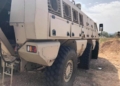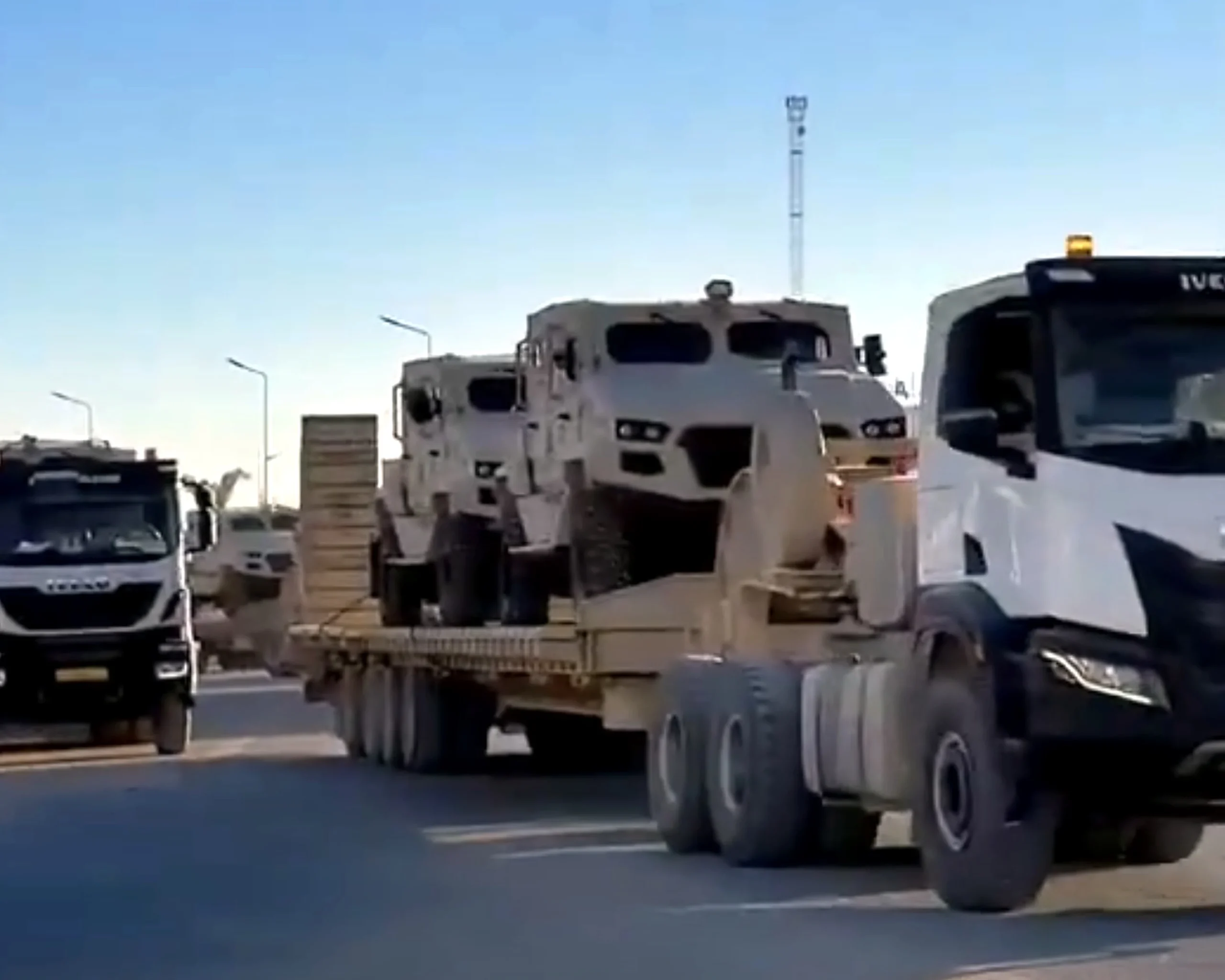
The Libyan National Army (LNA) of Field Marshal Khalifa Haftar has taken delivery of a large consignment of Calidus MCAV-20 4×4 armoured personnel carriers (APCs) built in the United Arab Emirates (UAE), according to footage circulating on social media this week.
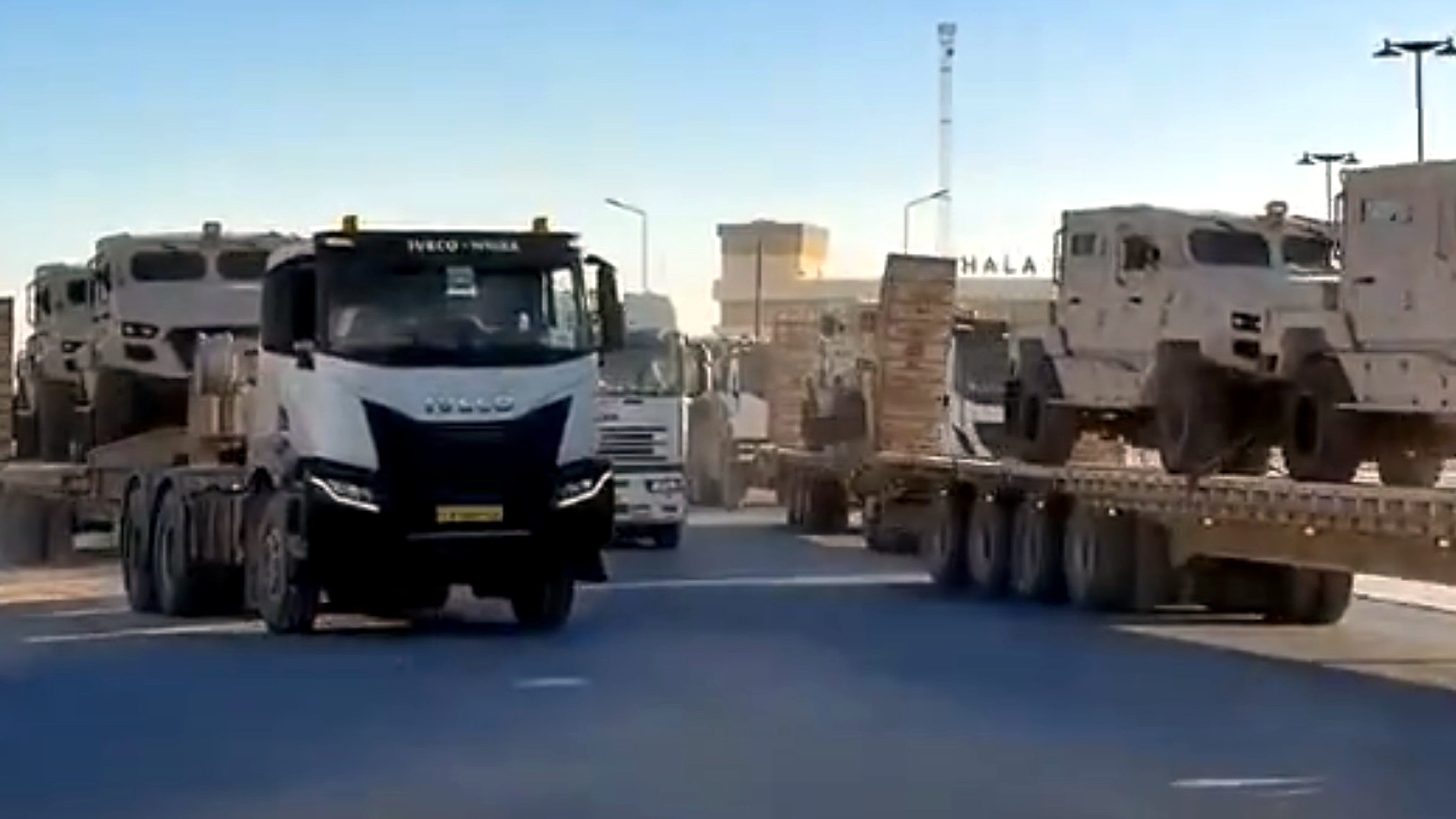
The video shows dozens of the vehicles carried on low-loader trailers through Ajdabiya (30.772080, 20.203612), the eastern Libyan town about 150 kilometres south of Benghazi, before the convoy continues westwards towards an unknown destination. The vehicles appear factory-fresh in a sand finish, loaded two to a trailer behind white Iveco tractor units, with further lorries carrying stacked crates and pallets in the same column. Neither the LNA, which also calls itself the Libyan Arab Armed Forces (LAAF), nor Calidus has commented publicly on the delivery, and the exact number of vehicles has not been confirmed.
Why the Ajdabiya route matters
Ajdabiya sits at the junction of Libya’s coastal highway and the desert road that runs south to Kufra. A convoy heading west from the town follows the coast towards Brega, Ras Lanuf and the oil terminals of the Gulf of Sirte, and from there to Sirte itself. Since the 2020 ceasefire, the Sirte and Jufra line has marked the boundary between LNA-held territory and forces aligned with the Government of National Unity in Tripoli, which makes the central coast the most likely place for new armour to be based. That is an inference from the route, not a confirmed destination.
The area has seen other recent military activity. Earlier this month Military Africa reported that satellite imagery may show a suspected Russian Iskander launcher at Al-Qardabiya airbase near Sirte, a claim that remains unconfirmed.
The Calidus MCAV-20 in detail
The MCAV-20, short for Multi-Role Combat Armoured Vehicle, is a 4×4 light-to-medium armoured vehicle designed for troop transport and tactical support. Abu Dhabi-based Calidus introduced it at the International Defence Exhibition and Conference (IDEX) in February 2021. The design uses an upgraded commercial 4×4 chassis fitted with an armoured monocoque crew cell, a layout that keeps costs and spare-parts demands lower than purpose-built military vehicles.
Published figures put the vehicle at about seven tonnes, 6.13 metres long, 2.4 metres wide and 2.38 metres high. A turbocharged diesel engine of about 330 horsepower drives it to a top speed of 110 kilometres per hour, with a stated range of more than 700 kilometres. The basic version carries a driver and commander plus three dismounted troops, while a stretched variant has room for six.
Protection is modular. According to Tank Encyclopedia, the base model meets North Atlantic Treaty Organization (NATO) STANAG 4569 Level 2 against ballistic threats and M2A/M2B against mines, which covers 7.62 mm armour-piercing rounds and blasts from a six-kilogram anti-tank mine. A heavier variant with add-on armour reaches Level 3 ballistic and M3A/M3B mine protection. The roof accepts weapon stations such as heavy machine guns or automatic grenade launchers, either in manual turrets or remote weapon stations such as the Eagle 1 with a 12.7 mm M2HB or 14.5 mm KPVT gun. Sudanese vehicles have even been seen with a ZU-23-2 twin 23 mm cannon mounted in the rear bed.
Calidus has since shown an upgraded MCAV with a passive “Spider Net” mesh cage over the sides, front and roof, reported by Army Recognition as protection against first-person-view (FPV) drones and loitering munitions. The vehicles in the Ajdabiya footage do not appear to carry it.
A growing African customer base
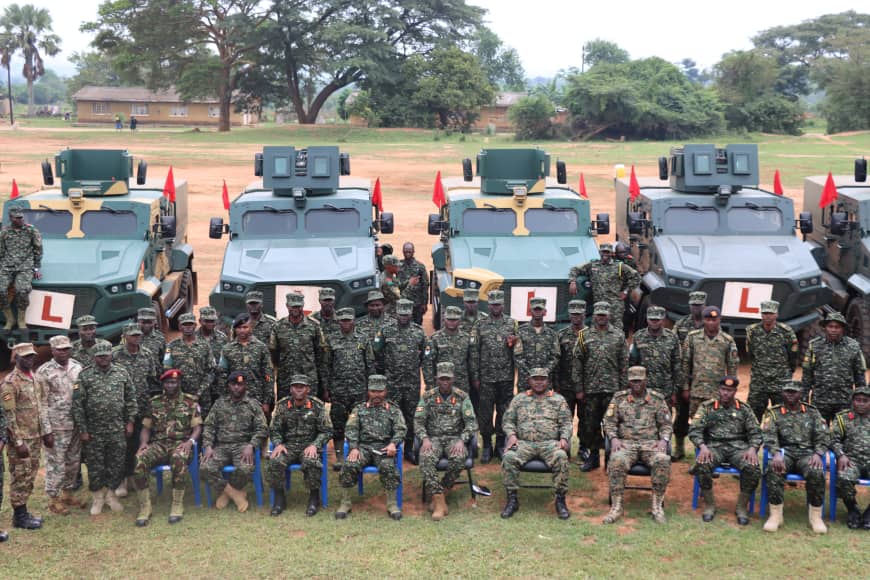
More than 350 MCAV-20s are believed to have been built, and Africa has become the vehicle’s main market. Military Africa first reported the type with the Sudanese Armed Forces and the Republican Guard of the Democratic Republic of the Congo in 2023, followed by Chad the same year. Mozambique received vehicles in 2024, and the Ethiopian Army took dozens that July, moved by rail from Djibouti. Benin and Uganda followed in 2025, Mauritania also operates the type, and Ethiopia took an additional batch in early 2026.
Libya now joins that list as the first North African operator outside Mauritania. The pattern is familiar: most MCAV-20 deliveries have gone to governments or forces with close political ties to Abu Dhabi, often as part of wider security packages rather than open competitions.
An arsenal drawn from many suppliers
The delivery adds to a steady build-up of LNA hardware over the past 18 months. At the May 2025 Benghazi parade marking the 11th anniversary of Operation Al-Karama, the force showed off a broad mix of new armour, aircraft and helicopters, alongside Chinese vertical take-off surveillance drones. In December 2025, Pakistan reportedly agreed a deal worth more than $4 billion to supply the LNA with 16 JF-17 fighters and 12 Super Mushshak trainers.
In October 2026 the LAAF released video of about 90 vehicles resembling the improved Turkish BMC AMAZON 4×4, marked “ANS” rather than “BMC”, which raised the possibility of licence assembly. A month earlier, Russian cargo ships unloaded dozens of Ural and Tornado-U vehicles at Tobruk, according to open-source analysts cited by Il Foglio, and research by C4ADS has tracked Russian-linked ships moving armour through Tobruk to Africa Corps units in the Sahel. Older LNA purchases include Jordanian Al-Mared 8×8 and Mbombe 6×6 vehicles in 2019, as well as a stream of cloned and unmarked armoured vehicles of uncertain origin.
The arms embargo question
Libya has been under a United Nations (UN) arms embargo since 2011, and any transfer of military equipment requires approval from the Security Council’s sanctions committee. There is no public record of an exemption for this shipment. In April 2026, a UN Panel of Experts confirmed that an earlier consignment of armoured vehicles from the UAE had been delivered to Libya in breach of the embargo, according to Dispatch Risk. The same month, Reuters reported that at least three combat drones, believed to include a Chinese Feilong-1 and two Bayraktar TB2s, had appeared at Al Khadim airbase east of Benghazi in 2025, with the supplier unknown.
The UAE’s role in eastern Libya is also under scrutiny over the war in Sudan. A joint investigation by Lighthouse Reports, Sudan War Monitor and Evident, reported by Middle East Eye in June 2026, described camps in LNA-held territory at Kufra, Sabha, Jufra and near Benghazi where Rapid Support Forces (RSF) fighters allegedly trained on Emirati-supplied weapons. The UAE denies giving military support to any side in Sudan, and the RSF and LAAF deny Emirati involvement. The new MCAV-20s are heading west rather than south towards the Sudanese and Chadian borders, but the convoy will add to questions about where Emirati armour in eastern Libya ends up.
Mobility on the Gulf of Sirte front
For the LNA, the MCAV-20 fills a practical gap. Its mine protection suits a coastline still littered with explosive remnants from the 2019 to 2020 Tripoli offensive, while its speed and range fit long patrols across the oil crescent and the desert approaches to Jufra. A fleet of standardised, newly built APCs is also easier to maintain than the mix of ageing Soviet-era armour, captured vehicles and copies that the force has relied on.
What remains unclear is the size of the full order, which units will receive the vehicles and whether further batches will follow. With Tripoli’s forces also re-equipping with Turkish support and talks on unifying Libya’s military making slow progress, the arrival of another column of foreign armour on the central coast will be watched closely in both Tripoli and Benghazi.