

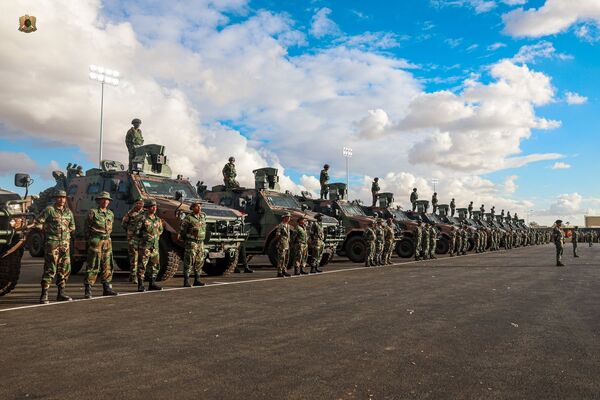
Video footage circulating online shows dozens of Turkish-made BMC AMAZON 4×4 armored vehicles in service withLibyan Arab Armed Forces (LAAF) that controls eastern Libya. The LAAF released a video of the event on 17 October showing about 90 vehicles that looked identical to the improved version of the Amazon made by the Turkish company BMC other than they had the initials ANS embossed on their front where BMC is usually written, raising the possibility they were assembled under license, similar to two different unmarked armoured vehicles supplied to Libyan forces in 2020.
Libya remains split between the Government of National Unity in Tripoli and the eastern authorities aligned with Khalifa Haftar. Turkish equipment has historically flowed to the Tripoli side, which makes the western government the likelier customer. That is an inference, not a confirmed fact.
The AMAZON is the smallest vehicle in BMC Otomotiv’s armored family. BMC first showed it publicly at the Eurosatory exhibition in Paris in 2016. It carries up to seven people and uses a V-shaped hull, which deflects mine and roadside bomb blasts away from the crew compartment. Unveiled in 2023, the improved version of the Amazon has only previously been seen in service in Syria, with the original version being in service in Qatar and Turkmenistan.
BMC says the vehicle reaches 120 km/h (75 mph) and travels about 800 km (500 miles) on one tank of fuel. Those are manufacturer figures. The remote-controlled weapon station, or RCWS, is a common option. It usually carries a 7.62 mm or 12.7 mm machine gun that the crew aims and fires from inside, using cameras and a screen. The gunner stays under armor, which matters in patrol and checkpoint work where exposure is the main risk.
The parade also included several 4×4 armoured vehicles that looked like the Jordanian-made Al-Wahsh fitted with remotely operated weapon stations for anti-tank guided missiles, a combination not previously seen in Libya. The launchers looked similar to the ones developed by the Jordanian company Jadara for its Terminator missile, which looks like the RK-3 used with the Ukrainian Corsar laser beam-riding system.
The LAAF also displayed jet-powered unmanned aerial vehicles (UAVs) that looked identical to the Belarusian Mirotvorets (peacemaker) alongside two trailer-mounted pneumatic launchers.
Turkey’s footprint in Libya
Türkiye has been a main military partner of Tripoli since 2019, when the two governments signed a security agreement alongside a maritime memorandum covering Eastern Mediterranean borders. Ankara later sent advisers, drones and armored vehicles. In 2022 the two sides signed protocols on Libyan Air Force capability and pilot training. In 2025 the Government of National Unity and the Turkish defense ministry agreed to upgrade the readiness and technical capacity of Libyan army personnel.
Turkish armored vehicles have a track record there. In May 2019 forces aligned with the then-government in Tripoli published photos of more than a dozen BMC Kirpi II mine-protected vehicles unloading at Tripoli port. The Kirpi is a larger 4×4 mine-resistant ambush-protected, or MRAP, vehicle. The delivery came while a UN arms embargo was in force, and the eastern-based Libyan National Army responded by announcing a naval blockade of western ports.
The Kirpi did not earn universal praise. A Military Africa report from 2020 described Libyan National Army tests on captured Kirpi vehicles and called their performance poor. Turkey also reportedly deployed M60 main battle tanks to Libya in 2020.
The supplied background also lists a lone Akinci armed drone seen in Libya in 2024 and a 2022 Libyan order for the Hürkuş-C light combat aircraft.
The legal and political frame
Turkey’s military presence now has a firm legal footing. Reporting from Türkiye Today says the Turkish parliament approved a 24-month extension of the Turkish Armed Forces mission in Libya on 22 Dec 2025, with the new term starting in January 2026. That runs the mandate to roughly early 2028.
The mission mainly covers training and advice. The motion cited the lack of elections in Libya and the need to protect a fragile ceasefire. A steady flow of Turkish-made vehicles fits that pattern, because training missions generate demand for the equipment being taught.
Apparently, Turkish suppliers moving from heavy armor toward lighter vehicles for internal security. That suits policing, border and checkpoint work better than front-line combat. It also keeps Turkish hardware in Libyan hands at a time when Ankara’s advisers are embedded with those same forces.