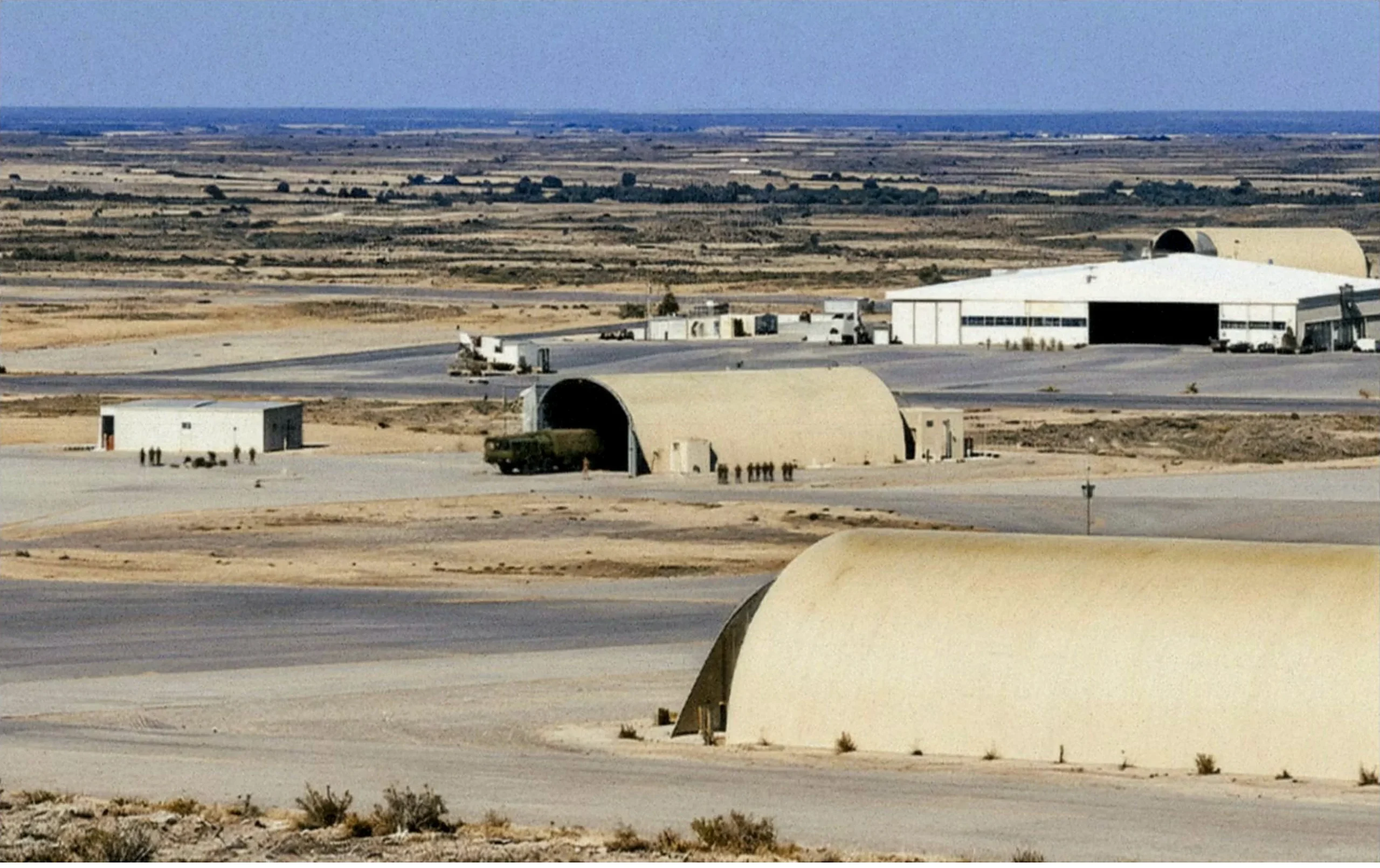
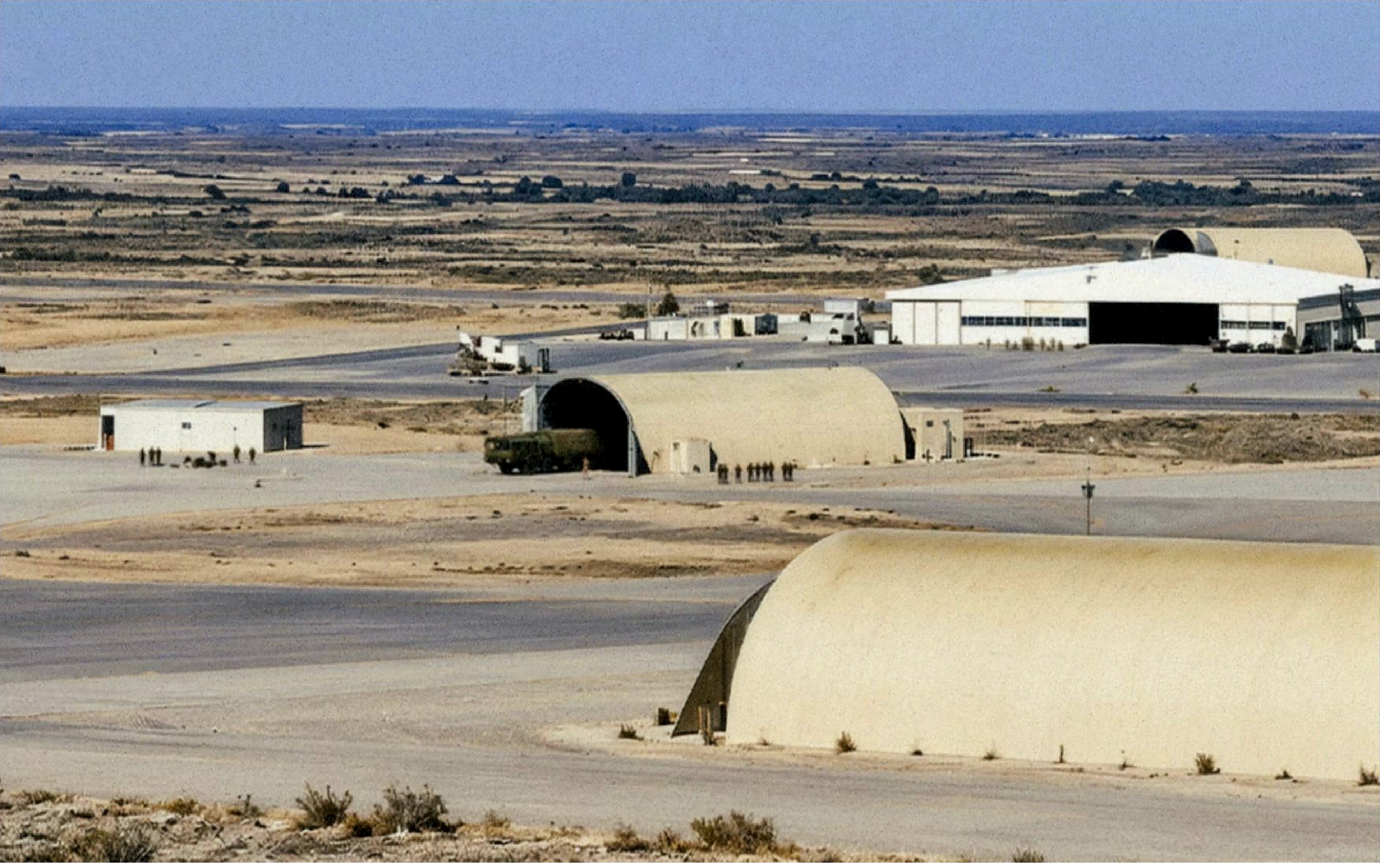
A Russian 9K720 Iskander short-range ballistic missile launcher may have been deployed to Al-Qardabiya airbase near Sirte in central Libya, according to the Greek military publication DefenceNet, which reported on 11 November 2026 that satellite images taken this month appear to show the system’s eight-wheeled MZKT-7930 chassis parked at a secure hangar on the base. If confirmed, it would be the first known deployment of a Russian ballistic missile system to Libya and a marked step up in Moscow’s military presence on the North Atlantic Treaty Organization’s (NATO) southern flank.
The finding remains unconfirmed. DefenceNet’s journalists said they also used a three-dimensional reconstruction built with artificial intelligence (AI) to analyse the images, but the material does not allow a reliable judgement on either the exact type of launcher or whether it was carrying missiles. As of 11 November, there had been no official NATO statement or independent international report confirming Iskander missiles in Libya.
What the Images Appear to Show
Al-Qardabiya, also spelt Ghardabiya, sits about 15 kilometres south of Sirte and is attached to the city’s international airport. It has two 3,600-metre runways and a set of hardened aircraft shelters dating from the Muammar Gaddafi era. Forces loyal to Field Marshal Khalifa Haftar’s Libyan National Army (LNA), which controls eastern and central Libya, took the base in January 2020.
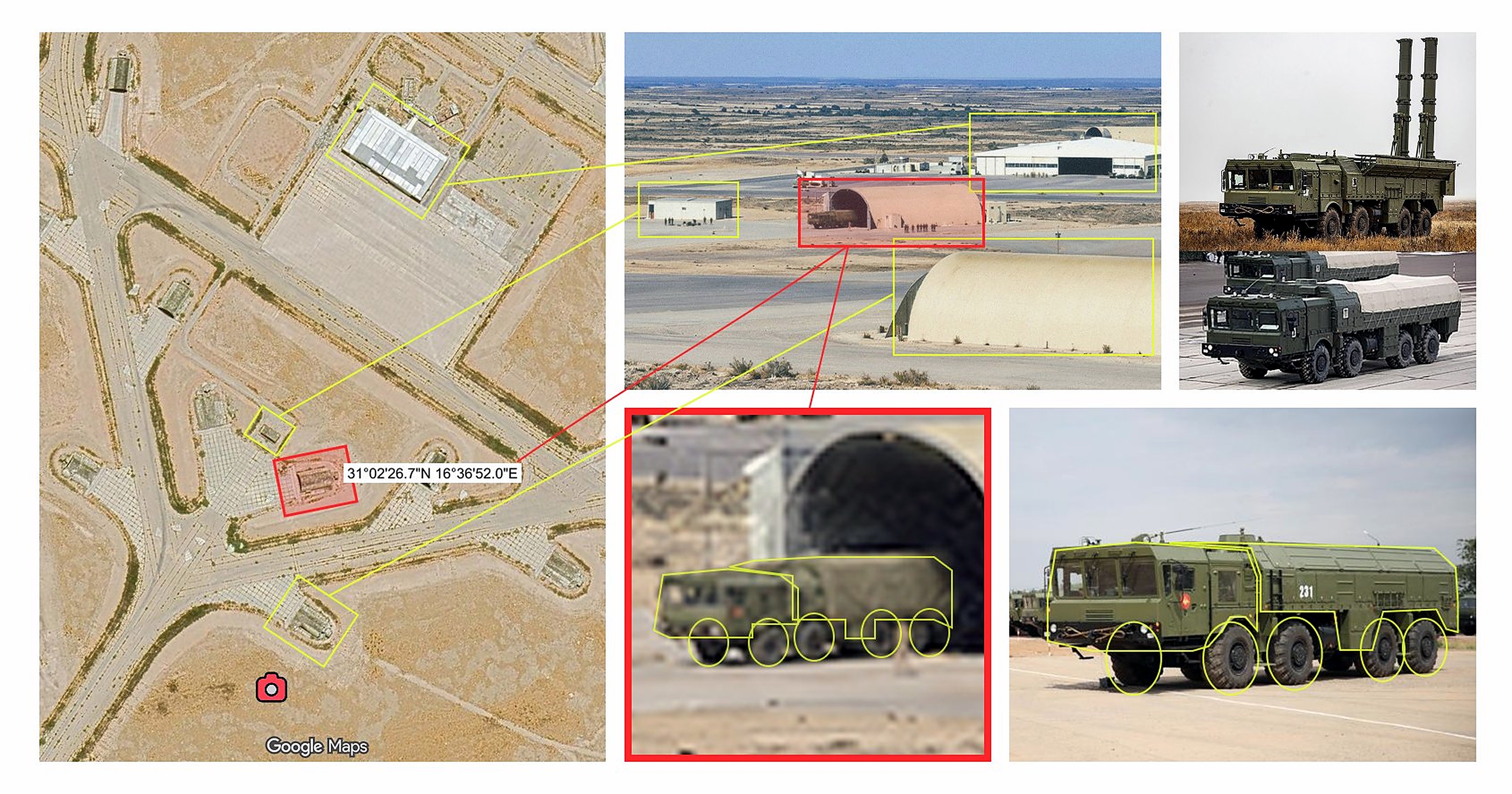
The open-source comparison that accompanied the reports places the vehicle at the entrance of one of the base’s shelters and matches its outline and four-axle wheel spacing to the MZKT-7930, the Belarusian-built chassis used for the Iskander’s 9P78-1 transporter-erector-launcher and its 9T250 transporter-loader. The same chassis is used for other Russian systems, which is one reason a heavy eight-wheeled truck in a hangar does not by itself prove an Iskander is present.
Russian activity at the base is well documented. Russian personnel were first seen at Al-Qardabiya in 2022, and in 2024 new infrastructure, refurbished runways and perimeter defences were built there, according to The Telegraph. A June 2026 study by the United States National Geospatial-Intelligence Agency (NGA), published through its Tearline project, recorded construction at six Libyan airbases used by Russian forces, including the repair of a hangar at Al-Qardabiya this year, the Africa Defense Forum reported. The other sites are Al-Jufra, Al-Khadim, Brak al-Shati, Maaten al-Sarra and Tamanhint. Infrastructure work, however, is not evidence of a missile deployment.
The Iskander System
The 9K720 Iskander (NATO reporting name SS-26 Stone) is a road-mobile short-range ballistic missile (SRBM) and precision-strike system that entered Russian service in 2006. Each MZKT-7930 launcher carries two missiles and can reach road speeds of up to 70 kilometres per hour. The domestic Iskander-M has a quoted range of 400 to 500 kilometres, while the export Iskander-E is limited to 280 kilometres. Ukraine’s Defence Intelligence (HUR) put the range of the basic Iskander-M missile at about 390 kilometres in August 2026.
The missile can carry conventional high-explosive, submunition, earth-penetrator or thermobaric warheads of 480 to 700 kilograms, or a tactical nuclear warhead with a yield of up to about 50 kilotons. Guidance combines inertial navigation with satellite updates from the Russian GLONASS or the American Global Positioning System (GPS), with optional optical or radar terminal homing, for a circular error probable (CEP) of 5 to 30 metres. The Iskander-M flies a flattened quasi-ballistic trajectory that stays within the atmosphere at speeds of Mach 6 to 7, performs evasive manoeuvres of 20 to 30 g, and releases radar decoys and chaff, all of which make interception difficult. The Iskander-K variant fires ground-launched cruise missiles such as the 9M728 and 9M729.
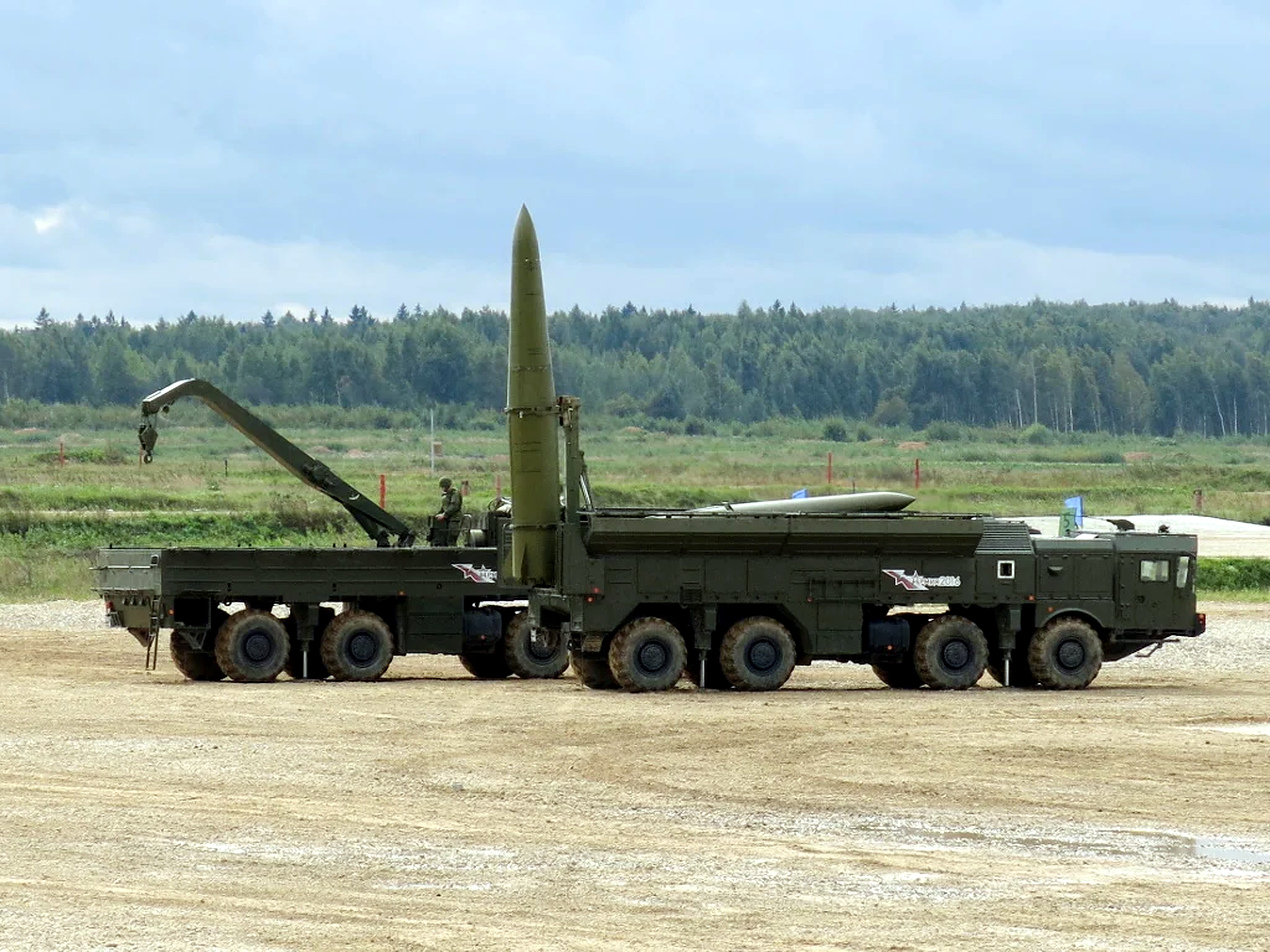
Russia has used the system in the 2008 war with Georgia and extensively in its war against Ukraine, and it was also deployed in Syria. Armenia fielded Iskanders during the 2020 Nagorno-Karabakh war. In Africa, Algeria is the only state reported to operate the system, as Military Africa has covered in Algeria to unveil Iskander ballistic missile and in its comparison of Algeria’s Iskander and Morocco’s HIMARS.
A Question of Range
Whether an Iskander at Sirte could threaten Italy or Greece depends on which missile it carries, and that is where the reports diverge. By Military Africa’s calculation, Al-Qardabiya is about 620 kilometres from the Italian island of Lampedusa, 640 kilometres from the southern tip of Sicily, 720 kilometres from the US and Italian air station at Sigonella, and 860 kilometres from the NATO base at Souda Bay on Crete. Malta lies about 575 kilometres away. All of these are beyond the reach of a standard Iskander-M.
Greek reporting has cited the newer Iskander-1000, said to reach up to 1,000 kilometres, which would bring southern Italy and Crete within range. Ukraine’s HUR, which says Russia first fired the upgraded 9M723-2 missile against Kyiv in summer 2026, puts its range at about 550 kilometres, The War Zone reported on 27 August. There is no reliable confirmation of a 1,000-kilometre version. At 550 kilometres, a launcher at Sirte would cover all of Libya, including Tripoli about 380 kilometres away, along with parts of Tunisia, Egypt, Chad and Niger, but not NATO territory.
Libya’s Unfinished Iskander Story
Libya has sought the Iskander before. After giving up its weapons of mass destruction programmes in December 2003, Libya committed to keeping its missile arsenal within the limits of the Missile Technology Control Regime (MTCR), which restricts the transfer of missiles able to carry a 500-kilogram payload more than 300 kilometres, to prevent their use as nuclear delivery vehicles. Libya eliminated most of its non-compliant systems, including its Scud-C missiles. In September 2004, Libya, the United States and the United Kingdom signed an “Agreement on the Disposition of Scud-B Missiles”, allowing Tripoli to postpone destroying its remaining Scud-Bs, which exceeded the MTCR payload limit, until September 2009.
According to a British diplomat quoted by Arms Control Today in October 2007, Libya agreed to annual inventory checks of these missiles on condition that it could buy Russian Iskanders as replacements. Washington initially objected on non-proliferation grounds. After months of delay the United States approved the purchase, but Libya then decided not to pursue it; other accounts say Moscow’s price had doubled in the meantime. The annual checks never took place. In a 19 September 2007 statement to the journal, John Herzberg, spokesperson for the State Department’s Verification and Compliance Bureau, said: “We remain convinced of Libya’s commitment to retire and destroy these missiles. Libya’s Scud-B’s are nearing the end of their lifespan and Libya is actively seeking to procure a replacement missile system.” The destruction was to take place under US and British supervision. It never did: the 2009 deadline passed, and Gaddafi’s forces fired Scud-Bs at advancing rebels in 2011.
Any Iskander in Libya today would be a Russian system under Russian control rather than a Libyan purchase, and a transfer to Haftar’s forces would breach the United Nations arms embargo on Libya in place since 2011. Moscow has steadily expanded its footprint in the country since sending warplanes to Haftar’s forces in 2020, and the Wagner Group’s successor, the Africa Corps, now uses Libyan bases as logistics hubs for operations in the Sahel. The European Union has meanwhile extended Operation Irini off Libya to 2029, adding Russian shadow-fleet monitoring to its tasks.
Missiles on the Mediterranean Shore
For now, the evidence amounts to one heavy eight-wheeled vehicle at a hangar entrance and an AI-assisted reconstruction that its own authors say cannot settle the question. Confirmation would need clearer imagery of the launcher’s raised missile compartment, transporter-loaders or support vehicles, or an official statement from NATO or a member government. If an Iskander is confirmed at Sirte, the range of the missile will decide whether it is a regional weapon covering Libya and its neighbours, or a lever aimed across the Mediterranean at southern Europe, and with it how hard Rome and Athens push NATO to answer Russia’s growing presence on Africa’s northern coast.