

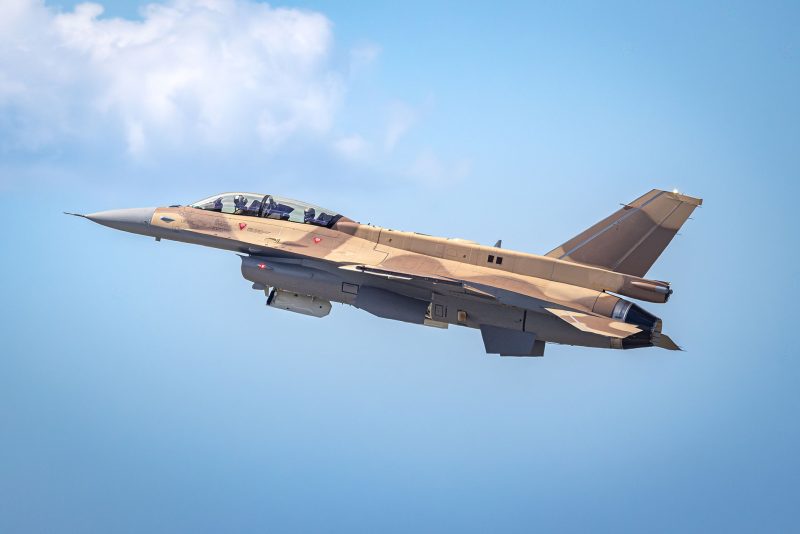
Lockheed Martin has announced that the first F-16 Block 72 Fighting Falcon for the Royal Moroccan Air Force (RMAF) has made its maiden flight, bringing the programme closer to first delivery. The company announced the flight on 6 October and called it a key milestone as the aircraft works through flight testing. The jet is a two-seat F-16D built at Lockheed’s Greenville plant in South Carolina, through Lockheed’s announcement.
“This first flight reflects meaningful progress on Morocco’s F-16 Block 72 programme and is a critical step in strengthening Morocco’s future airpower,” said Mike Shoemaker, vice president and general manager of Lockheed Martin’s Integrated Fighter Group. He added that the company expects the F-16 to keep supporting Morocco’s sovereignty and regional stability for decades. “The F‑16 remains a vital component of today’s and future air defense, and we’re proud of the role it will continue to play in supporting Morocco’s sovereignty and contributing to regional stability for decades to come.”
The Order Behind the Flight
The aircraft comes from a package the US State Department approved in March 2019, covering 25 new F-16C/D Block 72 fighters for an estimated $3.787 billion. Military Africa reported the request at the time. It included 29 Pratt & Whitney F100-PW-229 engines (four of them spares) and 26 APG-83 Active Electronically Scanned Array (AESA) radars, one of them a spare. The weapons package covered 40 AIM-120C-7 Advanced Medium-Range Air-to-Air Missiles (AMRAAM), 50 Paveway II laser-guided bombs and 60 GBU-39/B Small Diameter Bombs, alongside Joint Helmet Mounted Cueing Systems. The jets are meant to replace the Mirage F1s Morocco received in the 1970s and the Northrop F-5E/F Tiger IIs it received in the 1980s. Lockheed expects to finish production of Morocco’s aircraft by December 2026.
Lockheed describes the Block 72 as the newest and most advanced Fighting Falcon variant, with modernised avionics, advanced sensors, improved mission systems and better safety and reliability features. That is the manufacturer’s characterisation. The practical gain for Morocco is a fighter built around an AESA radar and a full beyond-visual-range missile loadout, which matters because the RMAF’s older F-5s and Mirage F1s lack both.
Morocco appears to be the only African country among the customers named for the Block 70/72 standard, as far as Military Africa’s reporting shows, although, Egypt which operates one of the largest F-16 fleets in the world, but its aircraft are older blocks, has requested new F-16 Viper Block 70 to replace aging airframes.
The Existing Fleet
The new jets will join an F-16 force that already exists. The RMAF flies 23 F-16C/D Block 50/52 aircraft delivered between 2011 and 2012, after losing one over Yemen during operations with the Saudi-led coalition. In 2019 the US Defense Security Cooperation Agency approved upgrading those aircraft to the F-16V Block 70/72 standard for $985.2 million. The material reviewed does not say whether that upgrade has started.
The current fleet carries Lockheed Martin Sniper targeting pods, Goodrich DB-110 airborne reconnaissance pods and Raytheon’s Advanced Countermeasures Electronic System (ACES). Its armament includes AIM-9X Block II Sidewinders, AGM-65D Maverick missiles and Enhanced Paveway II bomb kits. Morocco also ordered Harpoon anti-ship missiles for the type several years ago, and it reportedly asked in 2025 to buy $175 million worth of AMRAAMs and GBU-39B bombs. According to Army Recognition, an August 2026 US contract worth up to $42.1 million covers two Block 72 full-mission trainers for Morocco, which would put part of the training pipeline in place.
A Fifty-Year Relationship
Lockheed says its partnership with Morocco began with the first C-130H delivery in 1974 and now spans more than 50 years. The Royal Moroccan Armed Forces fly F-16s, C-130s, advanced radar systems and Black Hawks, and are due to receive HIMARS rocket launchers.
The company also points to local industry work. Maintenance Aero Maroc, a joint venture Lockheed set up in 2022 with Eaton-Souriau Tangiers, supports F-16 and C-130H fleets, and DefenceWeb reported that Morocco is building an overhaul facility at Benslimane of more than 8,000 square metres. It is designed for heavy maintenance and modernisation of C-130 Hercules aircraft, with plans to expand to platforms including the F-16, in line with Morocco’s ambition to become a regional hub for aircraft maintenance, repair and overhaul (MRO).
Benslimane is becoming a defence industrial cluster. BlueBird Aero Systems opened its SpyX loitering munition production site in the same area, and Military Africa reported this month that regional reporting places Aerodrive Engineering Services’ planned loitering munition production there too.
Spending and the Algerian Factor
The F-16 order sits inside a much larger spending rise. Morocco’s 2026 finance law allocates MAD 157.17 billion to defence, a rise of about 17.7 percent on 2025’s MAD 133.45 billion. That is roughly $15.3 billion by DefenceWeb’s conversion and $15.7 billion by Morocco World News, depending on the exchange rate. It remains below the $24.6 billion that Algeria has earmarked for its armed forces in 2026. DefenceWeb describes Morocco as in a kind of cold war with Algeria over decades-old disputes, most notably Western Sahara, and as modernising its air force to counter Algiers’ arsenal.
Air defence has been built up in layers. The long-range tier is reported to include the HQ-9B, Barak 8 and Patriot PAC-3 systems, the mid-range tier the SPYDER, VL MICA and Sky Dragon 50, and the short-range tier Stinger and Mistral missiles, supported by radars including French-made Ground Master 400s. Military Africa has covered the Patriot approval and satellite imagery of the Barak MX deployment, the latter a $500 million Israel Aerospace Industries contract signed in February 2022.
The F-16 purchase followed France’s lengthy effort to sell Rafale fighters to Rabat, which ended in 2025, leaving Washington as Morocco’s primary supplier of fast jets. The decision is consistent with a broader trend: Morocco has spent recent years diversifying its military suppliers rather than relying on a single country. As DefenceWeb has reported, the country’s air defense network draws on equipment from China, France, Israel and the United States. This includes HQ-9B, Barak 8 and Patriot PAC-3 long-range systems; SPYDER, MICA VL and Sky Dragon 50 systems for the mid-range tier; and Stinger and Mistral man-portable missiles for point defense, supported by French Ground Master 400 radars.
The air arm is also growing beyond fighters. Morocco has four Gulfstream G550 aircraft in an intelligence, surveillance and reconnaissance configuration, along with Israeli Heron or Hermes 900, Chinese Wing Loong-2 and Turkish Bayraktar TB2 and Akinci drones. On the helicopter side, the first AH-64E Apaches arrived in March 2025, and a second batch of six on 7 April 2026 brought the inventory to 12. Military Africa has also recorded a further seven delivered on 8 May 2026. Morocco ordered ten Airbus H225M helicopters, reported in November 2025 and finalised in September 2026, to replace its Pumas.
Building an Industry Around the Purchases
Rabat wants the money to leave something behind. In 2024 Morocco signed an aerospace cooperation agreement with Embraer, which is positioning its C-390 Millennium for the RMAF’s future tactical airlift requirement, with training, maintenance and logistics support included and some media reporting a possibility of partial assembly. Military Africa covered the memorandum. A year later Baykar announced a maintenance, repair and overhaul hub in Morocco after reports of a drone manufacturing facility. The type to be maintained was not named, though the TB2 is the likeliest candidate and the Akinci may follow, and recruitment opened in early 2026 for technicians and test pilots.
On the home-grown side, Aerodrive Engineering Services announced in 2024 that the Atlas Istar, billed as Morocco’s first homegrown military drone, had completed its maiden flight, as Military Africa reported. The programme follows a defence strategy from King Mohammed VI that includes manufacturing drones and maintaining military aircraft, with the stated aim of cutting import dependence. India’s Tata has opened a plant in Morocco for WhAP 8×8 armoured personnel carriers, with plans for as many as 150 vehicles. Rabat is also setting up industrial zones dedicated to defence, and its 2025 budget exempts defence firms from taxes. Any new acquisition will almost certainly come with offsets and technology transfer clauses.
The newly flown F-16D will now enter a flight-test program to validate its systems before any aircraft is delivered to Morocco. After years of waiting since the 2019 sale approval, Morocco now has a tangible aircraft progressing through the delivery pipeline, with production of the remaining aircraft continuing toward the expected end-of-2026 target.