

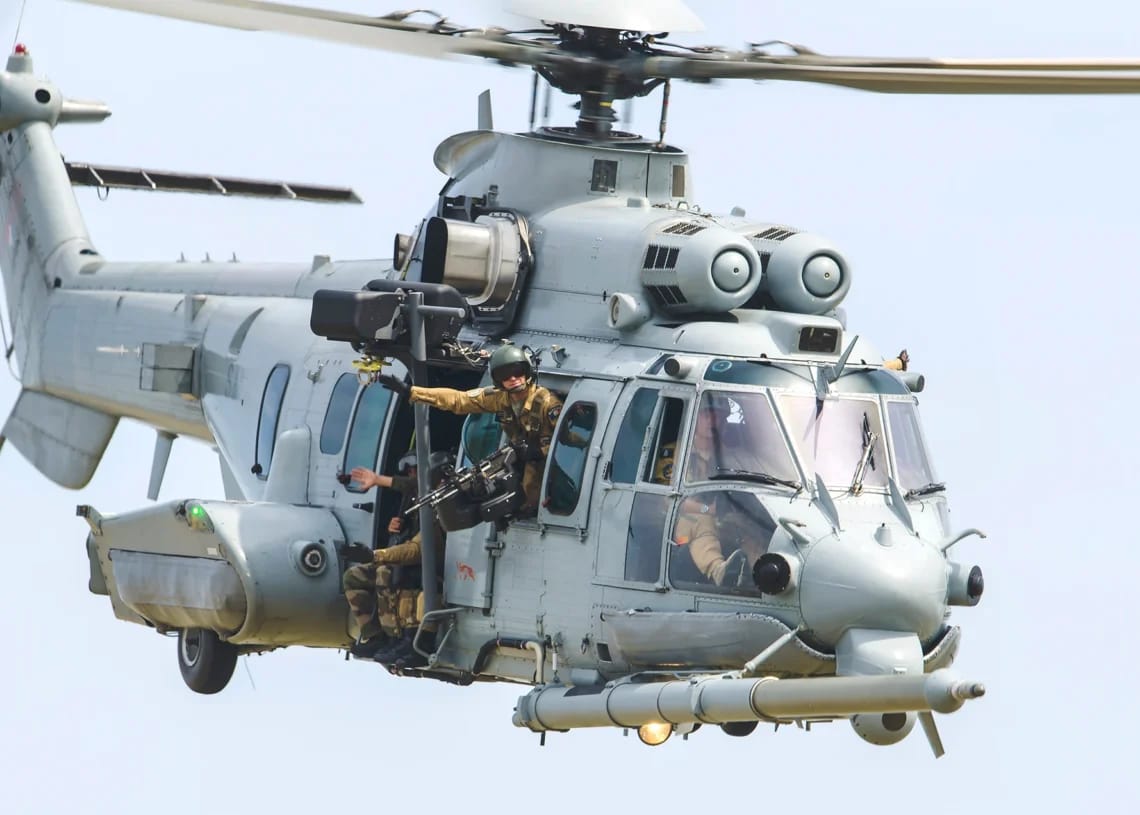
Morocco has finalized a contract to buy 10 H225M Caracal helicopters from Airbus Helicopters, giving the Royal Moroccan Air Force a modern combat search-and-rescue and special-operations platform to replace its aging Puma fleet.
On 18 November 2025, Airbus announced the deal at the Dubai Airshow, confirming months of speculation about the order’s size and scope. The Kingdom of Morocco signed the contract for 10 H225M helicopters, which will be equipped for combat search-and-rescue operations and operated by the Royal Moroccan Air Force. The aircraft will replace Morocco’s Puma fleet, which has flown for more than 40 years.
France’s Ministry of the Armed Forces listed the contract in its 2026 report to parliament on arms exports, noting that it took effect in 2025. The report gives no price for the 10 helicopters. It does show that French defence orders from Morocco jumped to €532.1 million in 2025, up from €13.1 million in 2024, though that figure covers all defence business placed that year, not just the Caracal deal. The same report records €83.3 million in French defence deliveries to Morocco in 2025 and 42 approved export licenses.
Negotiations between Morocco and France accelerated ahead of French President Emmanuel Macron’s state visit to Rabat in October 2024, when Morocco was reportedly evaluating an acquisition of up to 18 Caracal helicopters in a package valued between €600 million and €800 million. Although no defense contracts were finalized during that specific visit, bilateral discussions over technical specifications, fleet size, and commercial terms continued for several months. These negotiations ultimately concluded with a streamlined 10-unit order, which Airbus Helicopters officially announced at the Dubai Airshow in November 2025. While the United States actively marketed the Sikorsky S-70i Black Hawk to leverage its strong defense ties with Rabat, Morocco ultimately sustained its strategic supplier diversification by selecting the European platform.
The H225M is a twin-engine, 11-tonne-class helicopter built by Airbus for tactical transport, combat search-and-rescue (CSAR), special operations and medical evacuation. It descends from the Super Puma and Cougar family and entered service in the mid-2000s. According to Airbus’s own technical data, the aircraft has a maximum takeoff weight of about 11,000 kg, a top speed of 324 km/h and a maximum range of 920 km on standard fuel tanks, extending to roughly 1,253 km with additional tanks. It can carry a sling load of up to 4,750 kg.

The cabin accommodates up to 28 fully equipped combat troops, or a few casualties on stretchers when configured for medical evacuation. Crews fly it day or night and in poor weather, aided by systems built for low-altitude operations. An air-to-air refueling capability lets the Caracal extend its reach further by taking fuel from another aircraft in flight, a feature useful for deep missions alongside larger transport aircraft such as the A400M.
Morocco’s H225Ms are expected to carry a mission fit similar to other export customers. Reporting on the configuration points to a double hoist system for rescue work, a searchlight and a Safran Euroflir 410 electro-optical and infrared turret for day and night surveillance. The helicopters will also mount door guns, and Airbus offers the type with an electronic warfare self-protection suite that can detect radar, laser and missile threats and deploy countermeasures. Depending on configuration, the H225M can also carry rocket pods, machine guns and, on some export models, guided missiles.
Morocco already operates the heavy-class H225 Super Puma in Gendarmerie Royale service, so the new Caracal order extends an existing relationship with Airbus rather than initiating a new one. It also sits within a wider rotary-wing modernization drive. The Royal Moroccan Air Force began receiving H135M light-twin training helicopters in 2023, while separately taking delivery of Boeing AH-64 Apache attack helicopters from the United States.
The order also reflects a broader repair of the France-Morocco defence relationship. France recognized Moroccan sovereignty over Western Sahara in 2024, and Macron’s visit to Rabat that October helped restore high-level political and military contacts between the two countries. A joint arms committee, set up in July 2024, aims to expand defence industry and technical cooperation, and the two sides are discussing a Maintenance, Repair and Overhaul (MRO) center in Morocco that could service the new Caracals locally and potentially support other operators in West Africa. Airbus has said the center would also support the roughly 60 Airbus helicopters already flying with Moroccan air force, navy and gendarmerie units.
Military cooperation between the two countries now spans joint exercises, special operations training, counter-terrorism work, military medicine, logistics and maritime security, and the Caracal purchase fits into that wider pattern rather than standing apart from it. No delivery schedule for the 10 helicopters has been made public, and neither Airbus nor Rabat has released a contract value. Further clarity on delivery timing is likely to come as the MRO discussions progress and as France publishes future export reports tracking the contract’s execution.