

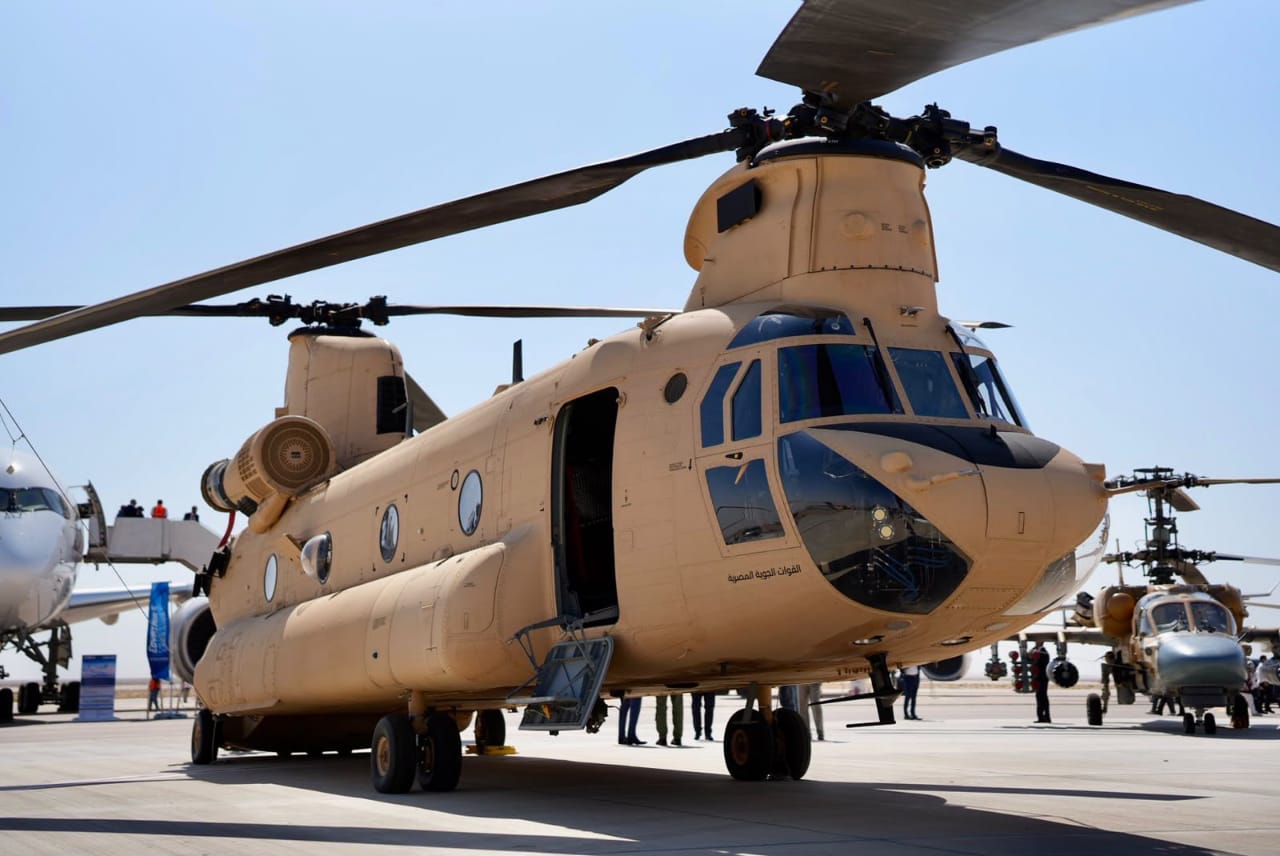
The Egyptian Air Force took delivery of its first five Boeing CH-47F Chinook heavy-lift helicopters this month, with the handover marked at the El Alamein International Airshow on Egypt’s Mediterranean coast. The milestone moves toward a roughly $426 million foreign military sale that Boeing was awarded in January 2023 to supply Cairo with 12 new-generation transport helicopters. The five helicopters are the first of the 12-aircraft batch to reach Egypt. The remaining 7 airframes are currently in the delivery queue under the contract schedule running through 2026.
The show ran from 8 to 10 September at El Alamein International Airport, organized by Egypt’s Ministry of Defence, the Egyptian Air Force, the Ministry of Civil Aviation, the Egyptian Space Agency and EgyptAir. Boeing took part as a Silver Sponsor and used the event to display the AH-64 Apache attack helicopter and the KC-46A Pegasus tanker alongside the Chinook. Brendan Nelson, Boeing senior vice president and president of Boeing Global, called Egypt “one of the region’s most important defense and security partners”.
The new F-model aircraft will replace the Egyptian Air Force’s CH-47D fleet, which Boeing now puts at 19 helicopters. Egypt’s Chinook history goes back further than that number suggests: the country received 15 CH-47C helicopters in the early 1980s, added four CH-47Ds in 1998 and 1999, and later upgraded most of the C-model airframes to D standard around 2002. A 2009 request to buy six more CH-47Ds appears not to have gone anywhere.
Cairo’s current order traces back to a State Department approval from May 2022 that cleared a possible sale of up to 23 Chinooks worth as much as $2.6 billion. Egypt scaled that down, contracting in January 2023 for 12 aircraft at roughly $426 million, a Foreign Military Sale case awarded to Boeing through the U.S. Army on Egypt’s behalf. In 2024, Egypt reportedly renovated Anchas Air Base to accommodate the new helicopters.
The F-model brings real changes rather than a simple repaint. It replaces the D-model’s analog dials with the Common Avionics Architecture System, a digital cockpit shared with the Apache that consolidates flight, navigation, and mission data onto common displays. A Boeing spokesperson described the aircraft as having “a much stronger airframe” than its predecessor, along with a strengthened rotor hub and crashworthy seats.
The helicopter is built around counter-rotating front and rear rotors, a tandem layout that removes the need for a tail rotor and sends all engine power into lift and forward thrust. Twin turboshaft engines give it a cruise speed near 170 knots and a maximum ferry range of roughly 400 nautical miles, extendable with in-flight refueling. It can carry up to 24,000 pounds internally or 26,000 pounds on an external sling load, enough for a light vehicle or a towed howitzer on the reinforced cabin floor. In a troop-transport role, it can carry up to 55 soldiers, though 33 combat-loaded troops are closer to a standard mission fit; configured for medical evacuation, it can hold two dozen litters plus attendants.
The CH-47F family more broadly can be fitted with missile warning sensors, radar warning receivers and chaff and flare dispensers, and Egypt’s earlier Chinooks have flown alongside its wider Boeing inventory of 46 AH-64D Apaches, a relationship with Cairo that Boeing traces back to the Egyptian Air Force’s purchase of the F-4 Phantom II in 1979.
The Chinook delivery lands inside a fast-growing regional market. Egypt already fields more than 300 helicopters of various types, drawing on Russian, American, French, and Chinese suppliers, and Global Firepower ranks it as Africa’s most powerful military by its index. A 2023 Defence IQ report projected African military helicopter spending at $2.2 billion between 2023 and 2028, making the continent one of the faster-growing regions for rotary-wing procurement even as individual programs, like Egypt’s, remain modest in scale next to Gulf or European orders.
For the Egyptian Air Force, the near-term effect is a gradual, aircraft-by-aircraft replacement of a CH-47D fleet that includes airframes dating to the 1980s. The digital cockpit and structural changes in the F-model should ease pilot workload and cut the maintenance burden that comes with keeping decades-old analog helicopters flying, without requiring an entirely new logistics chain since the type is already familiar to Egyptian crews and ground staff.