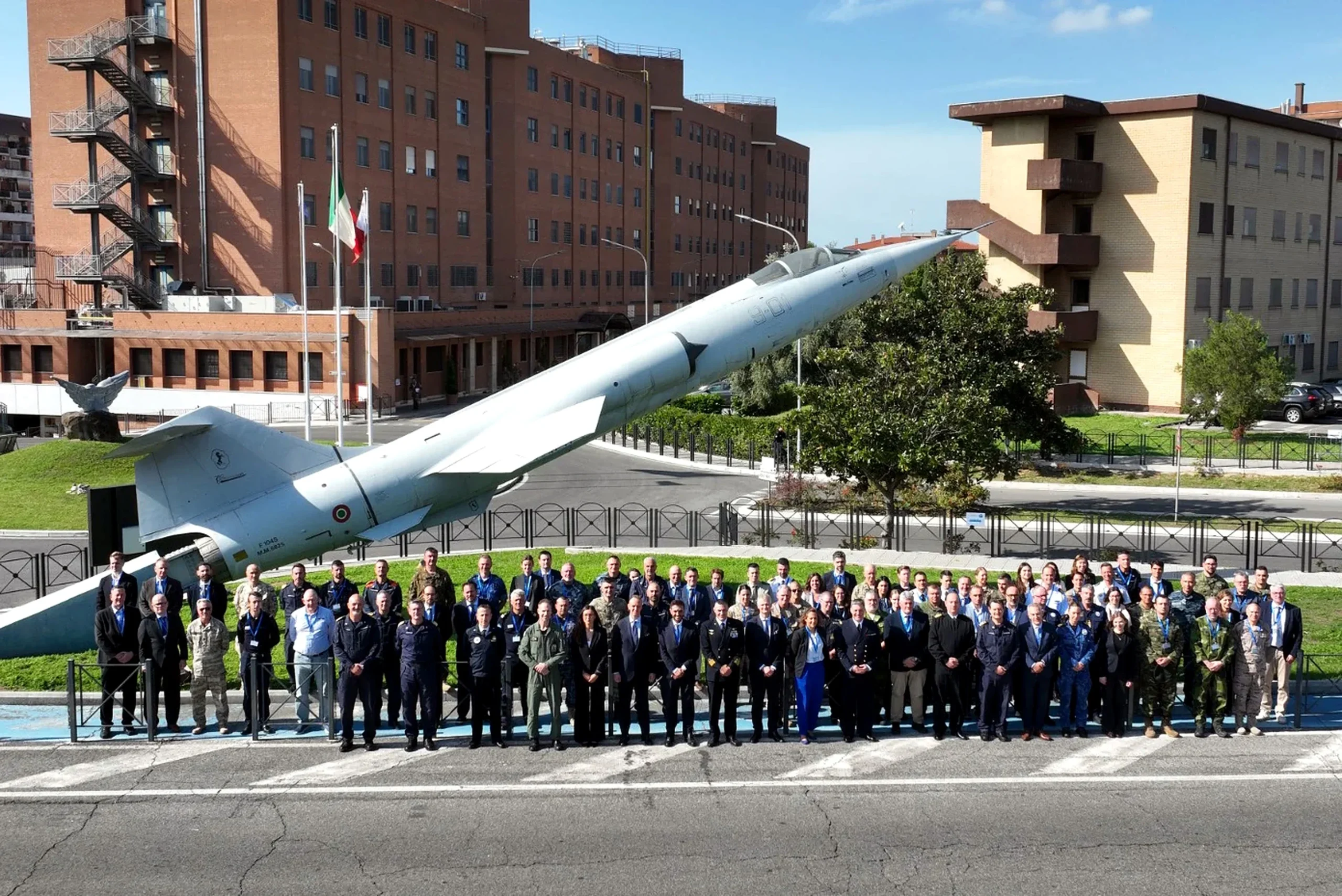
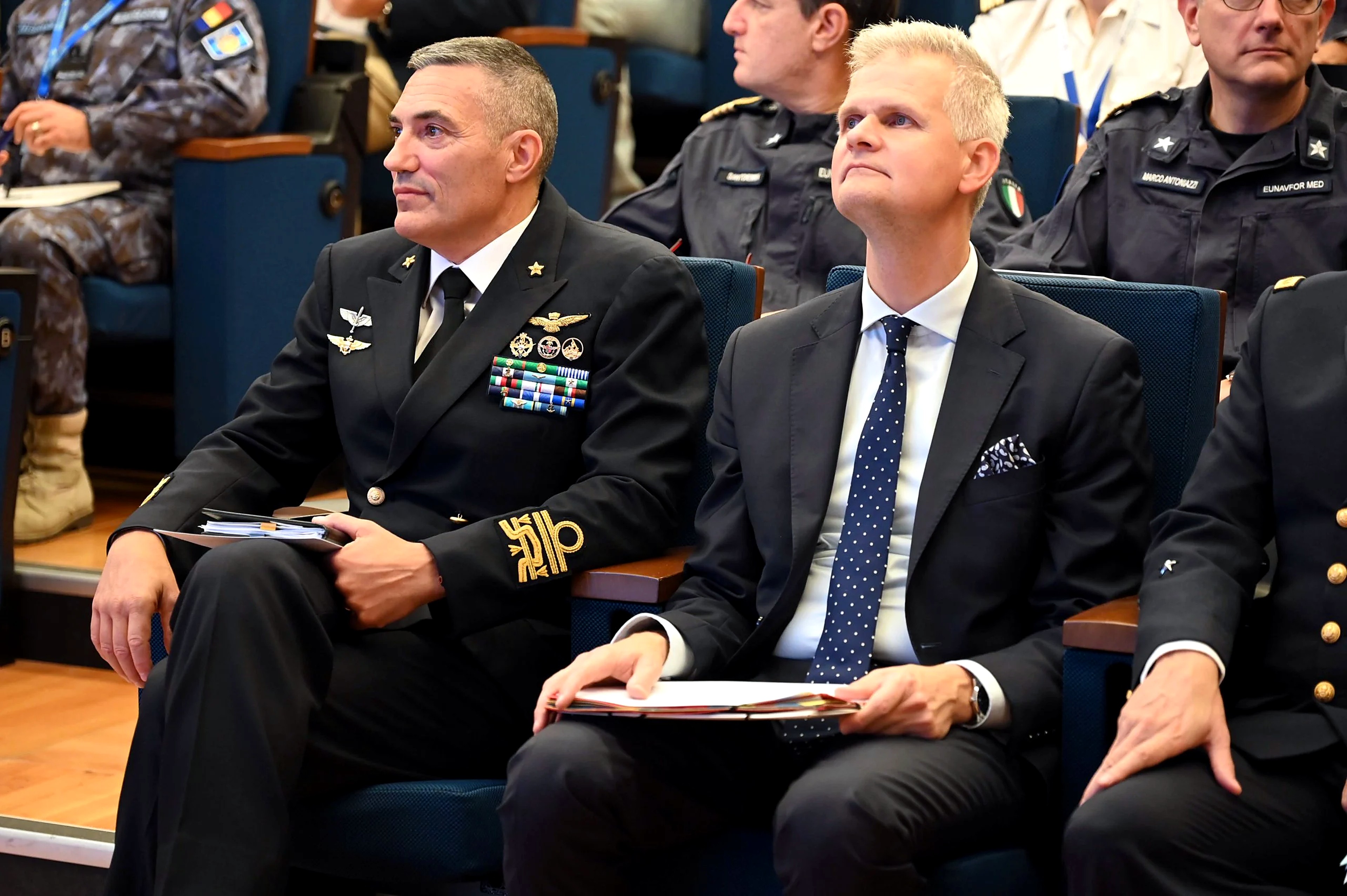
The European Union’s (EU) Mediterranean naval operation, European Union Naval Force Mediterranean (EUNAVFOR MED) Irini, held a one-day workshop on Russia’s shadow fleet at its Operational Headquarters in Rome on 20 October 2026. The meeting came 11 days after the Council of the EU gave the mission a formal task to constrain that fleet when it extended Operation Irini to 2029.
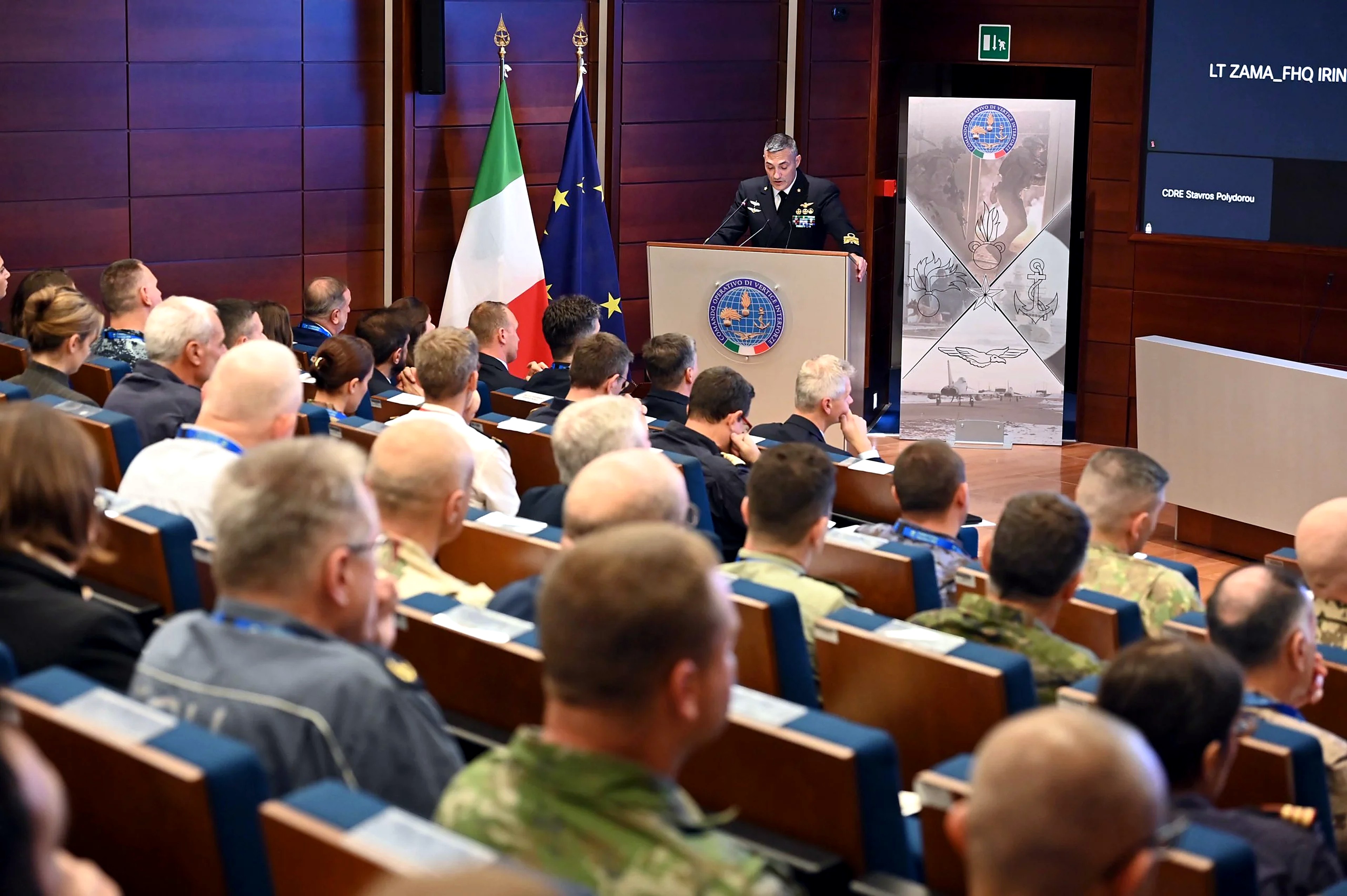
Rear Admiral Marco Casapieri of the Italian Navy, the Operation Commander, welcomed the guests. Maciej Stadejek gave the keynote address. He is Deputy Managing Director for Security and Defence Policy at the European External Action Service (EEAS), the EU’s diplomatic service, and the EEAS Shadow Fleet Coordinator. The programme also included senior Irini leadership and speakers from the EEAS, the Italian Navy, the French Ministry of Justice and Europol, the EU’s law enforcement agency, according to the operation’s own account of the event.
The audience mixed naval officers, prosecutors, police and EU officials. That mix was deliberate. Stopping a sanctions-busting tanker on the high seas is as much a legal problem as a naval one, and a boarding that cannot stand up in court achieves little beyond a photograph.
What Was on the Agenda in Rome
Irini says the agenda covered the EU sanctions framework, operational lessons and best practice, and legal perspectives. It also covered information sharing and cooperation between navies and law enforcement. A further session dealt with resilience against foreign information manipulation and interference (FIMI) in EU Common Security and Defence Policy (CSDP) missions and operations.
The operation said addressing the shadow fleet formed part of wider efforts “to strengthen the effectiveness of sanctions, improve coordination among relevant actors and reinforce a common European response to evolving maritime and security challenges.” It described the day as a way of “bringing some light in the shadow.”
DefenceWeb reported the workshop on 5 November 2026. Neither the operation nor that report has published outcomes or formal recommendations from the day, so the event is best read as groundwork rather than a policy announcement.
From Libya Arms Embargo to Tanker Checks
Irini began on 31 March 2020 to enforce the United Nations (UN) arms embargo on Libya. Its main tools are maritime patrol aircraft, satellite imagery and warships that hail and, where authorised, inspect suspect vessels on the high seas. It also monitors illicit Libyan oil exports and trains Libyan maritime forces. Germany, for example, moved a P-3C Orion maritime patrol aircraft from the Horn of Africa to support the operation in 2021.
The embargo work has produced results. In July 2022 Irini found military vehicles aboard the Libya-bound cargo ship Victory Roro, and in October that year it stopped the Meerdijk, which was carrying BATT UMG armoured vehicles to Libya. The EU later donated seized vehicles to Ghana.
Its scope has grown since. A March 2025 Council decision extended the mandate to 31 March 2027 and added a maritime situational awareness task. The operation’s May 2026 activity report says it already tracks suspicious vessels and uses the right of visit under Article 110 of the UN Convention on the Law of the Sea (UNCLOS) to check a ship’s flag. In plain terms, that article lets a warship verify a vessel’s nationality when there are grounds to doubt it, including when a ship may be flying a false flag or none at all.
Boardings Already Under Way
The operation has put that power into practice. Decode39, an Italian security outlet, reports that Irini boarded the tanker South Star on suspicion of a false flag. Decode39 dates that boarding to 20 July, while USNI News gives 22 July. The EU’s top diplomat, Kaja Kallas, said in June that the operation had changed its rules of engagement and begun boarding ships suspected of belonging to the shadow fleet, according to Euronews.
The next case had a clear African link. On 2 August the Italian Navy multi-purpose combat ship ITS Thaon di Revel (P430), then Irini’s flagship, carried out a flag verification boarding of the sanctioned tanker Toa Payoh, which was flying the flag of Cameroon. USNI News, citing the Italian Defence Ministry, reported that the tanker had left Cotonou in Benin on 16 July bound for Istanbul. The Greek frigate HS Kanaris and a Polish Navy M-28 Bryza maritime patrol aircraft supported the operation, and the tanker was allowed to continue while its papers were examined.
Later in August, Italian personnel from the same ship boarded the tanker Sun, suspected of sailing under a false flag. gCaptain counted it as the sixth such inspection by EU operations in recent months. Kallas also announced that the EU’s anti-piracy operation off Somalia, EUNAVFOR Atalanta, was authorised to carry out flag verification boardings “in the same way Operation IRINI does”, stretching the effort to the waters off East Africa.
The 2029 Mandate
On 9 October 2026 the Council adopted Decision (CFSP) 2026/2243 under the Common Foreign and Security Policy (CFSP). It moves Irini’s end date from 31 March 2027 to 31 March 2029. Some early accounts placed the decision in November, but the Council record, the operation’s announcement of 13 October and press coverage all give 9 October.
The decision reorganises Irini’s work around three roles. These are credible protection and deterrence for EU interests in the Mediterranean, support for UN Security Council resolutions on Libya, and partnerships built through training and naval diplomacy. It adds three tasks: constraining the shadow fleet, improving maritime domain awareness and protecting critical maritime infrastructure such as undersea cables and pipelines.
The text says Irini “shall contribute to constraining Russia’s ‘shadow fleet'”. It defines the term using an International Maritime Organization (IMO) resolution. An analysis on the Großwald site reads the task as adding no new inspection power beyond existing UNCLOS authority, which matches the wording of the decision.
Common costs for 1 April 2027 to 31 March 2029 are set at €16.88 million, according to the Council text. The previous two-year period carried €16.35 million, so the budget rises by about 3 percent. One trade outlet rounds the new figure to €16.8 million; the Council document is the firmer source.
A Fleet Built to Dodge the Rules
The shadow fleet is a loose network of ageing tankers that moves Russian oil outside the Group of Seven (G7) and EU price cap and outside normal insurance rules. Estimates of its size vary widely, from roughly 600 to between 1,300 and 1,400 vessels in open-source figures cited by DefenceWeb, so any count should be treated as an estimate.
Owners hide behind shell companies and switch flags often, sometimes to flags of convenience that include African shipping registries. Ships switch off or spoof their Automatic Identification System (AIS) transponders, use forged papers or false names, and transfer cargo between ships at sea. Russia-linked shipping is also active closer to the continent: Military Africa has reported on Russian cargo ships ferrying tanks and MRAPs to Africa through Conakry, Lomé and Tobruk.
Each of those tactics creates a different legal hurdle. A boarding team can check a flag, but it cannot seize a cargo on that basis alone. That gap is why prosecutors and police were in the room in Rome.
Borrowed Hulls and a Small Budget
Irini has few hulls of its own. It relies on ships and aircraft that member states lend for set periods, so what it can actually do depends on those pledges. A wider mandate does not add ships.
The common-cost budget is also small, so most of the expense will stay with the nations that supply the platforms. The workshop suggests the EU wants to close the gap between detecting a suspect tanker and acting on it. That means faster data sharing between navies and Europol, and legal groundwork so that boardings hold up in court.
North Africa’s Stake in the Shadow Fleet Effort
The decision also opens a maritime security cooperation platform that could include Egypt, Tunisia and Lebanon. The Libya work stays in place, from embargo monitoring to training the coast guard, and the operation says it can scale up if conditions there change. That matters as Libya remains a destination for undeclared hardware, from Wing Loong II drones seized in Italy to a suspected Russian Iskander launcher near Sirte.
The next steps are practical. Watch for new force pledges ahead of the April 2027 start of the extended budget period, and for any published findings from the Rome workshop. The first boarding that leads to a prosecution would show whether the legal work is paying off, and whether the African flags and ports that appear in these cases come under closer scrutiny.