

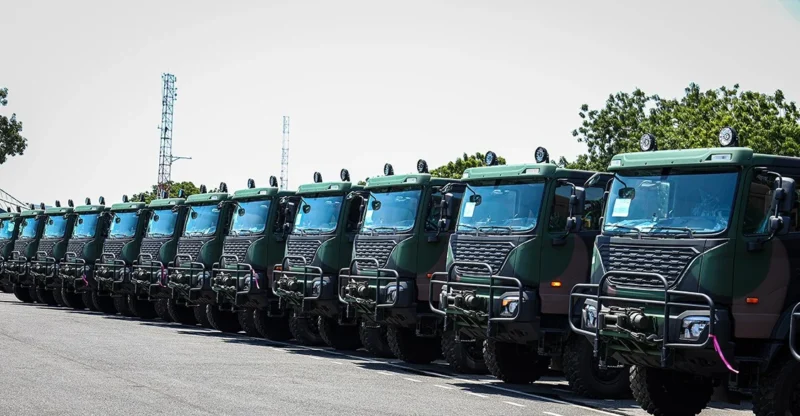
The Ghana Armed Forces (GAF) took delivery of 45 new Kia military vehicles on 16 October 2026, the latest step in a retooling drive that has already brought a new patrol ship to the Ghana Navy and the first of four Airbus helicopters to the Ghana Air Force this year, with more equipment still to come as the country rebuilds its defence capabilities.
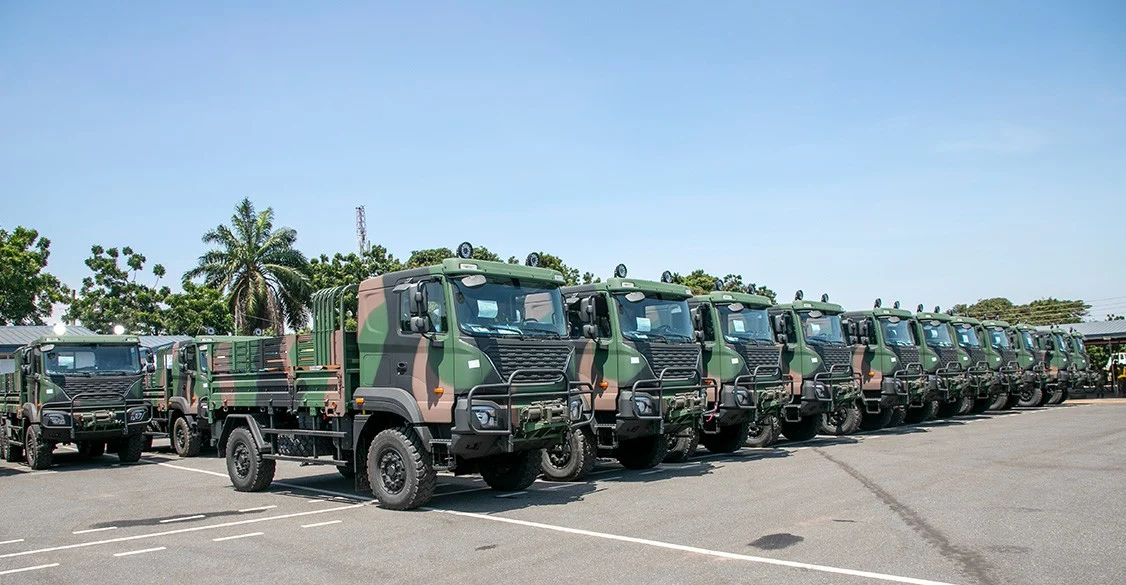
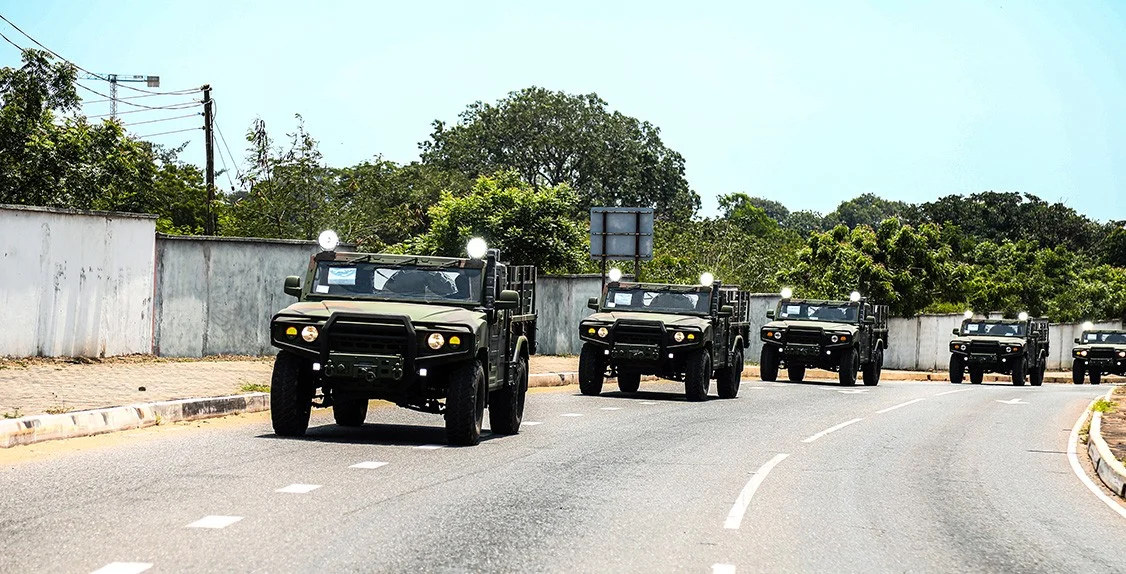
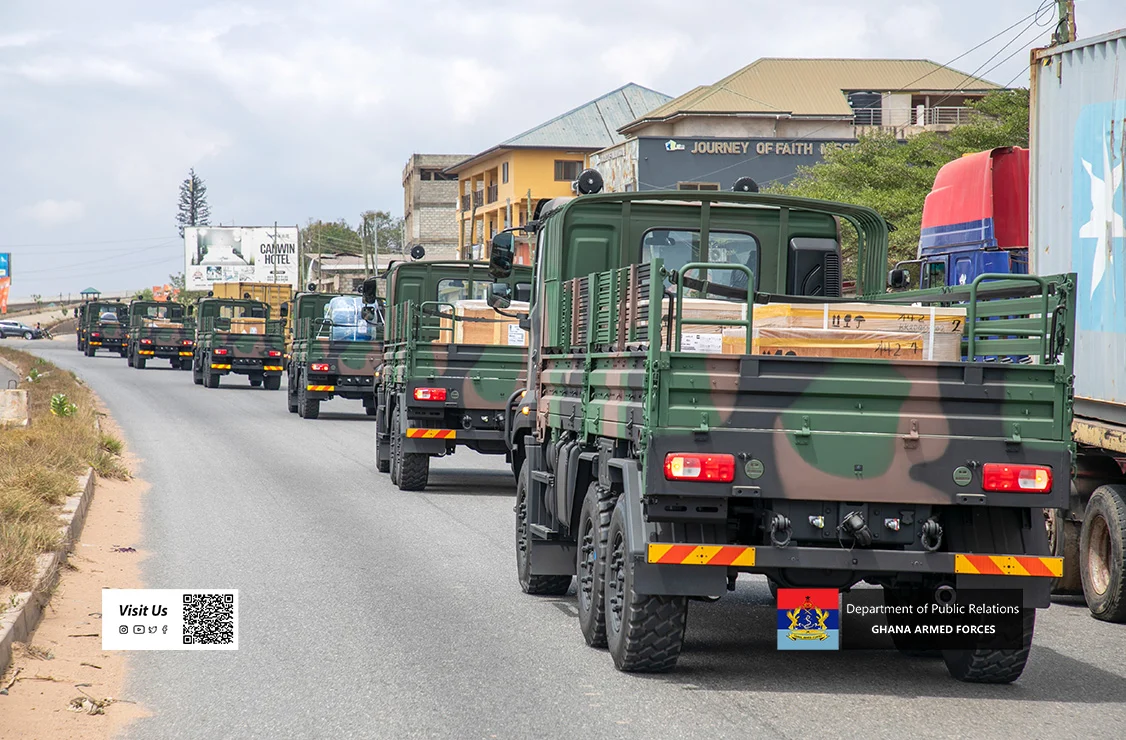
The batch comprises 15 Kia Light Tactical Vehicles (KLTV) for utility duties, together with 15 four-wheel-drive (4×4) and 15 six-wheel-drive (6×6) Kia Medium Tactical Vehicle (KMTV) troop carriers. The GAF said the vehicles advance a national retooling drive “across all frontiers” and are expected to improve troop transportation, ease movement across difficult terrain and let the Army respond swiftly to operational demands. The acquisition forms part of the government’s broader effort to modernise the GAF, strengthen national security and improve the force’s capacity to safeguard Ghana’s territorial integrity, according to the GAF.
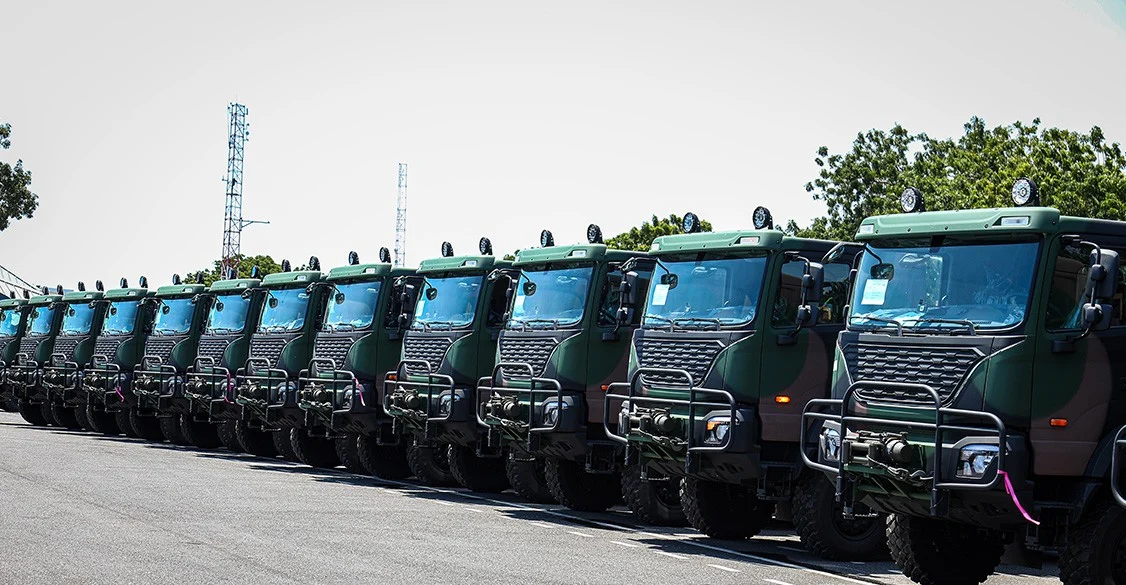
Korean trucks for the Ghana Army
The KLTV, known as the K151 in South Korean service, entered production in 2016 and has been in South Korean Army service since 2017. It is powered by a 3.0-litre V6 diesel engine producing 225 horsepower, has a top speed of about 130 km/h and carries a payload of one to three tonnes depending on configuration. The KMTV family is built in 2.5-tonne 4×4 and 5-tonne 6×6 classes around a 6,798 cc diesel engine rated at 280 PS in the 4×4 and 330 PS in the 6×6, with an eight-speed automatic gearbox, one metre of fording depth and an optional central tyre inflation system (CTIS) for sand and soft ground. According to Kia, the truck can carry up to 22 troops in the field.
Ghana joins a growing list of African users of Kia’s military vehicles. Military Africa has reported on Kia tactical vehicles delivered to Nigeria in 2020, Kia military trucks for Côte d’Ivoire the same year and 100 Kia all-terrain vehicles for Niger in 2023, while Mali has used the KLTV with its special forces since 2017.
The October batch follows a first phase of vehicles that President John Dramani Mahama commissioned in January at the West African Soldiers’ Social Activity (WASA) at Burma Camp in Accra, which included pickup trucks, buses and Land Cruisers. “This is just the first phase of vehicles that the Armed Forces are to receive,” Mahama said at the time, according to the Ghana News Agency.
GNS Pru joins the fleet
Earlier in the year, the Ghana Navy acquired the Ghana Navy Ship (GNS) Pru, commissioning the vessel on 10 February 2026 at the Sekondi Naval Base during a parade at which national and Ghana Navy Colours were presented to the Western Naval Command. Its commanding officer, Lieutenant Commander Joshua Hughes Addison, received a Commissioning Warrant signed by President Mahama, the Ghana Navy said.
Speaking at the ceremony, Deputy Minister of Defence Ernest Brogya Genfi said the ship would enhance maritime patrols, protect offshore resources, combat illicit maritime activities and contribute to regional and international maritime security. “With enhanced endurance and capability, GNS Pru will extend our reach,” he said. The Chief of the Naval Staff, Rear Admiral Godwin Livinus Bessing, said the commissioning of GNS Pru would strengthen the operational capacity of the Navy to respond to evolving and asymmetric maritime threats.
The River class ship (P47) is a 42-metre Flex Fighter design acquired from Singapore’s Penguin Shipyard. Ghana previously commissioned four 40-metre Flex Fighter vessels in February 2022, GNS Volta, Densu, Pra and Ankobra, which carry machine gun mounts fore and aft, have ballistic protection around the wheelhouse and can accommodate 12 security personnel for the protection of offshore oil and gas installations. The Nigerian Navy is also reported to have acquired three 40-metre Flex Fighter Max patrol vessels from Penguin. The Flex Fighter family derives from Penguin’s Flex series of crew boats, which are widely used for offshore resupply and support operations.
Offshore patrol vessels, drones and riverine boats to follow
Additional assets are expected to follow for the Ghana Navy, including a fisheries patrol vessel, 72-metre offshore patrol vessels (OPVs), six fast attack craft, 11 interceptor boats and numerous smaller patrol boats. Ghana’s 2026 budget provides for two 72-metre OPVs fitted with helicopter pads and combat systems, Finance Minister Dr Cassiel Ato Forson told Parliament when he presented it in November 2025. In mid-October, the GAF said the Navy is also expected to integrate six V-BAT unmanned aerial systems and 30 riverine boats to transform fisheries enforcement and the protection of offshore infrastructure. Built by the American firm Shield AI, the V-BAT is a vertical take-off and landing (VTOL) drone that can launch from and recover to a small deck without a runway, which suits it to patrol vessels. The Navy has operated smaller surveillance drones since gaining a drone surveillance capability in 2023.
The Navy’s largest vessel, the 65-metre GNS Achimota (P46), was acquired from Japan and commissioned by then President Nana Addo Dankwa Akufo-Addo at the Sekondi Naval Base on 23 December 2024, the same day he commissioned Forward Operating Base (FOB) Ezinlibo near the border with Côte d’Ivoire, as Military Africa reported at the time. The ship previously served as the Japanese fisheries patrol vessel Aratsu, according to the Embassy of Japan in Ghana. It was built by Kurinoura Shipbuilding in Japan in 1999, has a complement of 20 people, and sailed 10,869 nautical miles in 36 days from Yawatahama to Sekondi. In the Ghana Navy fleet it is employed for fisheries protection, among other duties, and as a training vessel for both officers and ratings.
Airbus helicopters and a Falcon 6X for the Air Force
The Ghana Air Force also strengthened its capabilities with the delivery of an Airbus Helicopters H175 from France on 5 March 2026, which Military Africa covered when the first H175 arrived at Air Force Base Accra. The government presents the delivery as fulfilling the strategic vision of the Commander-in-Chief, President Mahama, to build a standard 21st-century defence force. Speaking at WASA in January, Mahama said: “Let me assure you that government remains fully committed. Plans are well advanced to procure armoured personnel carriers, offshore patrol vessels for the Ghana Navy, four brand new Eurocopter helicopters for the Ghana Air Force.”
Ghana has ordered two H175Ms, one ACH175 and one ACH160 from Airbus Helicopters for transport, search and rescue, disaster relief and other duties, as Military Africa reported in January. The H175M is a military-configured airframe for missions such as personnel and cargo transport and civil support, while the ACH160 and ACH175 are Airbus Corporate Helicopters (ACH) configurations likely acquired for VIP duties. In December 2025, Ghana’s Parliament approved a €125 million agreement between the Ministry of Defence and Airbus Helicopters, as well as a $60 million agreement with Dassault Aviation for a single Falcon 6X aircraft for the Ghana Air Force. One more helicopter and the Falcon 6X are expected to be delivered later this year, followed by another two helicopters in 2027.
The helicopters will help rebuild a rotary-wing fleet that lost a Harbin Z-9 on 6 August 2025, when the aircraft crashed in the Ashanti Region, killing all eight people on board, including Defence Minister Dr Edward Omane Boamah, whom Ato Forson later described as the architect of the GAF’s modernisation strategy.
Broader expansion and retooling
The Ghana Armed Forces are considered among the most professional, experienced and capable in sub-Saharan Africa. Unlike many of its regional counterparts, Ghana has largely avoided military interference in the country’s politics since the early 1990s. As a result, the GAF has emerged as one of West Africa’s more dependable forces, perhaps best known for its substantial commitment to international peace operations through United Nations (UN) peacekeeping, and to regional security operations under Economic Community of West African States (ECOWAS) and UN banners.
Although the GAF has little in the way of offensive capability, it is relatively well equipped compared with its regional contemporaries, having benefited from prolonged modernisation, retraining and reorganisation efforts supported by foreign partners. It also benefited from modest but fairly consistent defence spending through the 2010s. More recently, defence spending rose sharply in 2024/2025, by some 61.3% year on year, and this higher level is expected to be sustained, at least in the near term, with the defence allocation increasing to GH¢10.77 billion (about $927 million) in 2026. Budget figures compiled by Ghana Fact show the Ministry of Defence allocation rising from GH¢6.3 billion in 2025, an increase of almost 70%.
The increase forms part of a renewed effort to retool and modernise the force so that it can more effectively face evolving global and regional security challenges. In October 2025, at the Land Combat Firepower Demonstration in Bundase, Genfi described the drive as one “the likes of which have never been witnessed in our history”, saying it would extend beyond defence procurement to the establishment of new military units, the construction of new forward operating bases and the upgrading of existing infrastructure to improve efficiency and operational capacity. Key government commitments include funding renewed armoured and mechanised capabilities, new light attack aircraft for the Air Force, more modern patrol boats and enhanced special forces capabilities. At WASA in January, Mahama added plans to recruit 12,000 personnel over four years, set up two new military units in the Oti and Central Regions and build a Cyber and Electronic Warfare Centre at the Tamale Air Force Base.
An Army facing north
Structurally, the Army remains by far the largest and most operationally important branch, with an estimated 12,000 to 15,000 active personnel. It forms the backbone of Ghana’s internal security and border protection efforts and is increasingly oriented towards countering potential spillover from Sahelian instability into northern Ghana, a threat Military Africa examined in Ghana confronts growing terror threats. The GAF has also deployed locally built AeriusPro VTOL drones along the northern border and commissioned a special operations training school in 2025.
In recent years, the Army has expanded its capabilities considerably through the procurement of several hundred vehicles over the past decade, including several large donations, among them just under 200 armoured personnel carriers (APCs) and infantry mobility vehicles. These include Puma M36 mine-resistant ambush-protected (MRAP) vehicles, APC-79 Fighters, MXT-MVs, BTR-70s and Otokar Cobras, alongside the SFIGHTER-2 APCs commissioned in 2024. Other capabilities have also grown, notably through the acquisition of four additional Type 81 122 mm self-propelled multiple rocket launchers from China in 2023, which Poly Technologies handed over at Bundase that December.
One armoured programme remains stalled. Ghana signed an $80 million supplier’s credit agreement with Elbit Systems Land in August 2020 for 19 armoured vehicles and related systems, and Ato Forson told Parliament in November 2025 that $40 million had been paid but no vehicles delivered, and that the government would renegotiate the agreement.
While more modest, the Air Force has also seen a boost to its capabilities over the preceding decade. Its training and airlift capabilities in particular have improved markedly, while the government has also committed to enhancing its combat capabilities for ground support. Ghana has weighed several options for that role, from the L-39NG, whose purchase stalled for lack of funds, to the A-29 Super Tucano and the L-39 Skyfox demonstrated in Ghana in December 2025, although funding has long held back air force modernisation.
Guarding Ghana’s offshore wealth
The Navy, by contrast, has undergone more substantive modernisation. Although a large proportion of its vessels are ageing, with many dating back to the 1980s, its overall capabilities have expanded considerably over the past 15 years. This reflects a growing recognition of the strategic importance of Ghana’s Exclusive Economic Zone (EEZ), particularly following the discovery of offshore oil and gas reserves. In response, the government has prioritised maritime security, committing to the acquisition of new inshore and offshore patrol vessels. These efforts, supported by foreign partners, have added approximately seven vessels to the fleet, including the current flagship, GNS Achimota.
Ghana has been waiting for high-endurance OPVs since at least 2019, when Military Africa reported that the Navy was building a new base and ordering patrol vessels, and our analysis last year found that modernising the Ghanaian Navy will require willpower and funding. Accra’s ambitions at sea were on show again when it hosted Africa’s first continental maritime security forum. With defence spending now sharply higher, the delivery of the two 72-metre OPVs, the V-BAT drones and the remaining Airbus helicopters, and a resolution of the Elbit armoured vehicle contract, will show how much of the retooling programme the GAF can turn into capability on the ground and at sea.