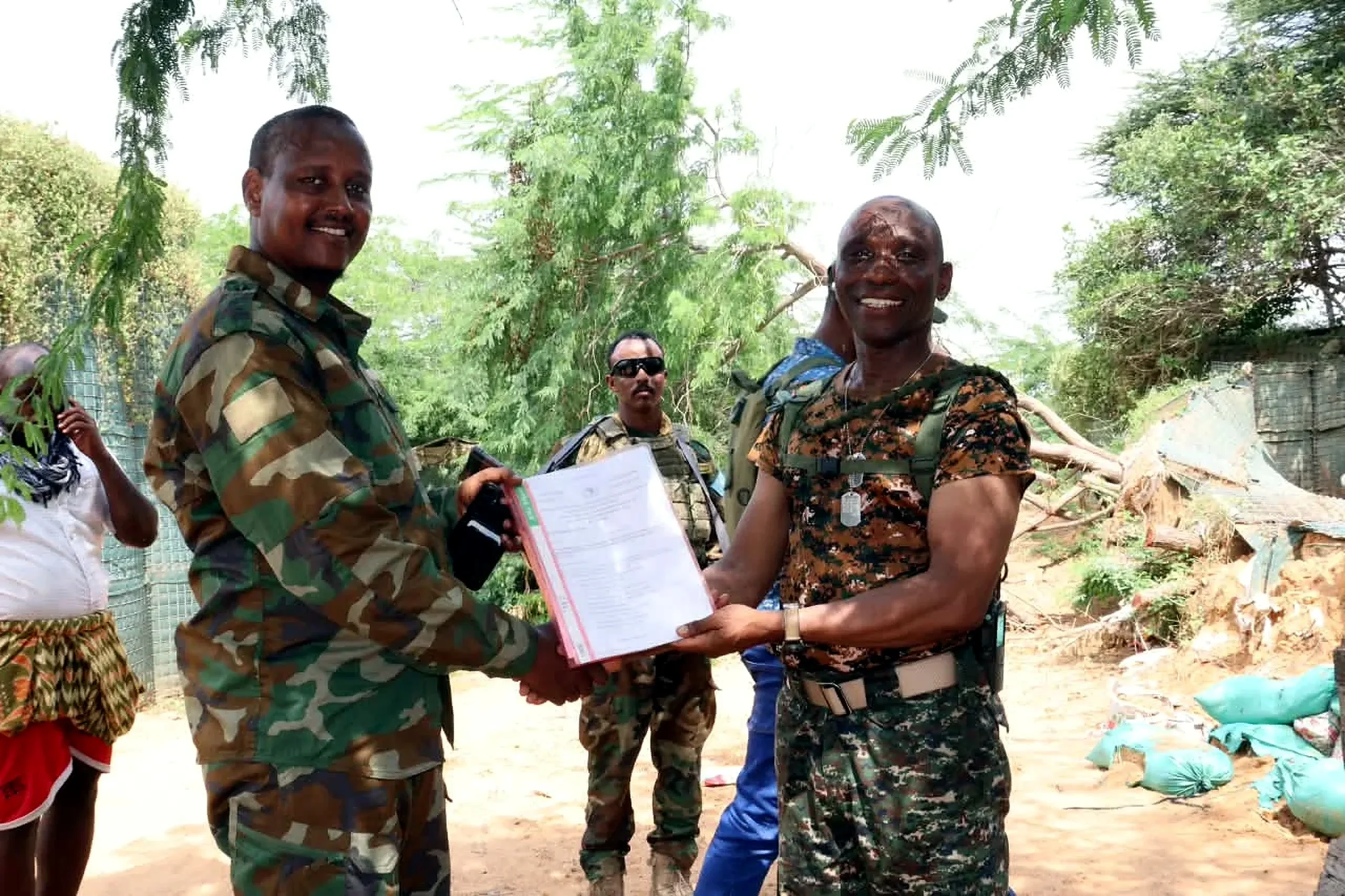
Ugandan peacekeepers serving with the African Union Support and Stabilisation Mission in Somalia (AUSSOM) have handed over five forward operating bases (FOBs) in the Barawe Sub-Sector of Lower Shabelle to the Somali National Armed Forces, the mission announced late on Sunday, 15 November 2026. AUSSOM called the transfer a milestone in Somalia’s security transition, which is gathering pace as the mission’s United Nations (UN) mandate approaches its expiry on 31 December.
The five sites are the Barawe Embresso, Barawe Knoll, Kismayo Road, Seaport and Runway forward operating bases, all of which AUSSOM said were handed over “fully operational”. Together they cover the coastal town’s port, its airstrip and the road south towards Kismayo, the facilities that have made Barawe a key logistics hub for security operations in Lower Shabelle since African Union (AU) and Somali forces took the town from al-Shabaab in October 2014.
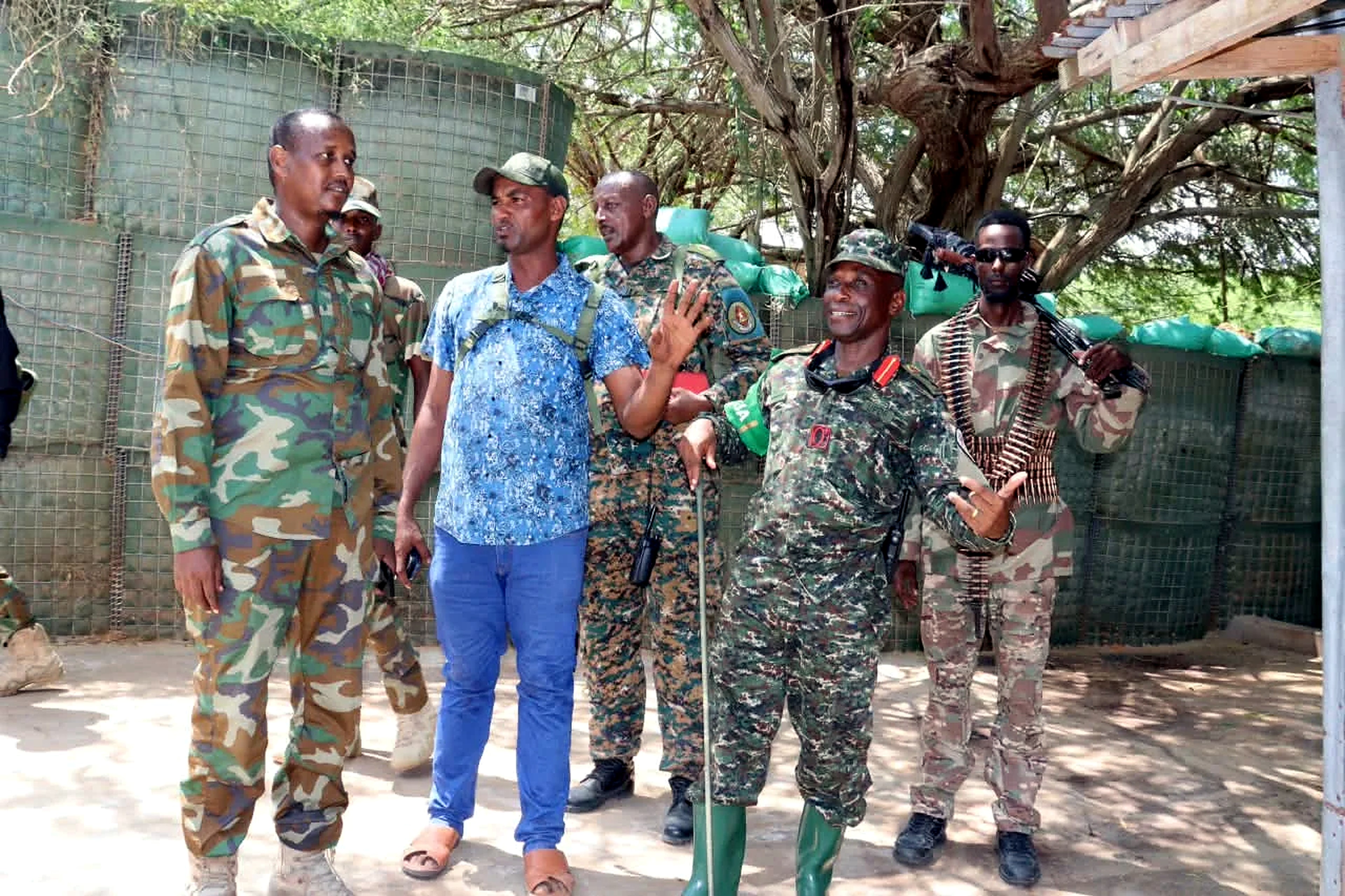
Ceremony at Embresso
The handover took place at the Ugandan battle group headquarters in Embresso, which Nile Post identified as that of Battle Group 45. It was led by Colonel Dr Justus Musenene, who represented the AUSSOM Sector One Commander, Brigadier General Jackson Kayanja, in the presence of Barawe district leaders and senior officers from the Somali army and the Uganda People’s Defence Force (UPDF).
Musenene thanked Barawe’s communities for their support during the Ugandan deployment, called on the Somali Armed Forces to safeguard the gains made over the years and urged residents to remain resilient in preserving the peace. He said the transfer showed “the preparedness and improving capabilities of Somali forces”, but added that “security cannot depend on military forces alone but requires cooperation between communities and security institutions”, Kaab TV reported. Colonel Mohamed Ahmed Cabd, commander of the Somali National Army’s 23rd Brigade, described the cooperation with the UPDF as a “historic partnership” and praised the Ugandan troops’ development and community projects in the district.
A mission running out of time and money
The handover comes as AUSSOM faces an uncertain end. The UN Security Council unanimously renewed the mission’s mandate in December 2025, but only until 31 December 2026. In July, Washington said it would oppose UN funding for the UN Support Office in Somalia (UNSOS), which provides AUSSOM’s logistics, beyond the current mandate, as Military Africa reported at the time. The United States pays about 26 per cent of the UNSOS budget, and The EastAfrican reported that officials fear the office could close at the end of the year, forcing troops home early. AUSSOM was launched on 1 January 2025 with an authorised strength of 11,826 soldiers, 680 police and 85 civilian staff, and had been planned to run until 2029.
Some troop-contributing countries have already started withdrawing. Uganda, the first country to deploy under the African Union Mission in Somalia (AMISOM) in 2007, has begun drawing down its forces and has said all its troops will leave Somalia in 2027. Military Africa reported in September that the UPDF had set 1 August 2027 as its final deadline, while Uganda’s Ministry of Defence has more recently spoken of withdrawal by the end of 2027. In October, the UPDF rotated Battle Group 48 into Somalia, and Egypt has been preparing to deploy troops under AUSSOM near Mogadishu, though no arrival date has been announced.
Nearly two decades of African Union operations
The African Union’s peace support operations in Somalia date back to 2007, when AMISOM deployed to protect the transitional government in Mogadishu, then controlling less than a tenth of the capital. AMISOM was replaced by the African Union Transition Mission in Somalia (ATMIS) in 2022, which began handing bases to Somali forces the following year, as Military Africa reported in July 2023. ATMIS was in turn succeeded by AUSSOM in January 2025, a change covered in our report on the transition from AMISOM to AUSSOM. Throughout, the missions have supported the Federal Government of Somalia against the al-Qaeda-affiliated al-Shabaab.
Mogadishu has tried to prepare its army for the handover. In August, the Somali National Army graduated about 3,000 soldiers at Xananbuure, its largest class trained inside the country since 1991. At the same time, foreign forces are taking a bigger role outside the AU framework, with United States Africa Command (AFRICOM) airstrikes and Ugandan, Ethiopian and Turkish forces operating under bilateral arrangements.
Holding Barawe without the UPDF
Handing over a base does not by itself secure the area around it. Somali forces in Barawe will need enough troops, vehicles, fuel and logistics support to keep the port, airstrip and Kismayo road open, and to protect the supply routes that link the town to the rest of Lower Shabelle, where al-Shabaab still operates in the countryside. Nile Post noted fears that the group could gain ground as AU forces leave, citing recent attacks and the capture of territory.
More handovers are likely in the six weeks before the mandate expires, and the Security Council’s decision on AUSSOM’s future, and on who will pay for it, will determine how many AU troops remain in Somalia in 2027. For the 23rd Brigade at Barawe, the test begins now.