

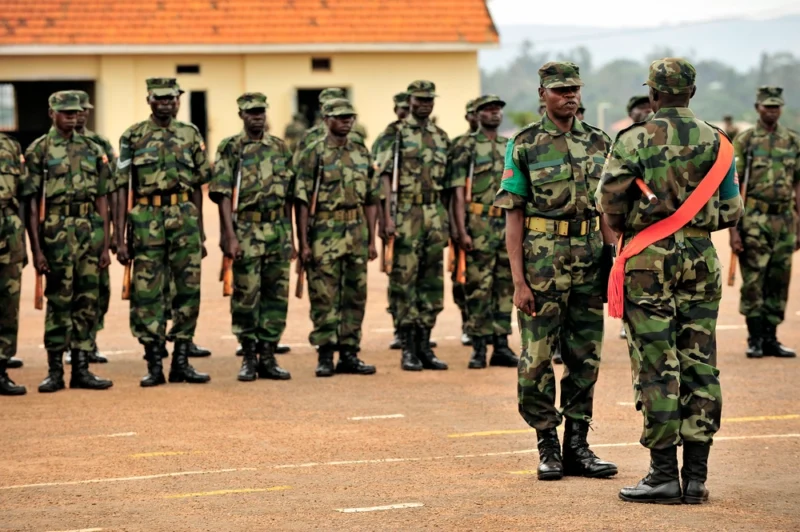
Ugandan troops from Battle Group 48 assumed frontline duties in Somalia on October 10, 2026, replacing Battle Group 45 in a routine rotation that comes as Kampala considers how much longer it intends to maintain its presence in the country.
The handover, confirmed by the Uganda Peoples’ Defence Forces (UPDF), places the new unit under the African Union Support and Stabilisation Mission in Somalia (AUSSOM), the multinational force that succeeded the African Union Transition Mission in Somalia (ATMIS) in January 2025. Battle Group 48 is commanded by Col Michael Opio Ocuka.
Sector One Commander Brig Gen Jackson Kayanja presided over the welcome session and told the incoming troops that “personal discipline is the key to your success.” He urged them to practise what he described as conscious discipline rather than mechanical compliance, respect the chain of command, and remain alert to the threat posed by al-Shabaab, the al-Qaeda-linked insurgency that has fought Somali and AU forces for nearly two decades.
Col Jude Rukubya, the Sector One deputy commander, told the troops to “be flexible in everything and ready to learn new things,” urging them to draw on the experience of the battle group they are replacing. Col Hamza Kasajja, the sector’s administration officer, also attended, along with other senior and junior officers responsible for helping the unit settle into its new area of operations.
Battle Group 48 completed a 16-week pre-deployment course at Camp Singo beginning in June 2026, the standard preparation undertaken by UPDF units before deploying to Somalia. The rotation follows a familiar pattern: Battle Group 47 arrived in May 2026, and battle groups have rotated approximately every few months since Uganda’s first deployment to Somalia in March 2007 under the African Union Mission in Somalia (AMISOM).
This history is important to understanding the scale of the current transition. Uganda is AUSSOM’s largest troop contributor, with approximately 4,500 soldiers on the mission’s approved list, within a mission authorised by the UN Security Council to include up to 11,826 uniformed personnel, including 680 police officers. A separate bilateral contingent, which Ugandan military sources estimate at approximately 2,000 troops (although some reporting from Kampala this year has cited figures as high as 4,000 to 6,000), has operated in Somalia since 2025 under a security pact Kampala signed with Mogadishu at the end of 2024.
Uganda’s military presence has declined considerably from its peak. At one point, the UPDF contingent under AMISOM comprised nearly 6,000 soldiers; a 2023 drawdown linked to UN Security Council resolutions on the ATMIS transition reduced the force by approximately 2,000 troops and brought the multilateral mission closer to its current size. The Security Council extended the AUSSOM mission through December 31, 2026, under a UK-sponsored resolution adopted in late December 2025. Council members also highlighted persistent funding shortfalls affecting both the mission and the UN Support Office in Somalia, which provides its logistical support.
That financial pressure forms part of a broader, unresolved question surrounding this rotation. In January 2026, Uganda’s Chief of Defence Forces, Gen Muhoozi Kainerugaba, signalled plans for a full troop withdrawal, remarks widely interpreted as indicating the likely end of Uganda’s nearly two-decade role in Somalia. By late August 2026, a senior Ugandan military official had specified a date: all Ugandan forces are scheduled to conclude their deployment by August 1, 2027. Gen Kainerugaba has stated on social media that Uganda is “withdrawing completely from Somalia” and that there “will not be UPDF in Somalia after that.”
Defence Minister Kiryowa Kiwanuka has placed a somewhat different emphasis on the issue. Speaking on August 15, 2026, he said Ugandan forces would remain in Somalia under the bilateral security pact with Mogadishu even if the multilateral AUSSOM mission collapsed or wound down. This suggests that Uganda’s presence could shift from an AU-mandated force to a bilateral arrangement rather than end altogether. The two positions are not necessarily contradictory, but they leave open which legal and operational framework—AUSSOM, a restructured AU mission, or Uganda’s bilateral arrangement—would govern any troops remaining after the multilateral mission’s mandate expires.
Kampala has also sought to manage the politics of the drawdown collectively. It hosted an extraordinary summit in Kampala from July 29 to 31, bringing together AUSSOM’s troop-contributing countries—Burundi, Djibouti, Ethiopia, Egypt, Kenya, Uganda and Somalia—to discuss the mission’s options as funding and mandate questions converge. Meanwhile, Uganda’s Parliament voted on August 6, 2026, to authorise a separate deployment to the Gaza Strip as part of a US-backed multilateral peacekeeping mission, indicating that Kampala’s willingness to undertake overseas deployments has not disappeared even as its posture in Somalia narrows.
For now, the operational rhythm on the ground remains largely unchanged. Battle Group 48’s arrival ensures that Sector One’s forward operating bases remain staffed and AUSSOM’s counter-al-Shabaab operations continue without interruption. However, each rotation between now and mid-2027 is likely to be seen increasingly as an indicator of the pace and legal framework under which Uganda’s longstanding mission in Somalia is winding down.