

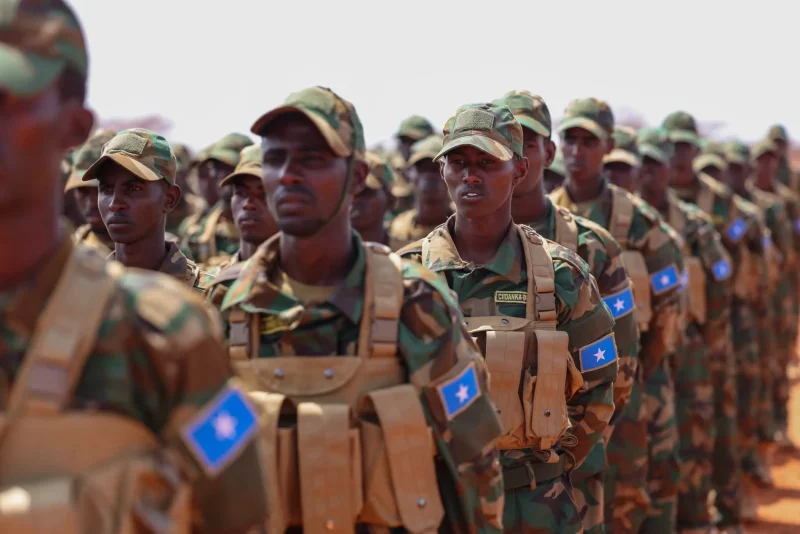
The Somali National Army graduated roughly 3,000 soldiers at the Xananbuure training camp in Galgaduud on 16 August 2026, the largest single cohort trained inside the country since the central government collapsed in 1991. President Hassan Sheikh Mohamud presided over the ceremony, calling the milestone evidence of “the recovery of statehood and the rebuilding of the Somali National Army.” The graduation was funded by Saudi Arabia under a February 2026 military cooperation agreement committing Riyadh to train up to 5,000 Somali recruits, with Saudi military representatives overseeing part of the programme and attending the pass-out parade alongside senior federal and regional Somali officials, including Galmudug President Ahmed Abdi Kariye, known as Qoor-Qoor, and Defence Minister Ahmed Moallim Fiqi.
The achievement is real and, on its own terms, genuinely significant for a country that has spent three decades rebuilding a national army largely through foreign-run training programmes abroad or scattered, smaller cohorts at home. It is also, within weeks of the ceremony, at the centre of a regional controversy the celebratory framing around the graduation did not anticipate.
What Happened After the Graduation
On 1 September, Somalia’s National Security Adviser, Aways Haji Yusuf, confirmed for the first time that an undisclosed number of soldiers from the Xananbuure cohort had crossed into Ethiopia’s Somali Region. Yusuf described the movement as authorised family leave, saying Mogadishu was aware of the troops’ presence across the border. That explanation has not settled the matter. Conflicting reports have put the number of soldiers involved anywhere between 180 and 900, and some accounts claimed the group was detained before being transferred to Jigjiga, the regional capital, rather than simply visiting relatives. The episode, now referred to in regional reporting as the Jigjiga incident, landed in an already sensitive bilateral relationship: Somalia and Ethiopia have been at odds since Addis Ababa signed a preliminary agreement with the breakaway region of Somaliland in January 2024 involving coastal land access in exchange for potential recognition of Somaliland’s independence, an arrangement Mogadishu has condemned as a direct attack on its sovereignty.
A separate and more serious set of allegations has attached itself to the broader Saudi-funded programme rather than to the Xananbuure graduates specifically. Kenyan outlet The Standard reported in late July, before the August graduation, that the programme involved more than 5,000 recruits trained by contractors from Romania, Ukraine, South Africa and Colombia, and that some recruits were being prepared for eventual deployment alongside the Sudanese Armed Forces in Sudan’s civil war.
Other regional reporting has placed total enrolment at 5,107 recruits across two camps in the Guri El area, roughly 2,000 of them from the semi-autonomous Puntland region, figures that broadly track with but do not precisely match the scale described in official Somali statements. These allegations have not been confirmed by the Somali, Saudi or Sudanese governments, and should be read as credible but independently unverified reporting rather than established fact.
Why the Timing Matters
None of this changes the underlying strategic pressure driving Somalia to train soldiers at this scale in the first place. Military Africa reported in July 2026 that the United States had informed the African Union it would block renewal of United Nations logistical support for the African Union Support and Stabilization Mission in Somalia (AUSSOM) once the mission’s current mandate expires at the end of 2026, a deadline that places heavy pressure on the Somali National Army to build independent capacity quickly. AUSSOM, which succeeded the African Union Transition Mission in Somalia on 1 January 2025 and traces its lineage back to the original African Union Mission in Somalia established in 2007, currently deploys close to 11,826 uniformed personnel across roughly 400,000 square kilometres of south-central Somalia. Every soldier Mogadishu trains domestically is, in principle, one fewer the country will need an international partner to supply once that funding cliff arrives.
A Reconstruction Effort With Many Foreign Hands
The Xananbuure graduation is the latest entry in a Somali military reconstruction effort that has drawn in an unusually wide spread of foreign partners over the past several years, each filling a different gap. Turkey’s role remains the most institutionally embedded. Camp TURKSOM, Turkey’s largest overseas military base, opened in Mogadishu in September 2017 at a reported cost of roughly 50 million US dollars and has since trained thousands of Somali personnel, including the elite Gorgor commando force. Military Africa reported in April 2026 that Turkish instructors had expanded Gorgor training to include heavy armour and main battle tanks, centred on the M48A5T2, a Turkish-modernised variant of the American Patton tank fitted with a 750-horsepower Continental twin-turbo diesel engine giving the 45-tonne vehicle a road speed of 48 kilometres per hour and a range of 499 kilometres, a shift from asymmetric counter-insurgency training toward conventional armoured manoeuvre warfare. Turkey separately delivered three T-129 Atak attack helicopters and two utility helicopters in 2025, following a 10-year bilateral defence agreement signed by Turkish Defence Minister Yaşar Güler and his Somali counterpart, Abdulkadir Mohamed Nur, and began construction of a rocket and space-technology testing facility in Somalia in December 2024.
Egypt has moved quickly to establish its own footprint. Military Africa reported in February 2026 that Egyptian forces were formally deployed into the AUSSOM framework following a parade in Cairo attended by President Mohamud, extending a relationship that began with a defence agreement in August 2024 and Egypt’s first military aid delivery to Somalia in more than four decades the following month, a move widely read as a response to Ethiopia’s Somaliland arrangement and the resulting three-way tension between Cairo, Mogadishu and Addis Ababa. Italy contributed four Bell 412EPX helicopters worth 16 million US dollars in 2024, described at the time as the largest single delivery since the lifting of Somalia’s arms embargo, while the African Union supplied Chinese-made ZFB-05 Xinxing armoured vehicles and logistics equipment ahead of the AUSSOM transition in March 2025. The United States resumed training for Somalia’s elite Danab Brigade at Ballidoogle airbase in June 2026, restarting a programme suspended after a 2023 ration-diversion scandal in which US-funded food meant for Danab troops was diverted and resold, an episode that prompted detentions within the unit and a US pledge to build stronger accountability safeguards before resuming support.
A Milestone
Somalia’s government is right that training 3,000 soldiers inside the country, rather than sending them abroad, represents genuine institutional progress after more than three decades of conflict. But the Xananbuure graduation cannot currently be reported as an unambiguous success story. A still-unresolved cross-border incident involving graduates from the same cohort, credible but unconfirmed allegations that the wider Saudi-funded programme may feed recruits into Sudan’s civil war, and persistent analyst warnings about soldier pay, retention and frontline ammunition supply networks all sit alongside the achievement Mohamud celebrated in August. Whether the programme ultimately strengthens Somalia’s own army or becomes entangled in conflicts well beyond its borders is a question that, as of this writing, remains open.