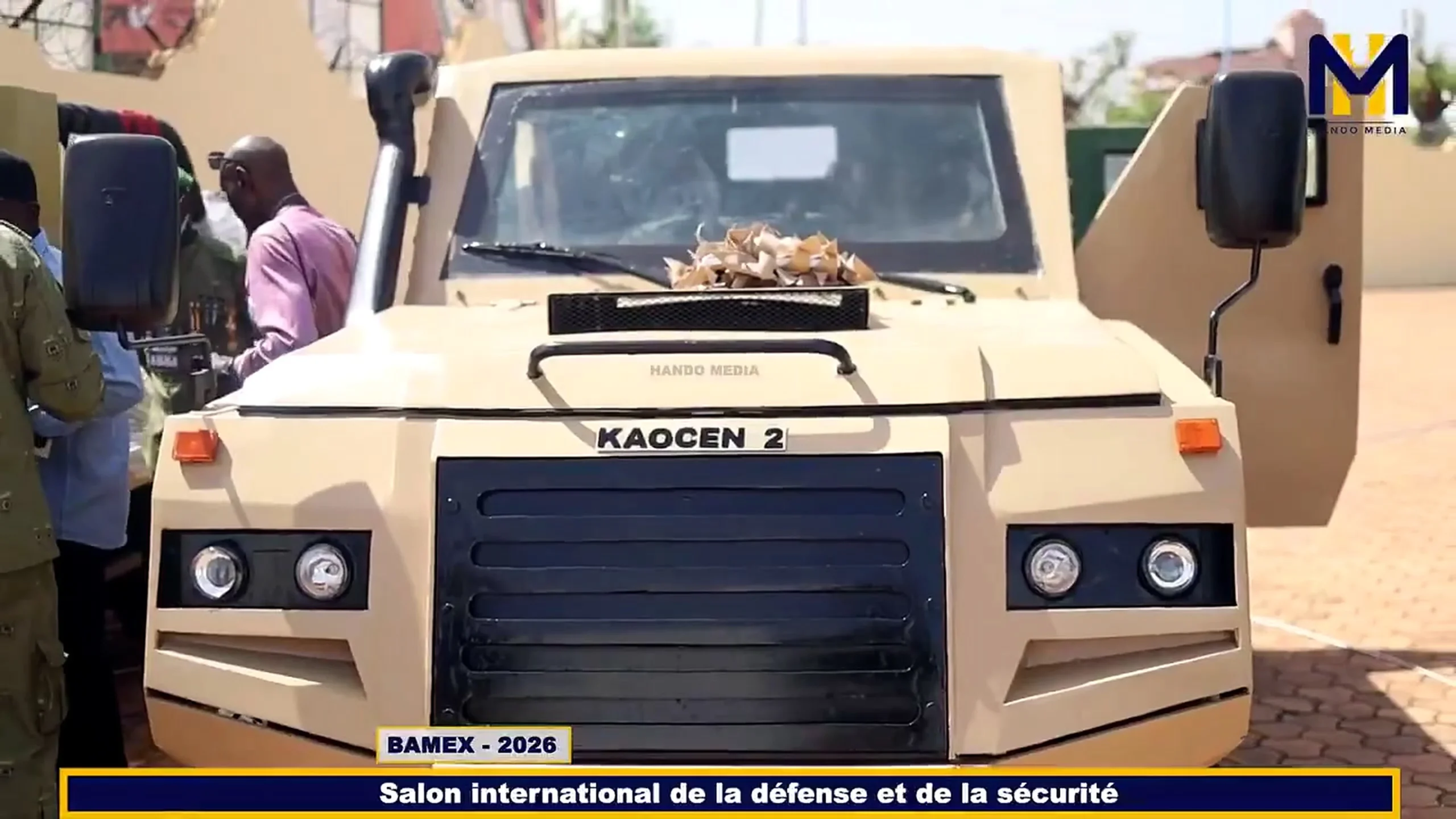
The Niger Armed Forces (Forces Armées Nigériennes, FAN) have presented two military vehicles built in their own workshops, the Kaocen 2 armoured command vehicle and the Inates 2 tactical troop transport, at the Bamako International Defence and Security Exhibition (BAMEX) 2026, which runs in the Malian capital from 9 to 13 November. The vehicles are the second versions of the Kaocen and Inatès vehicles that Niger first unveiled in August, and they were shown on the Nigerien stand alongside locally made individual protective equipment and drones.
“These vehicles are solutions for dealing with this asymmetric war,” a FAN officer presenting the vehicles told Hando Media at the show. “They are vehicles designed in the workshops of the Niger Armed Forces, from the chassis to the finish. The aim is to achieve our sovereignty and our material autonomy.” A post sharing the video on X said the vehicle had been designed “100 percent” in the army’s own workshops.
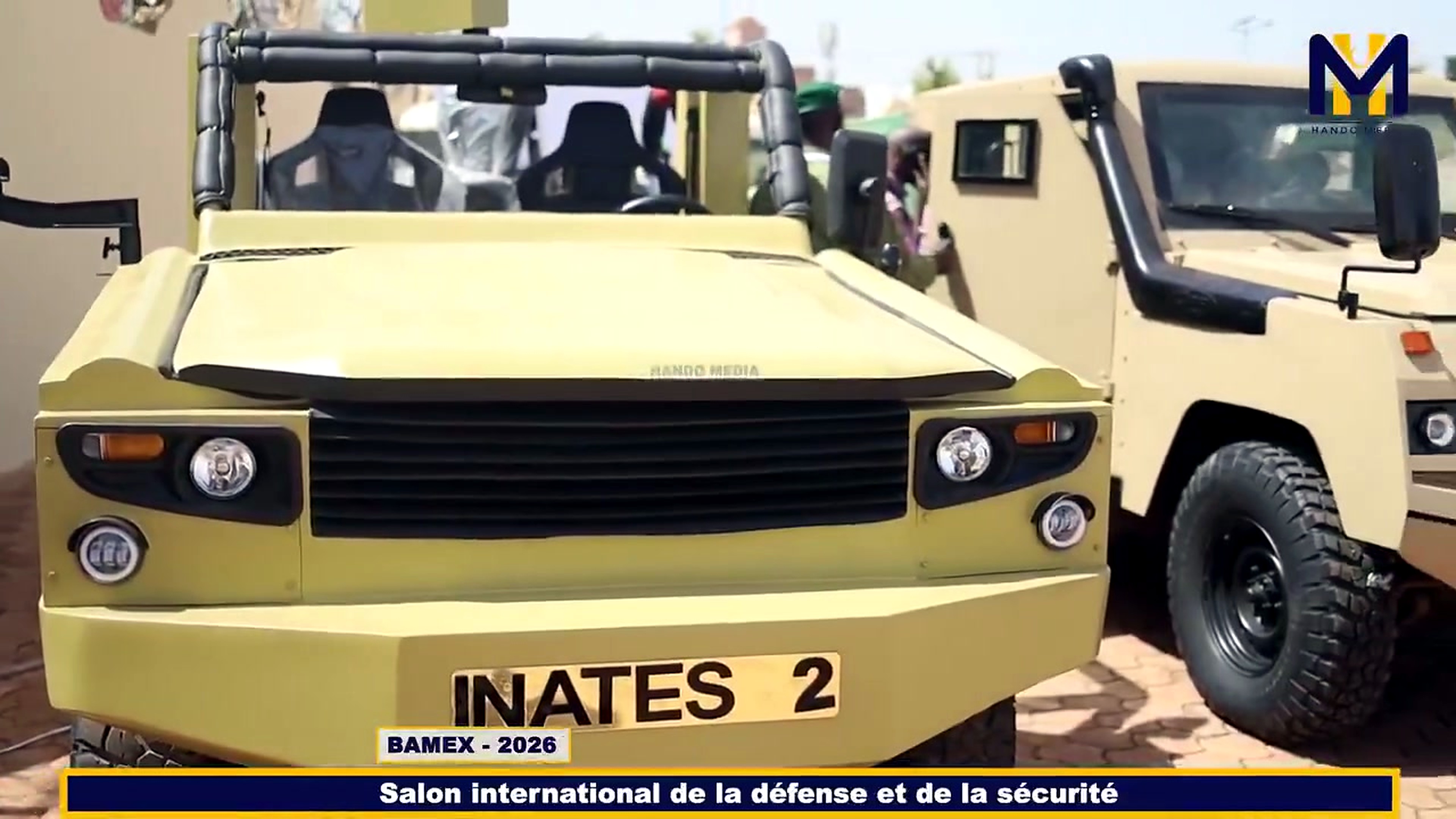
Inates 2: a five-seat tactical troop carrier
According to the presenting officer, the Inates 2 is a tactical troop transport vehicle for operations. It seats five and has keyless start, an integrated communication system, a reversing camera, two on-board weapon mounts, and reinforced suspension and tyres, and is “adapted to all types of terrain.” Footage from the stand shows an open-top, roll-barred 4×4 with an angular bonnet, a flat grille and the name Inates 2 painted on the front bumper.
The vehicle takes its name from Inatès, the town in the Tillabéri region where the Islamic State attacked a Nigerien army camp on 10 December 2019, killing 71 soldiers in one of the deadliest single assaults on the country’s military. Air Info Agadez reported that the first Inatès, a light intervention vehicle, was named in memory of the “martyrs of Inatès”.
Kaocen 2: armoured command vehicle with B7 glass
The Kaocen 2 is an armoured command vehicle. The officer said its armour meets North Atlantic Treaty Organization Standardization Agreement (STANAG) 4569 Level 2 and its glazing is rated B7, and that it is a four-seat vehicle with an integrated communication system for staying in contact with headquarters. STANAG 4569 Level 2 is generally associated with protection against 7.62 mm armour-piercing rifle rounds, while B7 is a European glazing standard for resistance to armour-piercing rifle fire, although Niger has not published test results to support either rating. The vehicle on display, carrying the Nigerien registration 23-0-E-658, has a box-shaped armoured body, a raised air intake snorkel, a slatted armoured grille and heavy side doors.
Kaocen is named after Ag Mohammed Wau Teguidda Kaocen, the Tuareg leader who led a revolt against French colonial forces and besieged the garrison at Agadez in 1916 and 1917. Air Info Agadez described the first Kaocen, presented in August, as a “100% Nigerien” armoured vehicle.
From the August anniversary to Bamako
Niger first unveiled the Kaocen and Inatès at celebrations for the 66th anniversary of the FAN in Niamey on 1 August 2026, where the vehicles were presented by the army’s Central Directorate of Matériel (DCMAT), Air Info Agadez reported. The ceremony was addressed by the Chief of Defence Staff, Major General Moussa Salaou Barmou. Three months later, the second versions were in Bamako.
Colonel Issaka Moctar, Central Director of Matériel of the FAN, said the equipment had been “created, designed and manufactured according to the realities of our land.” He told Hando Media that the army has also made a range of individual protective equipment for soldiers and has “transformed and modified” some of its vehicles, “because at one point there were supply difficulties.” “We have to count on ourselves and make the most of what we already have, for the benefit of the defence and security forces,” he said, adding that the show helped to “break this myth” and that “we will not stop there, we will keep producing.”
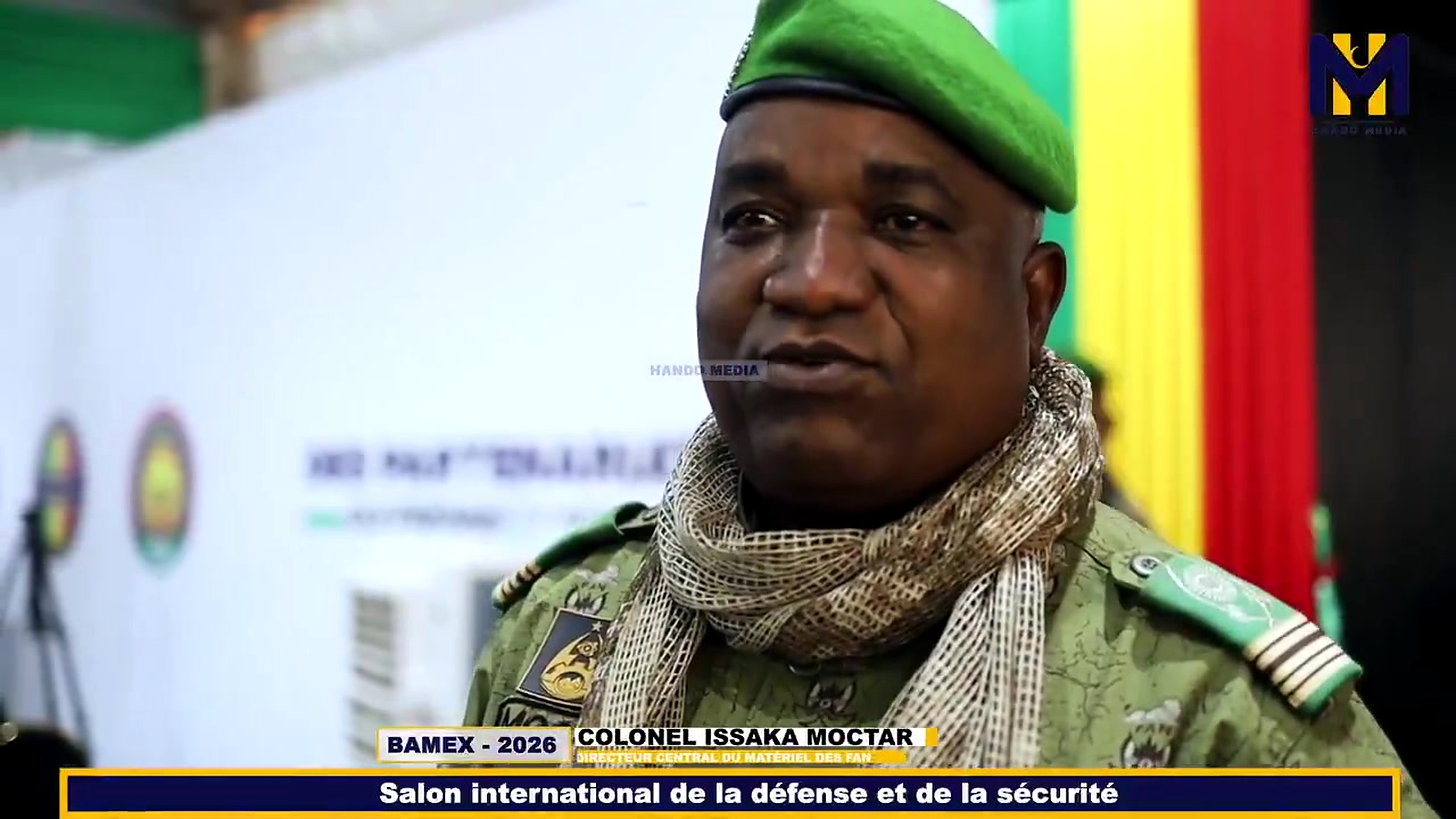
The Colonel’s reference to modified vehicles suggests that, as with other Sahelian programmes, some of the work involves rebuilding existing platforms. The FAN has not said which chassis, engine or drivetrain the Kaocen 2 and Inates 2 use, how many have been built, or whether either vehicle is in series production.
Sanctions, sovereignty and new partners
For visitors at the stand, the vehicles carried a political message. “It is a vehicle that was conceived and designed in Niger. No foreign hand was involved,” one visitor told Hando Media. “That proves that we Africans, if we want to, we can.” He linked the programme to the sanctions imposed on Niger after the July 2023 coup, saying Western suppliers “refused to sell us equipment and weapons, even with our own money.” He praised Türkiye as “a sincere partnership” with a country that “does not interfere in our internal affairs,” unlike the “paternalistic” approach of Western countries, and added: “It is the same with Russia. We have the choice of the partners we want to work with, and that sovereign choice belongs to us.”
Ankara has become one of Niamey’s main security partners since French forces left Niger in 2023. Military Africa has reported on the emerging Niger-Türkiye strategic partnership and on the agreement under which the two countries formalised on-site military training and logistics in May 2026. More than 20 Turkish companies are exhibiting at BAMEX, which is co-organised by Mali’s Ministry of Defence and the Istanbul-based firm The Peak Defense.
Part of a wider Nigerien vehicle effort
The army-built Kaocen and Inates sit alongside vehicles from the private Nigerien firm Guedesign Automotive, which unveiled the Tamgak Wangari tactical buggy in May 2025 and the Tin-Galen armoured personnel carrier with B6 protection in August 2025, together with an improved Tamgak Wangari 2.0. The Nigerien stand at BAMEX also showed small drones from a military aeronautics research centre and locally made body armour and soldier equipment.
Neighbours in the Alliance of Sahel States (AES) are following the same path. Burkina Faso says its company Faso Armored has built nearly 300 Nanga armoured vehicles since November 2025, Mali is using BAMEX to press for technology transfer from Türkiye, and Chad has set up Sahel Defence Industry to build a domestic arms base.
Workshops Built for a Sahelian War
The Kaocen 2 and Inates 2 show the FAN moving from one-off prototypes to second-generation designs within three months, and using a regional show to signal that it intends to keep going. Their value will depend on details the army has not yet shared: the base vehicles, independent verification of the STANAG Level 2 and B7 protection claims, production numbers, and how the vehicles perform against the improvised explosive devices and ambushes that jihadist groups use in western Niger. Colonel Moctar said the show was also meant to attract investors, a sign that Niamey sees local vehicle building as an industry as well as a military necessity.