

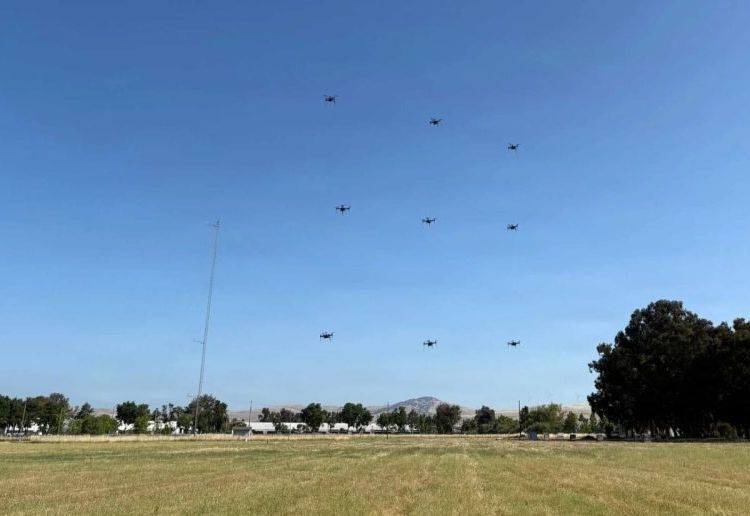
U.S. Africa Command completed a second field test of its CURTAIN CALL counter-drone swarm system at Lawrence Livermore National Laboratory in California from 27 April to 1 May 2026 – the most demanding evaluation the programme has faced so far.
The five-day event built directly on an initial demonstration at the same facility in January 2026. Where that first test focused on basic technical feasibility, this one introduced the scenario CURTAIN CALL was actually built for: a coordinated, multi-drone attack rather than a single inbound aircraft. The system detected and tracked both threat types and cued its defensive swarm faster than it had in February, according to AFRICOM’s public reporting verified on 4 June 2026.
“Our first demonstration gave us initial technical feasibility insights; this second event brought the concept to life,” said U.S. Air Force Lt. Col. Jared Bindl, AFRICOM’s chief innovation officer. Bindl described the test as “inching us closer to closing the gap between concept and a deployable, low-cost defense system.”
The CURTAIN CALL concept is straightforward in outline, though technically demanding in execution. Fixed cameras and sensors scan the airspace around a protected position. When they flag an anomaly, an alert goes to a human operator – the system does not engage autonomously. Once the operator authorises a response, a swarm of small interceptor drones launches and forms an aerial barrier in front of the incoming threat. AFRICOM describes this as a “flying wall,” a term that captures the geometry of the defence: instead of a single expensive interceptor chasing a single cheap drone, the system throws a distributed screen of low-cost platforms across the attack corridor.
During the Livermore tests, the team confirmed direct communication links between the command node and the swarm, allowing targeting data to update in near real time as threat conditions changed. The system was also integrated with the Tactical Awareness Kit (TAK), the situational-awareness software used across U.S. and partner forces, giving commanders a shared common operating picture of the engagement. Both capabilities – reliable swarm communication and TAK integration – were listed as key objectives for this phase.
The Economics Behind the Design
The programme is funded through the Joint Staff J7 Warfighter Laboratory Incentive Fund (WILF) and leans heavily on commercial off-the-shelf (COTS) components rather than purpose-built military hardware. The specific airframes used in testing have not been officially named, but the command has indicated it is looking at “Blue UAS”-certified platforms – drones that meet federal cybersecurity standards – for the operational system. AFRICOM currently fields as many as 25 interceptor drones in the swarm but has described potential expansion to hundreds.
The cost logic matters. Conventional short-range air defence relies on interceptor missiles that can cost tens of thousands of dollars per shot. Cheap commercial drones – the kind that groups like Al-Shabaab and Islamic State West Africa Province (ISWAP) can buy or assemble for a few hundred dollars – exploit that asymmetry by attacking in numbers. A single salvo of mass-produced attack drones can exhaust an expensive magazine in minutes. CURTAIN CALL is designed to flip that calculus: a defensive swarm built from similarly cheap commercial hardware can absorb attrition and still function, because losing one or two drones from a screen of twenty-five does not break the barrier.
That logic applies directly to the threat environment AFRICOM faces. Groups operating in Somalia, northern Nigeria, and the Lake Chad basin have demonstrated growing UAS capability, using small quadcopters for both surveillance and direct kinetic strikes. Forward operating bases and dismounted units in these environments typically lack the radar coverage and missile stocks of a conventional air defence battery. CURTAIN CALL is explicitly designed for those locations, not for high-end peer conflict.
AFRICOM was careful to set expectations after the Livermore test. The command confirmed the system tracked threats, held its communication architecture together, and achieved TAK integration – but released no confirmed intercept count. That is an honest framing. Detecting a swarm and tracking it in near real time is a genuine engineering achievement; reliably destroying incoming drones at a cost that stays below the attacker’s is the harder problem, and one the programme has not yet publicly claimed to have solved.
The data gathered over the five days will feed AFRICOM’s modelling and simulation work and shape the next phase of concept development. Bindl noted the command’s intention to compress the standard development timeline: “There’s absolutely an impetus for us to challenge the status quo regarding traditional timelines we see, from problem identification to capability delivery, and compress this down to a year or less”.
The next step after laboratory testing is an in-theatre demonstration within AFRICOM’s area of responsibility in Africa – a more operationally realistic environment that will expose the system to heat, dust, communication interference, and the clutter of real airspace. Engineers are also preparing for potential integration into upcoming major exercises, with Exercise Flintlock 2026 mentioned as a candidate venue for testing the system’s portability with special operations forces in remote terrain. Whether CURTAIN CALL can hold its performance gains outside a controlled laboratory setting will determine whether it moves from a promising concept to a fielded capability.