

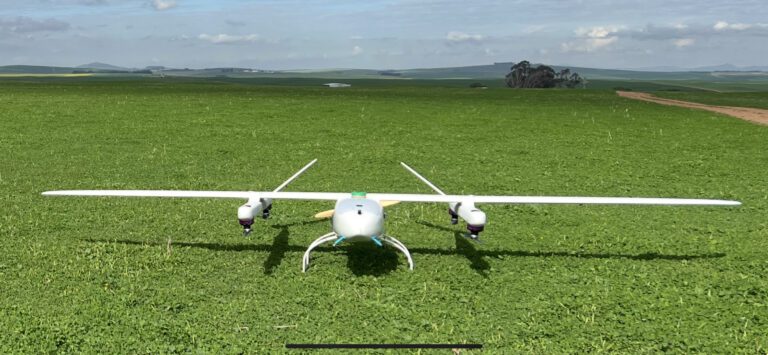
ShadowfaxUAS has launched the SF45, the first and largest of three new-generation unmanned aerial vehicles (UAVs) from the South African manufacturer, built on the lineage of the company’s earlier SF30.
Drawn from a DefenceWeb interview, the long-endurance, Group 3 fixed-wing vertical take-off and landing (VTOL) aircraft gives the Cape Town-based firm a heavier-payload, longer-range platform aimed squarely at persistent intelligence, surveillance and reconnaissance (ISR) work, in a global market where Western buyers are actively looking for alternatives to Chinese-made systems.
A Redesign Driven by Geopolitics
ShadowfaxUAS told DefenceWeb that the decision to develop an entirely new platform, rather than simply iterate on the SF30, came from watching the war in Ukraine reshape how Western governments think about their supply chains. “The main driver was the changing international geopolitical environment, as a result of the war in Ukraine and increased international polarisation,” the company said, pointing to growing Western reliance on Chinese manufacturing for drone components and the realisation that alternative domestic capacity simply did not exist at scale.
That realisation sharpened considerably once the United States moved to restrict Chinese-made drone hardware. Bans on components from Chinese suppliers including T-Motor, and on finished DJI drones, combined with tightening European and American requirements for supply chains free of Chinese-made critical parts, convinced ShadowfaxUAS that a partial fix would not be enough. Rather than simply swapping out restricted components on the existing SF30 airframe, the company said it went back to first principles and re-examined the functional requirements its customers actually needed.
“We realised that customers requiring persistent surveillance capability naturally fell into one of two categories: those that were satisfied with a relatively lower specification payload, and those who either were developing their own heavier payloads or who wanted the capability to be able to carry heavy or multiple payloads,” the company explained.
That review split the market into two groups. “We realised that customers requiring persistent surveillance capability naturally fell into one of two categories: those that were satisfied with a relatively lower specification payload, and those who either were developing their own heavier payloads or who wanted the capability to be able to carry heavy or multiple payloads,” the company explained. Over roughly two years, ShadowfaxUAS developed answers for both. The SF45 serves the heavier-payload Group 3 segment, while a smaller Group 2 platform, the SF25, is still to be launched and will be offered in both electric and gasoline propulsion variants depending on customer requirements.
“We have purposely developed robust, reliable UAVs, that, in conjunction with training on our proprietary simulator, makes using them in difficult terrain as easy and cost effective as possible for the client,” ShadowfaxUAS said.
From SF30 to SF45
ShadowfaxUAS first entered the market at the Africa Aerospace and Defence exhibition in September 2024, unveiling the SF30 as what Military Africa described at the time as a new entrant to the unmanned aviation sector. That original platform weighed 22 kilograms empty, carried a 4.13-metre wingspan and featured a 40-litre payload bay designed for rapid sensor changes, and the company registered the aircraft with South Africa’s National Conventional Arms Control Committee (NCACC) from the outset. The SF45 builds directly on that foundation while moving into a considerably more capable weight class.
Founded in 2020, ShadowfaxUAS is led by Chief Executive Officer Liezl Beyers and Technical Director Johan Beyers, joined in the development team by their son, a mechatronic engineer. The company has deliberately kept the full development and production chain in-house, from airframe design through composite manufacturing to avionics integration and testing, an approach it says reflects a philosophy of long-term stewardship and tailored, life-cycle support for customers rather than a transactional sales model. “The goal is to provide customers with a tailor-made solution and to support the customer throughout the UAV life cycle,” the company said.
What the SF45 Offers
As a Group 3 UAV, a United States Department of Defense classification covering uncrewed aircraft weighing between roughly 25 and 600 kilograms and operating below 5,500 metres, the SF45 has a maximum weight of 40 kilograms, an 8-kilogram maximum payload capacity and a 4.3-metre wingspan. Its datalink range extends to 150 kilometres. Carrying a lighter 1.5 to 3-kilogram payload, the aircraft offers up to 10 hours of flight endurance depending on configuration, enabling a sortie range beyond 1,000 kilometres at a maximum altitude of 3,000 metres. The company described the 10-hour figure as conservative, saying ongoing optimisation work is expected to push duration to between 12 and 13 hours depending on the payload carried.
Two patented systems distinguish this generation of ShadowfaxUAS aircraft from earlier designs. The quick-swap forward propulsion system allows the entire propulsion unit to be replaced in the field in under a minute, a feature the company says maximises platform availability by letting damaged or worn units be swapped out immediately and serviced later in a workshop, reducing both downtime and the number of airframes a customer needs to buy to sustain a given level of persistent coverage. A separate patented payload balancing system eliminates the need for ballast weight when switching between payloads of different sizes, simplifying field reconfiguration. ShadowfaxUAS also invested specifically in isolating the SF45’s sensitive electronics from vibration generated by its gasoline engine, developing what it describes as a proprietary vibration isolation engine mount system that it says has reduced vibration to negligible levels, improving flight controller precision, video feed quality and component lifespan in the process.
Beyond its core ISR role, the company says the SF45’s payload-agnostic design allows configuration for communications relay, signals intelligence, maritime patrol, counter-poaching and counter-insurgency work, as well as civilian applications including mining, agriculture and conservation monitoring, where its endurance gives it coverage advantages over shorter-range multi-rotor drones.
Positioning Against ITAR-Restricted Rivals
A central part of ShadowfaxUAS’s pitch is that the SF45 is free of International Traffic in Arms Regulations (ITAR) restrictions, the American export control regime that governs defence-related goods and technology with US-origin content. “Many of our competitors in the Group 3 market are ITAR restricted, which severely constrains their ability to export from the USA and largely limits the sales to close allies and partners under rigorous government licencing or foreign military sales processes,” the company said, positioning the SF45 as a comparable-capability, competitively priced alternative for buyers who either cannot clear US export hurdles or simply want to avoid them. That positioning echoes a broader pattern among manufacturers outside the United States and China; Turkish firm ASELSAN has made the identical ITAR-free argument central to its own export pitch in markets including Nigeria, suggesting South African and Turkish manufacturers alike see genuine commercial opportunity in the narrow lane between American export controls and Chinese supply chain risk.
A Crowded Field at Home
ShadowfaxUAS enters a South African UAV sector that is already comparatively dense by African standards. Military Africa’s own Africa Drone Procurement Report records South Africa as home to the continent’s largest indigenous drone fleet, with 94 units from domestic manufacturers, led historically by Denel Dynamics’ Seeker family and Milkor’s larger platforms including the MA380, alongside smaller developers such as the Council for Scientific and Industrial Research and Avior Labs, whose Elevation VTOL UAV entered production around the same period as ShadowfaxUAS’s SF30 debut. The competition is not limited to other South African firms. Military Africa reported in April 2026 that the South African Army itself was acquiring a new fixed-wing and rotary-wing drone fleet for border security, sourcing locally developed systems from Cape Town-based AutonoSky alongside commercial platforms from China’s Autel Robotics, a reminder that even South Africa’s own military customers have not uniformly favoured domestic, Chinese-component-free platforms over cheaper Chinese alternatives when procurement decisions are made.
While ShadowfaxUAS remains a largely export-focused company, it told DefenceWeb it will seek safety approvals from the South African Civil Aviation Authority in the coming months to allow domestic customers to acquire and operate its aircraft, a step that would open the local military and civilian market the company has so far left to competitors. Further expansion is planned beyond the SF45, with the smaller Group 2 SF25E and SF25G variants expected to launch once performance validation testing concludes, both developed entirely in-house in keeping with the company’s existing approach.