

Russia’s state-owned arms exporter, Rosoboronexport (ROE), is navigating a complex geopolitical landscape by reinforcing its long-standing defence ties with African nations. The company’s Chief Executive Officer, Alexander Mikheev, announced in early November 2025 that its African contract portfolio is valued at approximately $4 billion.
Speaking on the Zvezda television channel around the company’s 25th anniversary, Mikheev stated that ROE is actively cooperating with 46 of the continent’s 54 countries. “We work with Rwanda, Uganda, Congo, the Democratic Republic of the Congo, Nigeria, and Angola,” he said, noting a “good geographic reach.” This $4 billion portfolio, built over several years, represents a critical pillar of Russia’s foreign and industrial policy.
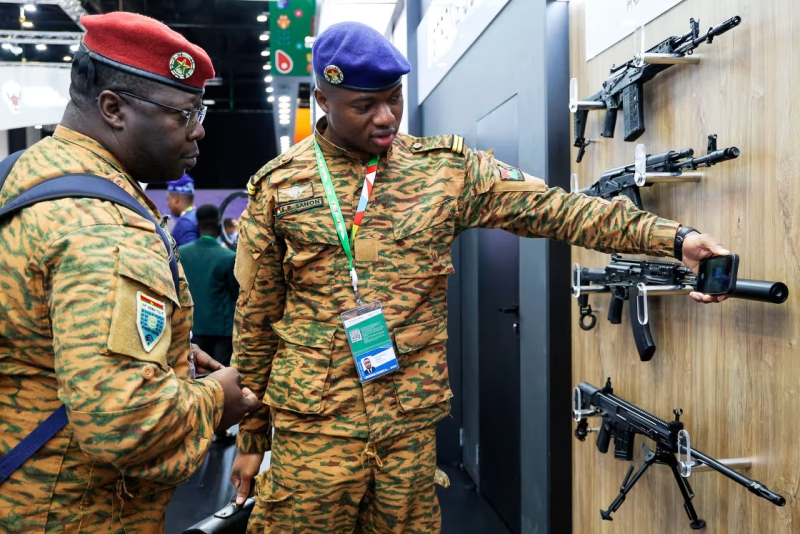
This intense engagement comes as Russia’s global arms export sector faces unprecedented pressure from Western sanctions and the high operational tempo of its own war in Ukraine, which consumes vast amounts of equipment and components. The public reinforcement of its African partnerships, demonstrated at events like the 2023 Russia-Africa Forum in St. Petersburg and the 2024 Africa Aerospace and Defence (AAD) expo in South Africa, shows Russia’s determination to maintain its status as a primary arms supplier to the continent.

Air and Air Defence Platforms
Air power remains a key Russian offering. The most recent high-profile delivery was to Ethiopia, which received its first Sukhoi Su-30K fighter jets in January 2024. The Su-30K is a 4+ generation, twin-seat multirole fighter, providing a substantial leap in air-to-air and air-to-ground capability. Ethiopia also recently netted Su-35s.
While concrete sales of its newest platforms remain elusive, ROE continues to market its 5th-generation Su-57E fighter. As far back as 2021, Mikheev claimed that five nations, including some in Africa, had expressed interest in the stealth fighter. As of late 2025, this interest has not translated into a confirmed export order, which is unsurprising given the aircraft’s high cost and the fact that the Russian Air Force is still in the process of its own induction.
More common in the region are Russia’s air defence systems. The Tor short-range surface-to-air missile (SAM) system, a mobile platform designed to protect troops and armour on the move, is among the most popular Russian weapon systems on the continent.
Land and Sea Systems
The battle-proven, mine-resistant Typhoon-K family of vehicles, which come in 4×4 (KAMAZ-53949) and 6×6 (KAMAZ-63969) configurations. These vehicles have seen extensive service, providing a hardened, mobile capability.
A more direct example of this hardware proliferation was seen on October 12, 2024, when a GAZ Tigr tactical vehicle was spotted in Equatorial Guinea during its 56th independence day parade. This sighting supports reports of deepening Russian security cooperation with the West African nation.
In the maritime domain, ROE has also found success with smaller, specialised platforms like the BK-10 assault boat, confirming a sale to a sub-Saharan country in 2020.
A Shifting Industrial Strategy
At the AAD 2024 expo in September, Russia’s presence was substantial, with over 250 products on display. The messaging, however, has evolved. Beyond direct sales, ROE officials are now placing heavy emphasis on “industrial partnerships” and technology transfer.
As the Military Yearbook 2026 by Centre for Analysis of World Arms Trade emphasises, industrial partnerships are actively evolving with many countries in the Middle East, Africa, the Asia-Pacific region, Latin America, the CIS and Europe.
“The main forms of cooperation are the establishment of joint ventures, localisation of production abroad, technical assistance in the construction of defence facilities, and joint development and production of military equipment. Among the projects being implemented are the production of UAVs, precision guided weapons, small arms, joint development of armoured vehicles, adaptation of Russian missiles to partner aircraft, and the establishment of equipment repair and maintenance centres.
This shift serves two purposes. First, it addresses a growing demand from African nations like South Africa, Egypt, and Nigeria to develop their own domestic defence industries rather than just being consumers. Second, in an environment where sanctions could delay the delivery of complete systems from Russia, joint ventures and local assembly offer a pragmatic path to fulfilling contracts and maintaining market presence.
While the $4 billion portfolio is a large figure, it represents a backlog of existing and future contracts, not a single year’s sales. Some African clients are weighing the proven designs and political non-interference of Russian hardware against new, pressing questions about delivery timelines, competition for spare parts, and the long-term reliability of a supplier engaged in a high-intensity war.