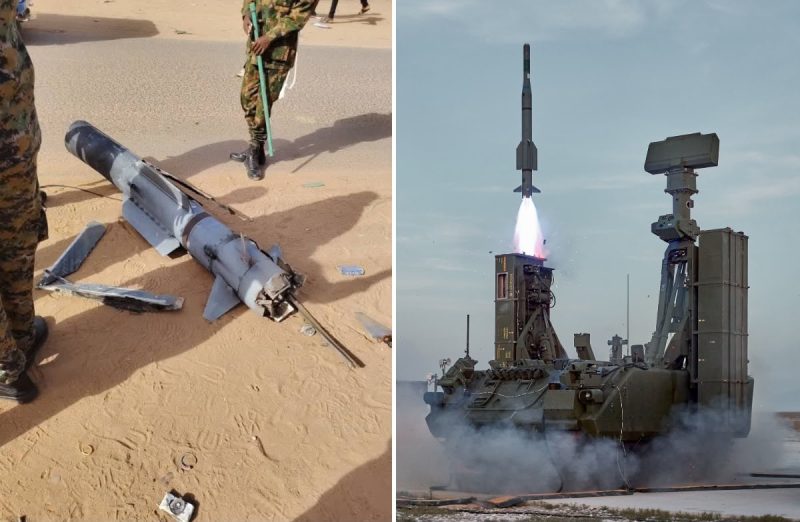
Open-source analysts identified wreckage of a Turkish-made HİSAR-A surface-to-air missile in Khartoum in June 2026, the first documented evidence that Sudan’s army has fielded the system against drone attacks. The photos, published by an open-source intelligence (OSINT) researcher, showed missile debris recovered in the Sudanese capital. The Sudanese Armed Forces (SAF) reportedly fired the missile in an attempt to intercept a drone launched by the Rapid Support Forces (RSF), the paramilitary group it has fought since April 2023.
On May 21, 2026, the RSF released footage said to show a Chinese-built drone destroying a HİSAR-A launcher vehicle near Rahid al-Nuba in North Kordofan. Open-source investigators at Misbar geolocated the strike and matched the vehicle’s radar and launcher layout to the Turkish system, though accounts aligned with the SAF disputed the footage’s authenticity. The HİSAR-A is Turkey’s first domestically developed low-altitude air defense missile, built by Aselsan and Roketsan under a program that began in 2007. An upgraded HİSAR-A+ entered Turkish army service in 2021. The system rides on a tracked FNSS ACV-30 chassis and carries an onboard 3D radar and electro-optical sensors, letting a single vehicle detect, track, and engage targets without external support. Reported figures put its intercept range at roughly 15 kilometers and its engagement ceiling at about 8 kilometers, with a proximity-fuzed high-explosive warhead built for aircraft, helicopters, cruise missiles, and drones.
Since 2023, the RSF group has leaned heavily on modified commercial and imported unmanned aircraft for reconnaissance, artillery correction, and direct strikes on SAF positions and infrastructure. The SAF’s older Soviet-era and Chinese-supplied air defenses were built for faster, higher-flying threats and have struggled against slow, low-altitude drones. A system designed specifically for that threat category, like the HİSAR-A, closes a gap the legacy inventory could not.
In May 2026, the SAF carried out what analysts describe as the first confirmed case of one armed drone shooting down another, using a Bayraktar Akıncı to destroy a rival Akıncı-type aircraft suspected of Ethiopian origin over Sudanese airspace, according to Turkish media reporting from early July. The Akıncı fired a Roketsan EREN loitering munition, a 35-kilogram weapon with a stated range near 100 kilometers built to catch slow aerial targets. Two more Akıncı-type drones tied to the RSF and reportedly supplied through the United Arab Emirates and flown from Ethiopia’s Bahir Dar airport have since been downed the same way.
On July 7, 2026, the SAF said its air defenses intercepted a Chinese-made CH-95 (also known as FH-95) surveillance drone over the Export Road linking Bara and Omdurman, west of Khartoum, though footage later indicated an Akıncı carried out the kill rather than a ground battery. A second CH-95 engagement followed on July 13, when Turkish Outlet Clash Report published video of an Akıncı shooting down one CH-95 in the air near El-Obeid, the North Kordofan state capital, while a second was destroyed on the ground in the same operation. The CH-95, built by Aerospace Times Feihong Technology Company, a subsidiary of the state-owned China Aerospace Science and Technology Corporation, has a reported service ceiling above 7,000 meters and an endurance of up to 12 hours, making it a capable reconnaissance and strike platform for the RSF.
For now, the HİSAR-A wreckage in Khartoum shows how far outside actors have shaped Sudan’s air battle without formally acknowledging it. Turkish systems, from the Akıncı to the HİSAR-A, have given the SAF tools to contest a domain the RSF once dominated largely unchallenged.