
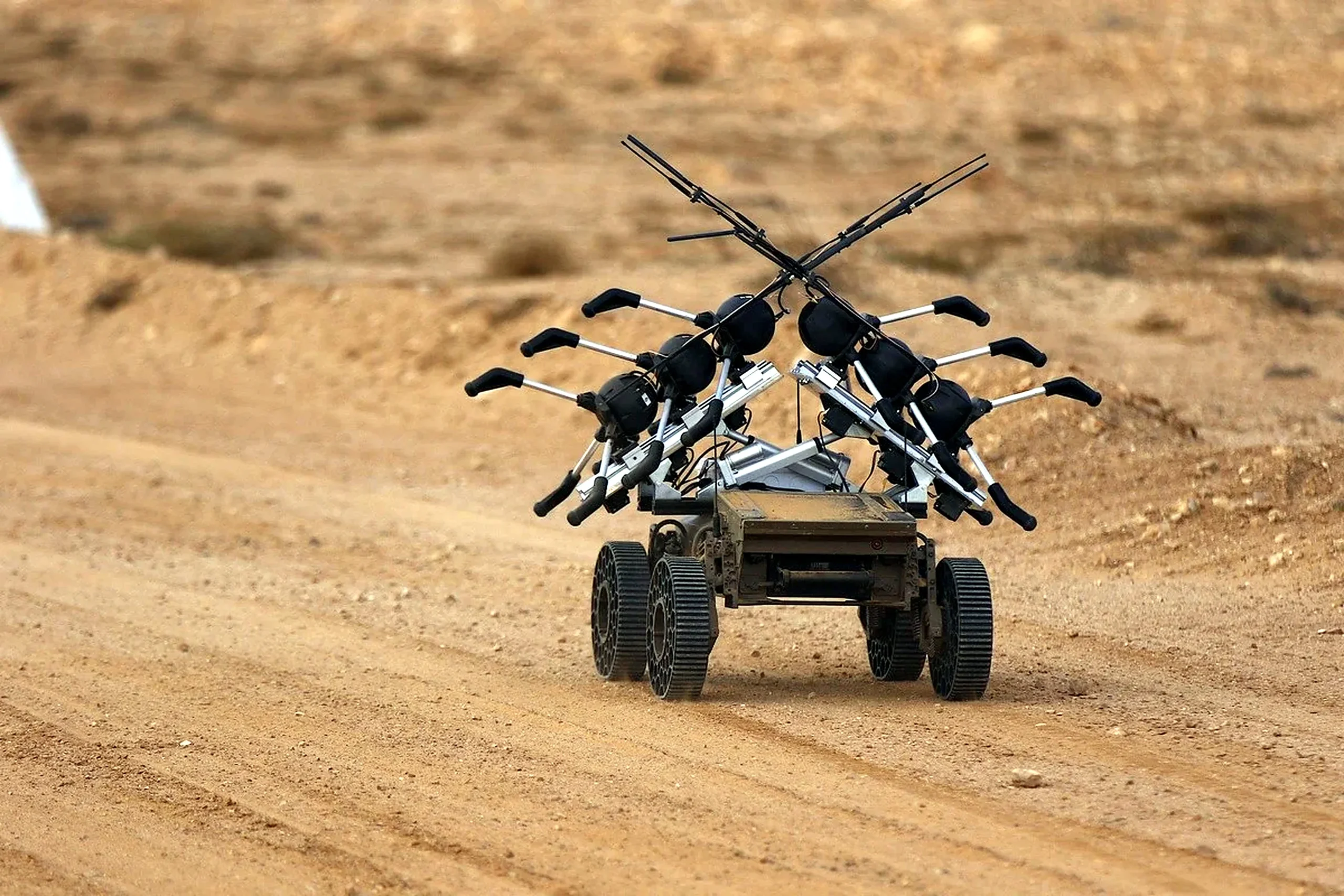
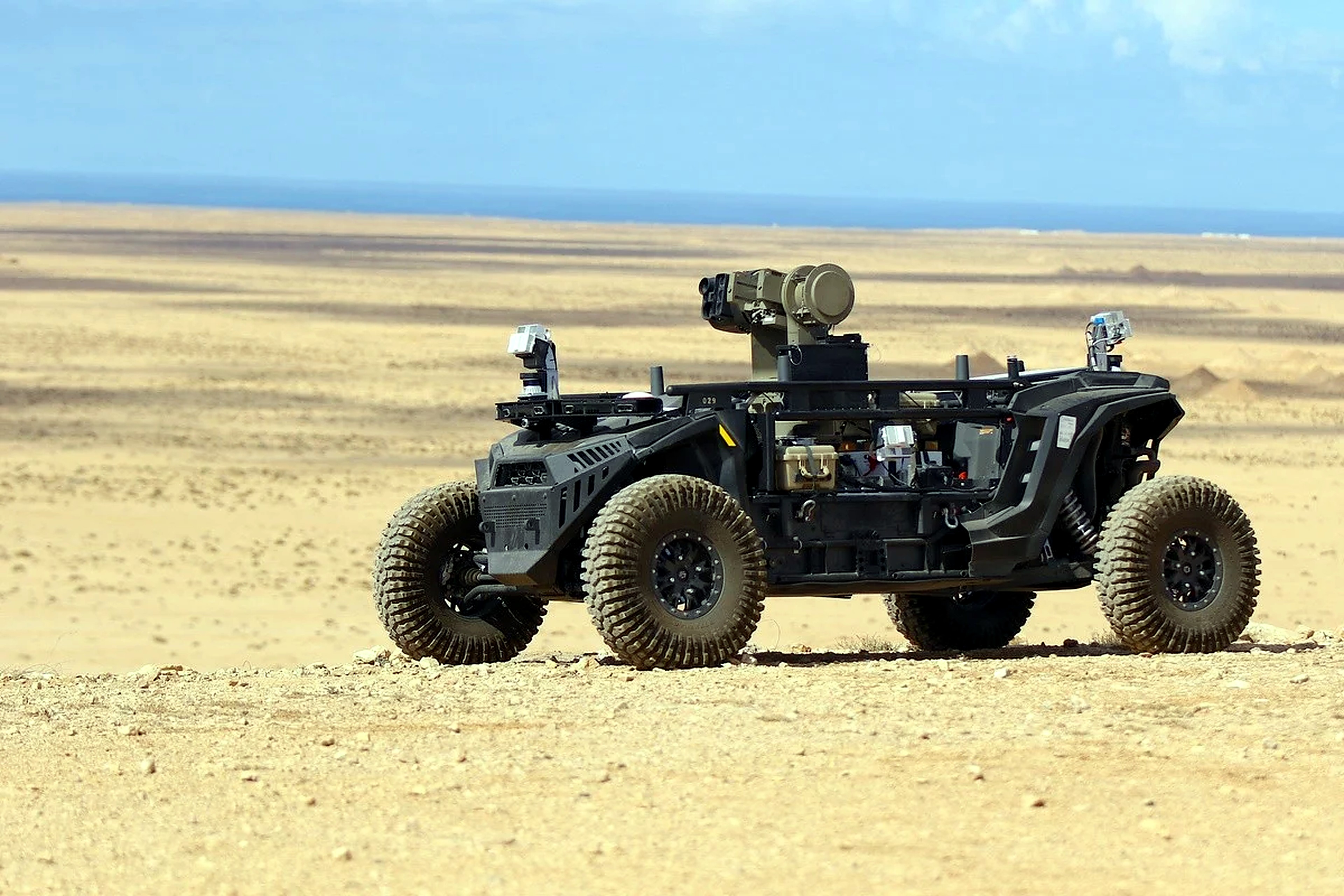
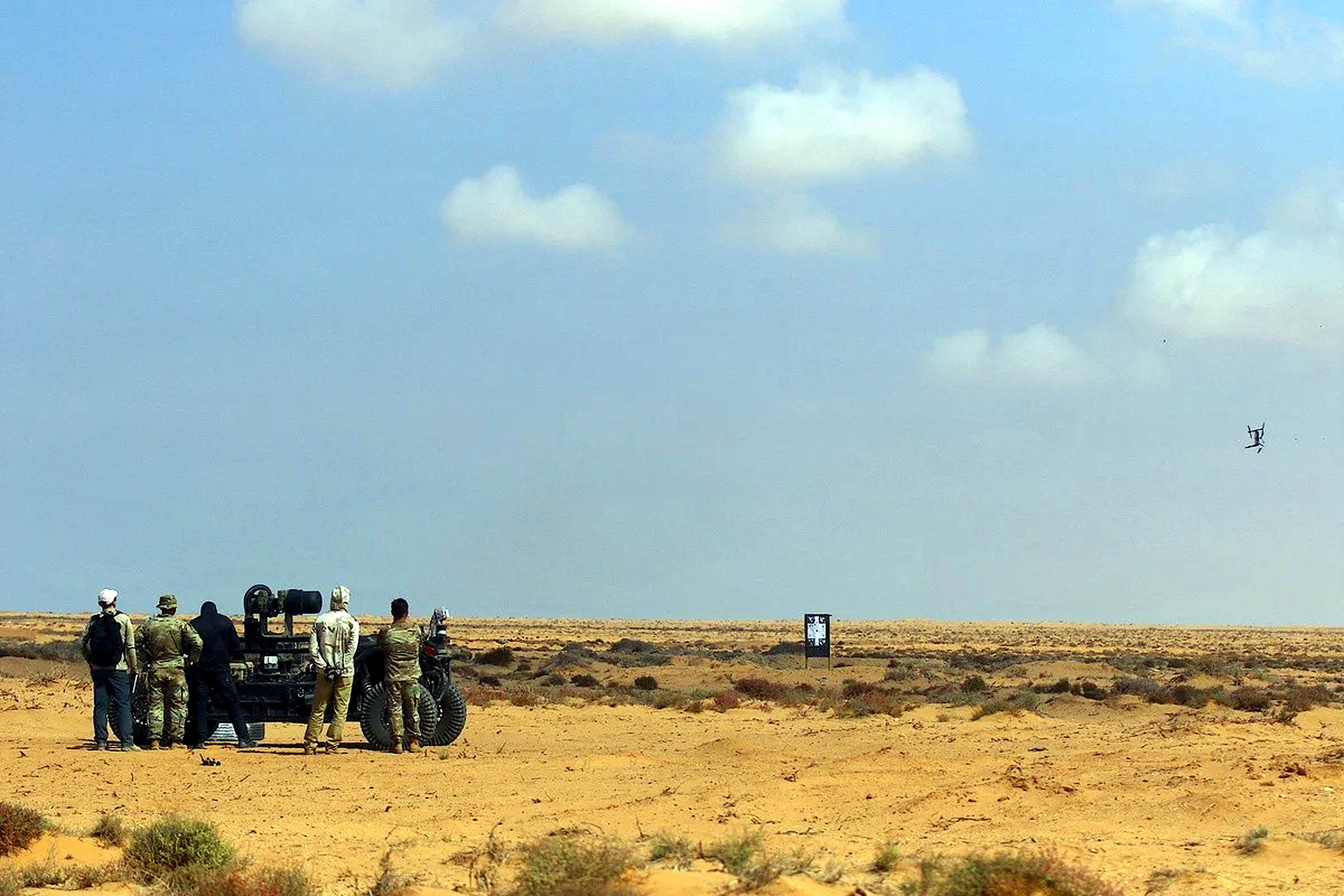
Small FireAnt unmanned ground vehicles (UGVs) dropped drone-detection sensors across the desert at Tan-Tan, Morocco, during a United States Army counter-drone evaluation held with Moroccan forces from 3 to 14 October 2026. The robots, built by the American firm Swarmbotics AI, were among the systems tested at the Needs-Driven Acquisition for Near-Term Operations Accelerated Capability event, known as NANO ACE II, at the Moroccan Multidomain Training Area.
The US Army said on 19 November that American and Moroccan soldiers worked with more than 10 US defence companies to test unmanned ground vehicles fitted with counter-unmanned aircraft systems (C-UAS). The Army did not name the products, but photographs it released allowed The War Zone (TWZ) to identify the FireAnt carrying a rack of small ground sensors on 24 November.
A robot that plants its own sensor net
The FireAnt is a four-wheel-drive UGV weighing around 27 kg and measuring about 76 cm (30 inches) long, designed to be quickly reconfigured for electronic warfare, surveillance, reconnaissance or use as a one-way attack munition, and to operate in semi-autonomous swarms. At Tan-Tan it carried six ground sensors, three on each of two angled rails. Each sensor slides off the rail and stands on three small legs, with a spherical body and a slim antenna mast to pick up the radio signals or acoustic signature of an approaching drone, according to TWZ.
The idea is simple: send an expendable robot into an exposed forward area to lay a passive early-warning net, instead of sending soldiers. TWZ also spotted other sensor fits at the event, including a fixed acoustic array, disposable low-power radio frequency sensors called Maple Seeds and the FireFLY passive acoustic system. Swarmbotics has won the US Army’s xTech Overwatch competition, and soldiers of the 1st Cavalry Division have already launched FireAnt swarms from the side of an M2A4 Bradley infantry fighting vehicle in an earlier exercise, Tectonic reported.
Testing in rough terrain and a jammed spectrum
NANO ACE builds on the Army’s Jailbreak series and is jointly led by the Army’s chief technology officer and its Pathway for Innovation and Technology director, under the Army Acquisition Executive. Systems were judged on whether they could operate on their own over unimproved ground while surviving a contested electronic warfare environment. Preliminary trials took place at Yuma, Arizona, in September before the kit was flown into Agadir in early October.
Nine organisations took part, among them the Global Tactical Edge Acquisition Directorate, the Army Test and Evaluation Command, US Army Central, US Africa Command (AFRICOM), US Army Southern European Task Force, Africa (SETAF-AF) and an unnamed tactical division. “With the various organizations here, in one place we are able to test, evaluate, validate and procure, so we can put this capability in the hands of warfighters,” said Lieutenant Colonel Corbett Baxter.
Major Kyle Rau said the capability set could “save U.S. Soldiers effort, time and cognitive load” and “stop them from having to go into that kill zone.” Colonel Woodrow D. Miner said NANO ACE gives tactical units and industry “a series of events to stress test their systems, operate in a degraded and contested area, and find out what capabilities can be provided to senior military leaders on the battlefield.”
Tan-Tan becomes a testing ground
The event is the latest to use the Africa Multidomain Training and Experimentation Center (AMTEC), set up under a memorandum of understanding signed by the Royal Moroccan Armed Forces (FAR) and AFRICOM in Stuttgart on 13 July 2026. AMTEC has three parts: the multidomain training area, a drone academy and an innovation and experimentation centre. The Army says it is meant to exploit the region’s open electromagnetic spectrum, uncongested airspace and difficult terrain.
Tan-Tan has hosted a run of trials since then. In August, US and Moroccan forces carried out the first live-fire demonstration of a low-cost, long-range cruise missile at an expeditionary site near the town, and the area is a regular venue for the African Lion exercise, for which planning for the 2027 edition opened in Agadir in September. Each event gives Moroccan soldiers hands-on exposure to American prototypes before they reach US units.
Counter-Drone Lessons for Moroccan Forces
For the FAR, the timing is useful. Morocco now operates one of Africa’s largest drone fleets and buys from five foreign suppliers while building its own, and the same threat it fields is spreading among armed groups across the Sahel and the Maghreb, where FPV attack drones have turned up in seized arms caches. Cheap robots that can push a sensor screen forward without exposing troops address exactly the gap African forces face against small drones, which conventional air defence radars struggle to see. The US Army has not said which NANO ACE II systems will move towards procurement, but its own release stresses that the point of holding the test in Morocco was to decide quickly what goes into soldiers’ hands.