
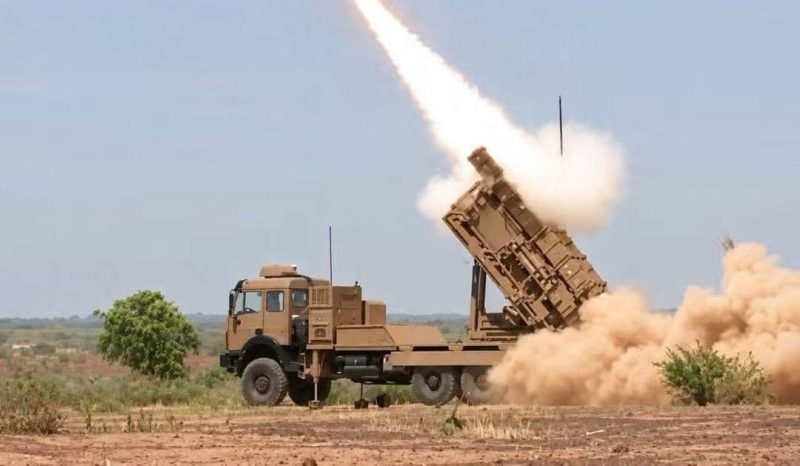
Burkina Faso has brought the Chinese Sky Dragon 30 short-range surface-to-air missile system into service with its National Armed Forces (FAN, Forces Armées Nationales), according to an identification by Janes reported by DefenceWeb on 17 September 2026. The system, built by China North Industries Corporation (Norinco), first appeared in video footage released by the Burkinabe presidency on 1 September, which showed a live missile firing. It is the country’s first public demonstration of a radar-supported air defence capability.
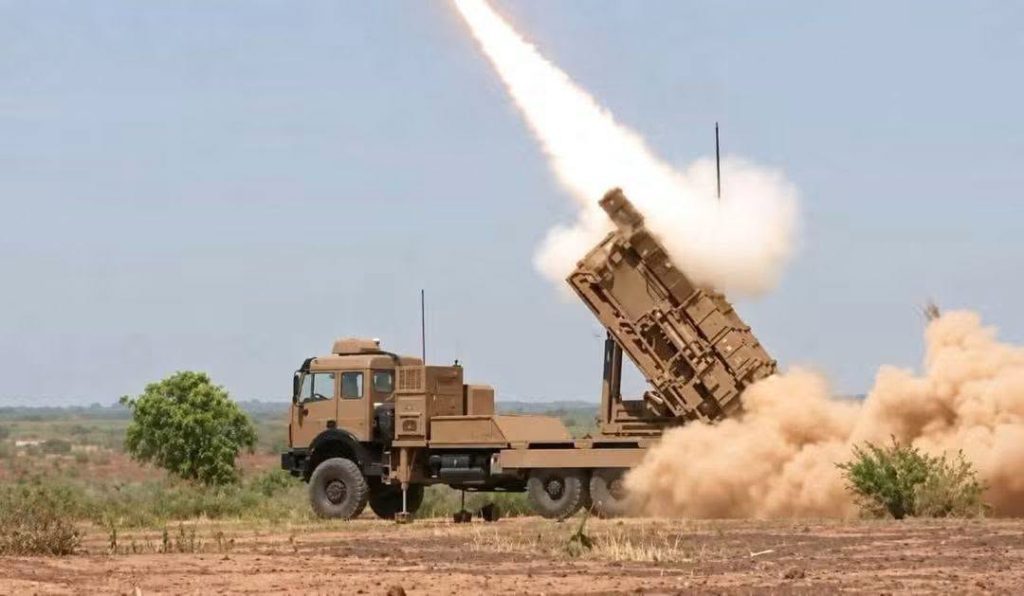
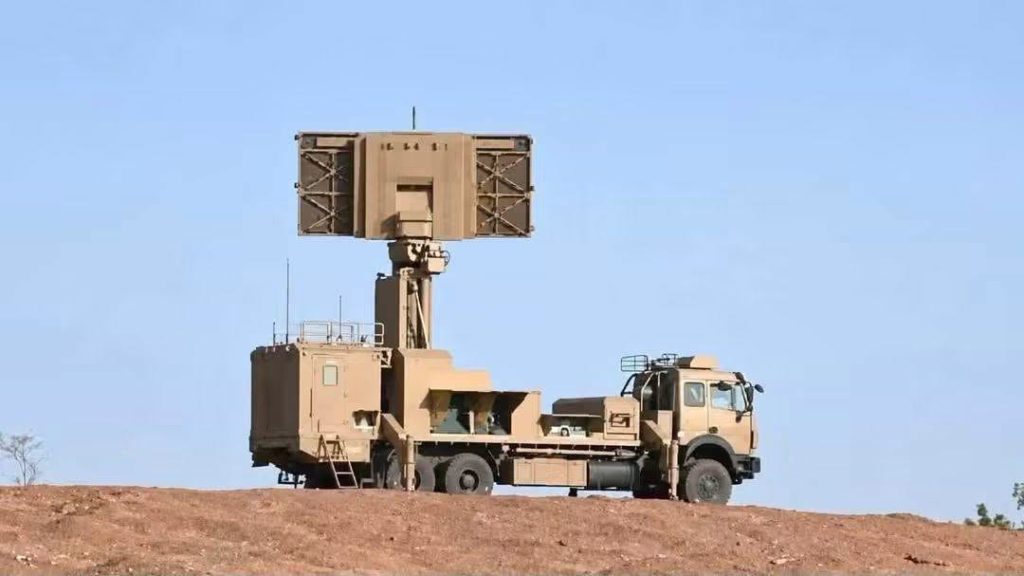
The footage forms part of a series marking the fourth anniversary of Captain Ibrahim Traoré’s time in power. It shows a mobile air-surveillance radar with its antenna rotating, three soldiers monitoring screens inside a command shelter, and a wheeled launcher firing a missile from one of two visible canisters. Major General Célestin Simporé, Burkina Faso’s Minister of State for War and Patriotic Defence, said in the video that recent acquisitions included surface-to-air artillery, without naming a specific system, in line with the government’s general practice of withholding equipment details in its public releases.
Sky Dragon 30, Not Sky Dragon 50
When Military Africa first reported the test in early September, the variant was disputed. Some early social media analysis identified it as the medium-range Sky Dragon 50, built around the DK-10A missile, while other observers argued the canisters matched the smaller Sky Dragon 30, although the launcher differs slightly from the version Norinco displayed at Airshow China in Zhuhai in 2022. Janes has since assessed the system as the Sky Dragon 30, settling the question in favour of the lighter system.
At its 2022 Zhuhai debut, the Sky Dragon 30 missile appeared to be the front end of the PL-10E infrared-guided air-to-air missile mated to a larger rocket motor, according to Janes. A Norinco brochure at the show gave a maximum range of 30 kilometres, a maximum engagement altitude of 18 kilometres and the ability to engage up to 12 targets at once, and described the system as a low-maintenance, short-range point defence weapon aimed at export customers. Chinese state broadcaster CCTV reported in 2018 that the same launch vehicle could also fire the Sky Dragon 50 missile, which has a range of about 50 kilometres, so the launcher leaves Burkina Faso a possible route to longer reach later.
The difference between the two is more than a label. A Sky Dragon 30 launcher typically carries six ready-to-fire canisters and relies on an infrared seeker. The Sky Dragon 50 uses DK-10A missiles adapted from the PL-12 active radar-guided air-to-air missile; they are large enough that a standard 6×6 truck carries only four canisters. A full Sky Dragon 50 battery pairs an IBIS-150 or IBIS-200 S-band radar with its launchers and can track 144 threats and guide 12 missiles onto separate targets, a more capable and more expensive system. Janes has not said how many Sky Dragon 30 units Burkina Faso has received or when they entered service, and the exact missile variant fired in the 2026 footage has not been confirmed.
Filling a Capability Gap
The acquisition addresses a gap in Burkina Faso’s order of battle. Until now, FAN air defence has consisted of close-range weapons: Soviet-era 9K32 Strela-2 man-portable air defence systems and towed anti-aircraft guns including the ZPU-2 and American-supplied TCM-20, none of which offer radar-cued detection or engagement beyond visual range. A mobile, radar-linked launcher gives the FAN its first organic means of detecting and engaging aircraft or drones before they come into sight, and can cover convoys, bases or contested roads without fixed installations.
The gap stands out against Burkina Faso’s own drone fleet, which has grown in the same period. The country’s five Bayraktar TB2 combat drones, acquired in spring 2022 at a reported 4.5 million euros each under then-transitional leader Lieutenant Colonel Paul-Henri Sandaogo Damiba, have since roughly tripled in number, and Burkina Faso has added the larger, twin-engine Bayraktar Akinci, which can carry close to a tonne of ordnance. Until the September video, a force that had spent several years building offensive drone capability had no organic way to detect or engage an equivalent threat, whether from a state or from the small reconnaissance and improvised-strike drones that armed groups across the Sahel increasingly use.
Part of a Larger Rearmament
The Sky Dragon 30 extends a run of Chinese deliveries to Ouagadougou under the modernisation plan Traoré outlined on 31 December 2023, and most of the other Norinco equipment in the anniversary video has been seen in the country since January 2024. The first delivery, unveiled in January 2024, brought six Norinco WMA301 105mm fire-support vehicles and at least eight CS/SM1 81mm self-propelled mortars on EQ2050 vehicles. A June 2024 shipment of about 100 armoured vehicles included 50 CS/VP14 and at least 40 VP11 mine-resistant, ambush-protected (MRAP) vehicles, alongside 17 Caterpillar excavators. Deliveries through the port of Tema in neighbouring Ghana later in 2024 added around 25 VN22 6×6 armoured vehicles, CS/VN9 armoured personnel carriers and Shacman trucks and tankers. Stockholm International Peace Research Institute (SIPRI) data for 2024 records 16 VN22s, 10 WZ-551 armoured personnel carriers and six Assaulter fire-support vehicles from China.
A 10 October 2025 handover gave the Rapid Intervention Field Artillery Battalion (BACIR) and Rapid Intervention Armoured Battalion (BBIR) six VN22B 105mm fire-support vehicles, four SR5 multiple rocket launchers with two resupply vehicles, six SM6/WMA09 120mm self-propelled mortars and two WZ551-based command vehicles, with DongFeng EQ2050 Mengshi vehicles also on show. Janes reported probable deliveries of 14 SH1 122mm self-propelled howitzers, at least 16 towed howitzers that may be second-hand Soviet M-30s or Chinese Type 54s, and at least 10 Shaanxi trucks. The FAN has also taken Egyptian-built Temsah 6×6 vehicles and Fahd armoured ambulances, GAZ 3308 Sadco and KrAZ-6322 trucks, and South African-built Paramount Mbombe 4 vehicles fitted with machine-gun turrets, which appeared in social media video in October 2025.
The buildup is a response to an insurgency that has made Burkina Faso the epicentre of militant Islamist violence in the Sahel for five years. Jama’at Nusrat al-Islam wal-Muslimin (JNIM) and Islamic State-linked fighters rely on mobility and hit-and-run raids, and control an estimated 40 per cent of national territory according to earlier Military Africa reporting. None of the earlier hardware addressed aerial threats.
Norinco’s Growing Sahel Footprint
Burkina Faso’s move to Chinese air defence fits a wider realignment in its neighbourhood. Mali and Niger, its partners in the Alliance of Sahel States (AES), have deepened defence ties with China and Russia as Western security cooperation has receded, and Mali signed a defence agreement with Norinco in 2024 covering equipment, training and technology transfer. Norinco now has sales offices in at least four African countries, according to the South China Morning Post. Rwanda and Morocco have previously bought the Sky Dragon 50, according to Janes, giving the family an established African export record.
Separate reports through early 2026 pointed to Russian-origin air defence equipment also reaching Ouagadougou, but those claims remain unverified. The Sky Dragon 30 shown in the presidency’s video is the only air defence acquisition Burkina Faso has itself demonstrated on camera.

Why Cost Likely Shaped the Choice
Norinco markets the Sky Dragon family as cheaper than comparable Western or Russian systems, an appeal for a government with a defence budget reported at around $2.5 billion for 2025 while it fights an insurgency on several fronts. The Sky Dragon 30 is also simpler to crew and maintain than a full Sky Dragon 50 battery, a practical consideration for a force that has expanded rapidly since 2022 and is absorbing large volumes of new Chinese vehicles and artillery at the same time.
From Point Defence to a Layered Shield over Ouagadougou
The Janes identification answers the question this article first asked, but leaves others open: how many launchers Burkina Faso has received, which units operate them and whether the shared launch vehicle will later be armed with the longer-range Sky Dragon 50 missile. The live-fire demonstration is the government’s first acknowledgment that its air defences now extend beyond guns and shoulder-fired missiles, and Ouagadougou is likely to show the system again at future handover ceremonies under Traoré’s modernisation plan.