

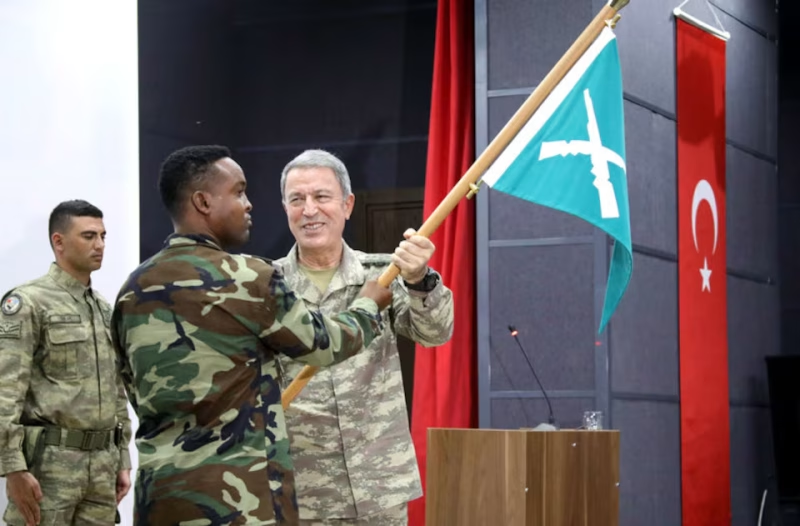
In the same year that African Union forces were due to hand Somalia responsibility for its own defence, Mogadishu’s defence ministry announced that Turkish military support had reached its highest level yet. Those two facts do not sit comfortably together. A decade of capacity building was meant to end in self-reliance. It has instead produced a force that needs its partner more, not less, at the precise moment the scaffolding is removed.
For many years, Turkey has been positioning itself as a security partner for Africa, developing a compelling brand, capable systems, no political conditions, and a promise of joint capacity building that distinguishes Ankara from both Western suppliers and Chinese/Russian alternatives. Somalia is where that brand has been deployed most fully. Humanitarian support in Somalia in 2011 paved the way for long-term infrastructure deals, and by 2017 the establishment of TURKSOM, Turkey’s military training academy in Mogadishu, shifted the focus to building Somali forces.
Ankara frames its engagement as an equal partnership, a win-win, in the language of its own institutions and pro-Turkey commentary. The record on the ground is more complicated.
Most coverage of Turkey-Africa defence ties focuses on the TB2 combat record or Turkey’s geopolitical positioning. This piece asks the question African defence ministries actually need answered: does the capacity-building component deliver autonomous capability, or does it produce well-equipped units that remain functionally dependent on Turkish support, finance, and political goodwill? Somalia is the stress test. Morocco is the emerging contrast case.
In July 2026, as NATO convened in Ankara, the question of what the Turkish model actually builds is one the alliance itself has reason to ask.
Anatomy of the Turkish model
At the Bamako International Defence and Security Exhibition (BAMEX) in November 2025, around 30 Turkish companies, including Aselsan and Otokar, displayed integrated defence solutions under the Presidency of Defence Industries (SSB) supervision, with live field-testing in the Sahelian environment, all under the supervision of the Presidency of Defence Industries (SSB). The SSB is the authority responsible for Turkey’s indigenous defence technology, procurement, and international partnerships, overseeing a portfolio reported of over $76 billion. BAMEX is just the Turkey pitch made visible; Turkey is no longer selling individual platforms; it is marketing a complete security ecosystem to African nations.
Platform and weapon sales are an important component of Turkey’s engagement model on the continent; since 2021, African states, including Libya, Ethiopia, Angola, Somalia, Djibouti, Mali, Burkina Faso, Niger, and Nigeria, have acquired Turkish-made Bayraktar combat drones (TB2). According to a TRENDS Research & Advisory study of Turkish defence sales in Sub-Saharan Africa, Ankara has rapidly expanded its security footprint on the continent, while separate trade data show that Turkish defence and aerospace exports to Africa surged from around 83 million dollars in 2020 to over 460 million dollars in 2021, more than a fivefold increase.
The model has four major components: Platform sales (TB2, Akinci, HÜRKUŞ, and armoured vehicles); Military training (in-country and in Turkey); Basing and troop presence; and Economic integration (ports, construction, and the TIKA development agency). These are not separate tracks; they are deliberately layered. Each of these steps creates a dependency the next one capitalises on. The test of the model is not whether the components work in isolation, because each does. The test is what they produce when assembled in a state with little capacity of its own. Somalia is that test we can look to, where the assembly is done in full.

Somalia: the stress test
TURKSOM is Turkey’s most complete deployment of the model: officially operational since September 2017, covering 400 hectares and serving as Turkey’s largest overseas military base, with Turkish forces contributing to organisation, education, military infrastructure, logistics improvement, and educational support. Turkey has trained up to 16,000 troops and, alongside the United States, has conducted drone strikes against al-Shabaab, with dozens of strikes reported since late 2022. Ankara also plays an important role in training the Haramcad paramilitary unit and the Gorgor commando brigade, one of two major elite units in the Somali National Army, the other being the US-trained Danab brigade.
Turkey has trained more than 6,000 Gorgor personnel since 2017. However, as of March 2024, reporting by The Somali Digest, later cited in a West Point assessment, found that over 1,300 Turkish-trained Gorgor troops had deserted their units during recent offensive operations, while several hundred had been killed, including several battalion commanders. It is important to note that this is not a Turkish failure in isolation; it is a system design problem.
The Gorgor brigade, primarily suited to special operations raids, has been used to clear territory and, at times, to serve as holding forces, making these units sitting ducks for al-Shabaab attacks. The strength of the Turkish-trained Gorgor forces is also contingent on Turkey continuing its support; in comparison, similar US-supported special forces in Afghanistan were overused, worn out, and eventually destroyed as the US withdrew.
This flaw isn’t just theoretical. In April 2025, al-Shabaab retook Adan Yabaal, a town government forces had held since 2022 and a logistics hub barely 220 kilometres from the capital. One key reason is that units trained to raid had been left to hold the ground, and when the militants pushed, the ground was ceded. The pattern you would predict from the design is the pattern that played out.
Ankara’s response told its own story. In 2025 it deployed roughly 500 additional troops, including commandos and drone operators, nearly tripling its contingent from about 400 to 800, against a parliamentary authorization of up to 2,500. A partnership sold as capacity building had reached the point where the trainer sent its own soldiers to do the holding that its trainees could not. The line between training a Somali army and fighting Somalia’s war had been blurred and slowly worn away.
While Turkish official bodies like the SSB present the partnership with Somalia as an equal, demand‑driven relationship, Somali analysts at the Heritage Institute describe it as a “new brand of humanitarian diplomacy” whose uniqueness lies precisely in bundling military training, infrastructure, and control of strategic assets such as Mogadishu’s port and airport. That bundling has generated domestic criticism that Ankara is too Mogadishu‑centric, i.e., too aligned with federal elites, which already sits uneasily with the language of symmetric partnership.
The bundling gets tighter with every passing day. Turkey and Somalia signed a Defence and Economic Cooperation Framework Agreement on 8 February 2024, a ten-year deal under which Turkey will build, train, and equip the Somali navy. A hydrocarbons agreement followed on 7 March 2024, and in July 2024 the Turkish state petroleum company and the Somali Petroleum Authority signed an exploration and production agreement.
A December 2025 fisheries pact placed licensing across Somalia’s entire exclusive economic zone under a joint company linked to a Turkish military entity. The structure folds back on itself: the navy Turkey is building exists, in part, to protect the waters where Turkey’s own survey vessel hunts for oil. Mogadishu pays in sovereignty for a capability it does not yet command, and the asset it defends belongs, in revenue terms, substantially to its patron.
Morocco: the same supplier, a different outcome.
Morocco actually started at a similar position to Somalia: it bought the drones from Turkey. In April 2021, Rabat ordered thirteen Bayraktar TB2s for about $70 million, with deliveries beginning that September. Though the platform was identical, what Morocco did next was not.
In December 2024, Baykar registered a Moroccan subsidiary, Atlas Defence, partly because Moroccan rules require foreign firms to establish a local entity before they may service equipment on Moroccan soil. The plant at Benslimane sits beside the Royal Air Force logistics base, in the same industrial zone where Lockheed Martin maintains Morocco’s F-16 and C-130 fleet, and is expected to be operational in 2026. Morocco used regulation as leverage. Somalia has no such leverage to exert, and exerts none.
The bigger difference is that Morocco refuses to be monogamous. Alongside the Turkish facility, it has contracted an Israeli firm, BlueBird Aero Systems, for a drone factory, and India’s TATA group for an armoured-vehicle plant, against a projected 2026 defence budget of $15.7 billion, up almost a fifth, and two new industrial zones for local production. A buyer with many suppliers extracts terms from each. A buyer with one partner, like Somalia, takes what the partner offers.
This glaring contrast should not be overdrawn. Reporting diverges on whether Atlas Defence is genuine co-production or a maintenance-and-spares operation dressed as industrialisation, and the subsidiary’s modest capitalisation invites scepticism. Even Morocco’s leverage may buy less than the announcements promise. The point is not that Rabat has achieved autonomy. It is that Rabat began with the state capacity to bargain for it, and Mogadishu did not.
There is a final irony the Ankara summit makes hard to miss. When NATO leaders meet at the presidential complex on 7 and 8 July 2026, the host will be the alliance member running the most active African defence portfolio of any of them, and running it on its own national account rather than NATO’s. Turkey’s pitch to African states is precisely that it offers NATO-grade equipment without NATO-grade conditions: the drones are interoperable and combat-proven, the training follows a Western template, but the human-rights clauses, basing demands, and alignment expectations that France and the United States attach are stripped out.
Nowhere is that clearer than in the Sahel, where Mali, Burkina Faso, and Niger have expelled French forces and welcomed Turkish drones precisely because they do not arrive as NATO. A member of the Western alliance has built its African business by selling itself as the alternative to it.
Conclusion: The day the trainers leave
The Turkish model does not fail Somalia. It succeeds on the terms it sets for itself, and that is the problem. It sells platforms, trains units, builds bases, and locks in the economic agreements that follow, yet at no stage does it transfer the one capability a state needs to stand on its own: institutions that can plan, fund, and regenerate a force without a foreign hand on the supply line.
This pattern is not unique to Ankara. The United States built the Danab brigade and then held it together with American salaries, weapons, and mentorship, producing a force that remained tied to external decisions about tempo and withdrawal. Both partners deliver tactical competence and battlefield effects. Neither delivers institutional autonomy. Morocco avoids the Somali outcome not because Turkey treats Rabat differently, but because Morocco brings leverage, functioning institutions, alternative suppliers, and a defence budget that can underwrite domestic industry.
The lesson is that capacity building, on the evidence so far, does not create capacity out of nothing. It amplifies what already exists. Where there is already planning discipline, procurement rules, and bargaining power, the partnership can look like the brochure: interoperable systems, localised support, and some degree of co-production. Where those foundations are thin, it looks like Somalia: a better-equipped dependence, marketed as a path to sovereignty.
African defence ministries therefore need to treat Turkish offers and Western or Gulf counterparts less as turnkey solutions and more as stress tests for their own institutions. The question is not only whether the drones fly or the brigades fight. It is whether any of the critical functions associated with those systems migrate into local control. Who owns the production line, the logistics data, the maintenance schedules, and the licensing rights? Who can pay, promote, and replace units when the foreign trainers, financiers, and survey vessels depart?
On the day the trainers leave, what remains is whatever the state has built for itself. The Turkish model multiplies that baseline. The choice for African governments is whether to invest first in the institutions that make that multiplication worth having, or to settle for a temporary upgrade that leaves the supply line, and much of the sovereignty, in someone else’s hands.