

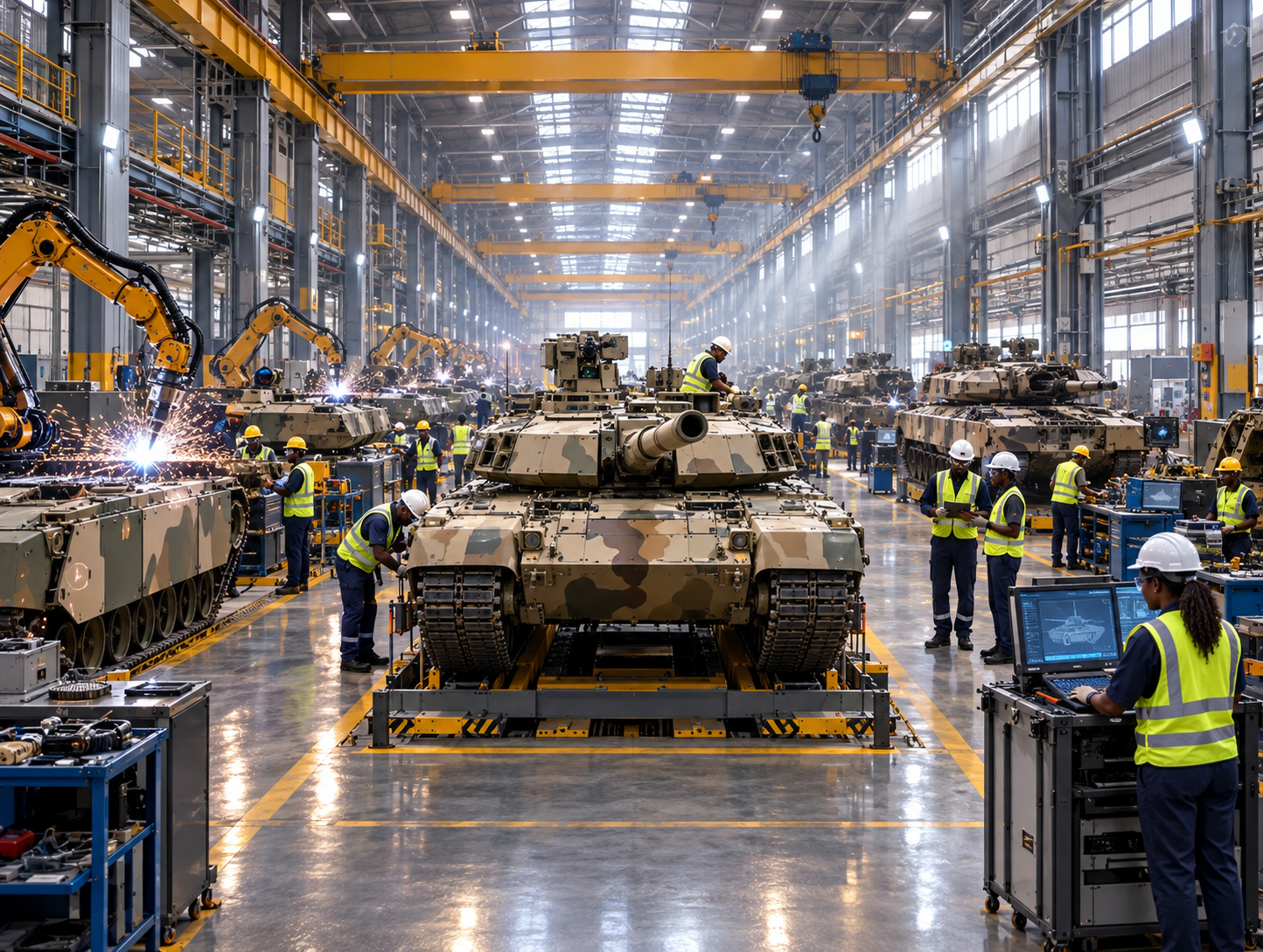
At the height of some of the most consequential military campaigns the Nigerian Air Force had against Boko Haram in 2016, some of Nigeria’s Franco-German Alpha Jet aircraft, acquired decades earlier, were close to being grounded in the middle of the war. The reason for this was not a missing missile or a failed engine; it was something as mundane as a brake assembly. Combat aircraft central to the counter-insurgency campaign were about to become unusable because we didn’t have the capacity internally to manufacture the required brake assemblies. This may seem shocking to many, but it is a normal occurrence for many countries that rely on external military equipment and support and are not conscious about building internal capacity, which in turn builds sovereignty.
The solution to this dilemma for the Nigerian Air Force did not arrive in the form of another multibillion-dollar aircraft purchase, a foreign military package, or a televised arms delivery. It came quietly through Innoson Vehicle Manufacturing; the Nigerian company was brought in to adapt and overhaul brake assemblies, including work associated with the MB-339 brake system, helping return Alpha Jets to service. It was a small industrial intervention with a large strategic meaning: a locally available solution helped restore combat availability where foreign dependency had created a vulnerability.
A fighter aircraft, even when purchased fully and handed over, is not sovereign simply because a government owns it. Without the ability to repair, sustain and adapt it, the platform remains only as useful as the supply chain behind it.
According to SIPRI, military expenditure across Africa is rising: $58.2 billion in 2025, up 8.5 percent in one year and 45 percent since 2016. Conflicts are also becoming more technologically intensive, and governments are acquiring drones, attack helicopters, surveillance systems and precision munitions from an expanding range of suppliers. At the same time, African firms are beginning to manufacture airframes, batteries, vehicles, components and autonomous systems.
Yet the most consequential parts of military power are often the least visible: the sensors, encryption keys, software, datalinks, munitions, technical documentation, spare parts and maintenance approvals that determine whether a weapon can actually operate.
Nigeria’s Alpha Jet episode exposes a distinction that is becoming more urgent across African defense: possessing a platform is not the same as controlling the capability it represents. A state may own an aircraft, drone or helicopter, but still depend on outsiders for the parts, software, encryption, sensors, maintenance approvals, munitions and export permissions that make it operational.
Africa is buying more weapons and beginning to make some of them. The harder question is where the decisive bottlenecks sit, and who has the power to close them.
Africa as a combat market, not simply an arms market
Africa’s wars are no longer only places where weapons are used. They are increasingly places where the value, credibility and consequences of modern military systems are established in real time. Take Sudan: Al Jazeera’s analysis of ACLED data recorded more than 1,000 drone attacks from April 2023 to January 2026, devastating & displacing the civilian population, showing how quickly externally supplied drone capability has become central to the conflict.
In 2025, Amnesty International identified China’s GB50A guided bomb in Sudan, describing it as the weapon’s first documented use in an active conflict. The Sudanese Armed Forces have used Turkish and Iranian systems, while the Rapid Support Forces have obtained increasingly sophisticated Chinese-origin weapons and drones through external supply networks; Sudan is therefore not only a civil war. It is an arena in which networked, externally supplied military technologies are being operationalized and assessed.
The Sahel reveals a related shift. Burkina Faso acquired Turkish Bayraktar TB2 drones for counterinsurgency operations, while Human Rights Watch documented civilian deaths from several strikes in 2023. At the same time, armed groups are using commercial quadcopters, modified first-person-view drones and improvised munitions for reconnaissance, propaganda and attack. The barrier to launching an aerial strike has fallen, but the institutions required to use force responsibly, accurately and accountably have not kept pace.
A drone that performs in Sudan or the Sahel does more than alter a battlefield. It produces operational evidence, commercial visibility and demand from governments confronting similar threats. But battlefield visibility should not be mistaken for sovereign capability. The strategic question is not merely whether an African state can buy, fly or assemble a drone. It is whether it can sustain, modify, arm, secure and operate it when a supplier, software vendor or export-control authority no longer agrees.
The platform is only the visible layer of military power
A drone operator may sit in Abuja, Bamako or Khartoum while directing an aircraft hundreds of kilometers away. That control depends on a datalink carrying commands to the platform and imagery back to the operator. If that link is insecure, unavailable, or hacked by a third party, the operator may be holding the controls at that moment without truly owning the system; at any point, his operations may be compromised or even undermined. A country should always ask itself: Who owns encryption keys? Can the military change mission software? Can our engineers connect a different camera, local radio, or new weapon systems? Does the supplier control updates or diagnostic access? Where is mission data stored, and are we the only ones with access? Because it is increasingly becoming obvious that in the digital age, sovereignty is the right to control & debug your own weapon.
When a country does a military parade, people mistake the visible layer – weapons and machinery – as the most important layer of their defense platforms, but it truly isn’t; it is only the visible layer of their military strength, easier to photograph for propaganda and also the easiest layer to buy. But these platforms are only the outer shell. Its real power sits in less visible places: the camera that finds a target at night, the encrypted link that carries orders, the software that controls its mission, the foreign factory that makes a replacement part, and the government that can approve or deny its export. To put simply, a country may own the machine while somebody else controls its eyes, voice, brain, ammunition, or heartbeat.
Türkiye’s Bayraktar TB2 has become a symbol of an indigenous drone industry, but it also demonstrated the vulnerability of the supply chain beneath its airframe. In 2020, Canada suspended export permits connected to military goods and technology for Türkiye after allegations that Canadian-made sensors had been fitted to Azerbaijani drones in the Nagorno-Karabakh war. After its review, Canada canceled permits after saying the use of the technology was inconsistent with Canadian foreign policy and Türkiye’s end-use assurances. Canada’s report did not present the matter as a simple, conclusively proven case of diversion; it said the available information could be interpreted as inconsistent with those assurances.
The more important lesson is what happened next. Türkiye moved to integrate ASELSAN’s domestically developed CATS electro-optical system into TB2 deliveries, reducing its exposure at that particular bottleneck. Dependency, then, is not permanent. It can trigger substitution, investment, and learning. The question for African defense industries is whether local production is reducing dependence at similarly critical points, or merely relocating final assembly.
Even when a platform is assembled in Africa, the chain of permission may still pass through several capitals: the country that licenses the engine, the company that supplies the sensor, the owner of the software, the satellite provider carrying the signal, and the state that regulates a critical material or component.
Military sovereignty is not a purchase receipt; it is the degree to which a state controls, or has reliable alternatives for, the decisive parts of its capability chain: the platform, sensors and software, communications and data links, munitions, sustainment, technical data and political permission.
The point is not autarky, i.e complete self-sufficiency with zero need for external trade. No modern military makes or controls everything it uses. The test is narrower and more demanding: where are the bottlenecks that could ground a fleet, disable a system, block an upgrade or halt a sale, and who has the power to close them?
Some of these dependencies are technical, embedded in software, sensors, intellectual property and engineering access. Others are contractual and political, embedded in maintenance agreements, export licenses and continuing supplier approval.
When ownership does not mean control
Control can also fail even when the technology itself is fully functional. Maintenance contracts, export permissions and supplier support can determine whether an owned platform remains operational. South Africa offers a particularly clear example.
South Africa possessed a world-class fighter force on paper. In practice, a break in the support chain made ownership of part of that force largely ceremonial. The country did not lose its Gripen fighter jets in combat. No enemy destroyed them on the runway. The country still owned them.
Yet in 2021, its Gripen fleet was grounded because support arrangements with Saab and GKN, the original airframe and engine manufacturers, had lapsed amid funding and contractual problems. Support was subsequently restored under new contracts, but the episode remains glaring: ownership does not guarantee operational availability.
A newer aircraft does not automatically guarantee a more sovereign capability. Nigeria’s A-29 Super Tucanos arrived through a United States Foreign Military Sale; that deal was never just about the twelve aircraft; it bundled munitions, training, spare parts, infrastructure, contractor logistics and maintenance support into one operating system. Then, in October 2024, the Nigerian Air Force had to engage the United States Office of Security Cooperation as the existing contract extension approached its end, seeking a seamless transition for maintenance and sustainability. The purchase was completed years earlier; the capability, however, remained an ongoing negotiation that ended up leaving our Military capability as a subscription that needs to be periodically renewed.
The dependency chain does not disappear when a country becomes an exporter. It can simply move deeper into the weapon. Nigeria operates Türkiye’s T129 ATAK attack helicopter, a platform marketed as part of Türkiye’s growing defense-industrial rise. But its CTS800 engine was developed by LHTEC, a joint venture involving Honeywell and Rolls-Royce. That meant export permissions tied to the engine, which incorporates US-controlled technology, became a strategic issue for Türkiye and potential export customers. In the exact same light, Pakistan’s proposed acquisition of 30 T129 helicopters was delayed for years because the required United States export license for the engines was not granted.
Nigeria could buy a Turkish helicopter, but the ability to manufacture and export that helicopter was still shaped partly by decisions beyond Türkiye. Supplier diversification matters, but it is not always independence. Sometimes dependency has simply been pushed deeper into the bill of materials.
Africa’s emerging defense manufacturers, including Paramount Group, DICON and Terra, matter for more than the symbolism of local production. Their strategic value lies in whether they reduce reliance on the bottlenecks that determine operational availability, adaptation and political freedom of action. The degree of sovereignty lies not in how much of a weapon is manufactured locally, but in which decisive dependencies remain externally controlled.
African-made is not yet sovereign: manufacturing, procurement and the struggle for control
Africa has an emerging defense-industrial base, which changes the equation for the continent because it can move expertise, production, maintenance and adoption closer to users, but a locally assembled platform is not automatically a sovereign capability; what makes the difference is control of critical bottlenecks and whether governments procure not only weapons but also the right skill, infrastructure, software, spare parts and long-term funding that makes the weapons usable and readily available. Dependency is often designed across international supply chains, but it is also reproduced by domestic procurement decisions, weak sustainment planning, and political preference for visible acquisitions over invisible readiness.
“African-made” is a great starting point; Terra closed its $52 million seed round in August 2026 after raising an additional $18 million in strategic funding. It has framed itself around autonomous systems and ArtemisOS, its AI-powered operating system; its significance is not that Nigeria has found a local company to print a Nigerian label on imported equipment. Its significance lies in whether the partnership can transfer control over the capabilities that determine availability, adaptation, and operational independence.
Terra illustrates both the promise and the limits of the new model. Its proposition combines autonomous systems with software through ArtemisOS, while its DICON partnership formally includes local production, R&D, training and technology transfer. That potentially moves more than final assembly into Nigeria: it could build a domestic base of engineers, maintainers, system integrators and users capable of adapting equipment to Nigerian conditions. But the strategic test remains unresolved. Can Nigerian personnel service the platform without external approval? Can they modify mission software, integrate another sensor, extend or modify, access diagnostics, retain critical mission data, and replace a restricted component? The answers reveal where localization ends, and meaningful control begins.
“African-made” should therefore be treated not as a marketing claim, but as an auditable supply-chain question, where important questions can be verified, such as: What share of the system is manufactured, designed, and tested locally? Who owns the IP and software? Which components require external export approval? Can Nigerian engineers independently repair, modify, and upgrade it? Can the country sustain production during a diplomatic rupture or supply interruption? The answers reveal where localization ends, and meaningful control begins.
South Africa offers the historical warning. It built one of the continent’s most substantial defense-industrial bases, Denel, with capabilities accumulated over decades; it was intended to preserve a sovereign defense-industrial base spanning artillery, ammunition, missile technologies, aerospace maintenance and design authority over locally developed systems. South Africa did not merely import defense equipment: through the industrial ecosystem Denel inherited and later managed, it developed indigenous competence in weapons production, aerospace support, testing and systems integration.
The problem, however, is that much of this capability has since been allowed to erode. Years of governance failures, particularly during the state-capture period, undermined Denel’s credibility with customers, suppliers and financiers, while skilled engineers, artisans and program managers departed and infrastructure aged. The consequence is larger than the decline of a state-owned company: it risks the loss of strategic skills, intellectual property and the local ability to maintain, upgrade and adapt critical defense systems without deeper dependence on foreign suppliers. The lesson is severe: sovereignty is not acquired once. It must be funded, staffed, ordered from, and continuously exercised.
Conclusion
A Nation’s defense vulnerability rarely arrives with a warning. It appears when a platform needs a part that cannot be sourced, when a weapon needs a software update its operator cannot access without external authorization or validation, when a weapons system cannot be modified without permission from a company or government thousands of kilometers away. In those moments, the difference between possessing military hardware and controlling military capability becomes impossible to ignore.
Africa’s defense future will not be decided only by the size of its procurement budgets or the number of platforms produced locally. It will be decided by whether its states can repair, adapt, secure, arm, and sustain the systems they depend on, on their own terms and when circumstances demand it.
No country can produce everything. But every country can identify the dependencies it cannot afford to lose. Until that becomes the measure of defense policy, Africa may continue to own the machines while others retain control over their limits.