

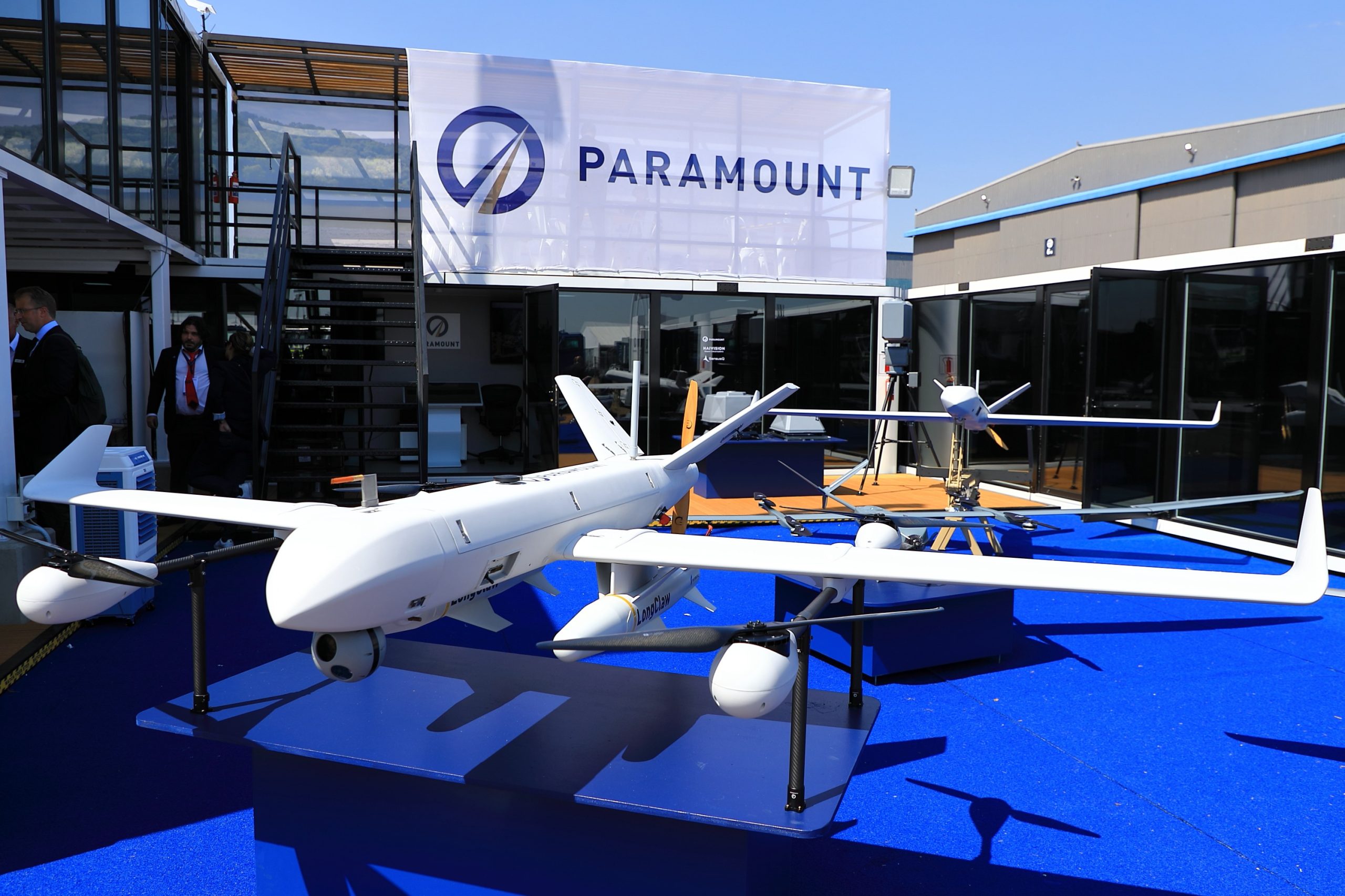
PRETORIA, Sept 19 — Paramount unveiled a new family of reusable unmanned aircraft called V-Raven at the Africa Aerospace and Defence exhibition (AAD 2026) on Saturday, the South African aerospace and defence company said, shifting a five-year-old loitering munition programme toward vertical take-off and landing (VTOL) aircraft designed to be flown and recovered repeatedly rather than expended in a single mission.
The aircraft is built for intelligence, surveillance and reconnaissance (ISR) work in the near term, with a light-attack version planned to follow once Paramount completes further systems integration and flight testing, the company said in a statement. It described V-Raven as an evolution of its N-Raven programme rather than an entirely new product line.
“The V-Raven has been developed for the realities of the modern African battlefield,” Sello Ntshiele of Paramount said in the statement. “Vast operating areas, remote terrain, dispersed threats and the increasing use of drones mean that forces need to be able to see further and stay on station longer.”
From Catapult to VTOL
Paramount first unveiled N-Raven in February 2021 at the International Defence Exhibition and Conference (IDEX) in Abu Dhabi, describing it then as a swarm-capable loitering munition weighing about 41 kilograms with a cruise speed of 180 kilometres per hour and roughly two hours of loiter time. That version launched by catapult from land, naval or airborne platforms and did not return; it was designed to strike its target and be expended in the process.
Paramount moved the programme into production two years later. At IDEX 2023, the company said manufacturing would begin that April with first deliveries in October, and then-Group Chief Executive Steve Griessel described the aircraft as addressing “governments for defence industrial autonomy and maintaining the security of supply.” Paramount later partnered with Greece’s Hellenic Defence Systems to produce a licensed variant called Irix, transferring technology so the Greek state company could manufacture the aircraft domestically for its own and export markets.
The shift toward VTOL recovery predates V-Raven’s unveiling. Paramount fielded a VTOL aircraft called Vulture earlier this year in a South African border security deployment alongside its Maatla armoured personnel carrier, a heavier ISR-focused platform with a 135-kilogram maximum take-off weight capable of carrying up to 30 kilograms of interchangeable sensors. That aircraft, like V-Raven, launches and lands without a runway or catapult, a capability Paramount said was needed for operations in mountainous or densely vegetated terrain along South Africa’s eastern border.
Specifications
Paramount said the petrol-powered version of V-Raven offers up to eight hours of endurance, a range of up to 1,200 kilometres and a cruise speed of approximately 140 kilometres per hour, with a communications range to its ground station of up to 150 kilometres. An electric configuration trades range and endurance for a quieter signature, offering up to two hours of endurance and a range of up to 250 kilometres.
The aircraft has a wingspan of 3.6 metres, a fuselage length of 2.1 metres and a maximum take-off weight of 65 kilograms, according to the company. The ISR configuration carries an electro-optical sensor system for day and night surveillance with automatic target tracking, and Paramount said the airframe can accommodate multiple electro-optical and infrared sensor options depending on mission requirements.
Ntshiele said the light-attack configuration shown at AAD 2026 illustrates how precision-guided glide munitions could eventually be integrated into the same airframe, but that this capability will be matured through what he called “a phased programme of systems integration, ground testing and flight trials” rather than delivered immediately. “It is a common aircraft architecture that can evolve as operational requirements develop,” he said. “The immediate focus is a highly capable ISR platform, while the family architecture provides a pathway towards additional mission configurations, including light attack.”
Prospects in loitering munition market
Paramount’s decision to keep developing loitering munition and ISR aircraft comes as the broader market for such systems has expanded sharply since Russia’s invasion of Ukraine. A market analysis Paramount cited in 2023 projected loitering munition spending would grow 525 percent between 2020 and 2024, with annual spending surpassing 600 million US dollars.
Neither V-Raven’s pricing nor a customer timeline was disclosed at the AAD 2026 unveiling. Paramount described V-Raven as forming part of its “expanding portfolio of aerospace and unmanned systems” aimed at both African and international markets, without naming specific prospective buyers.