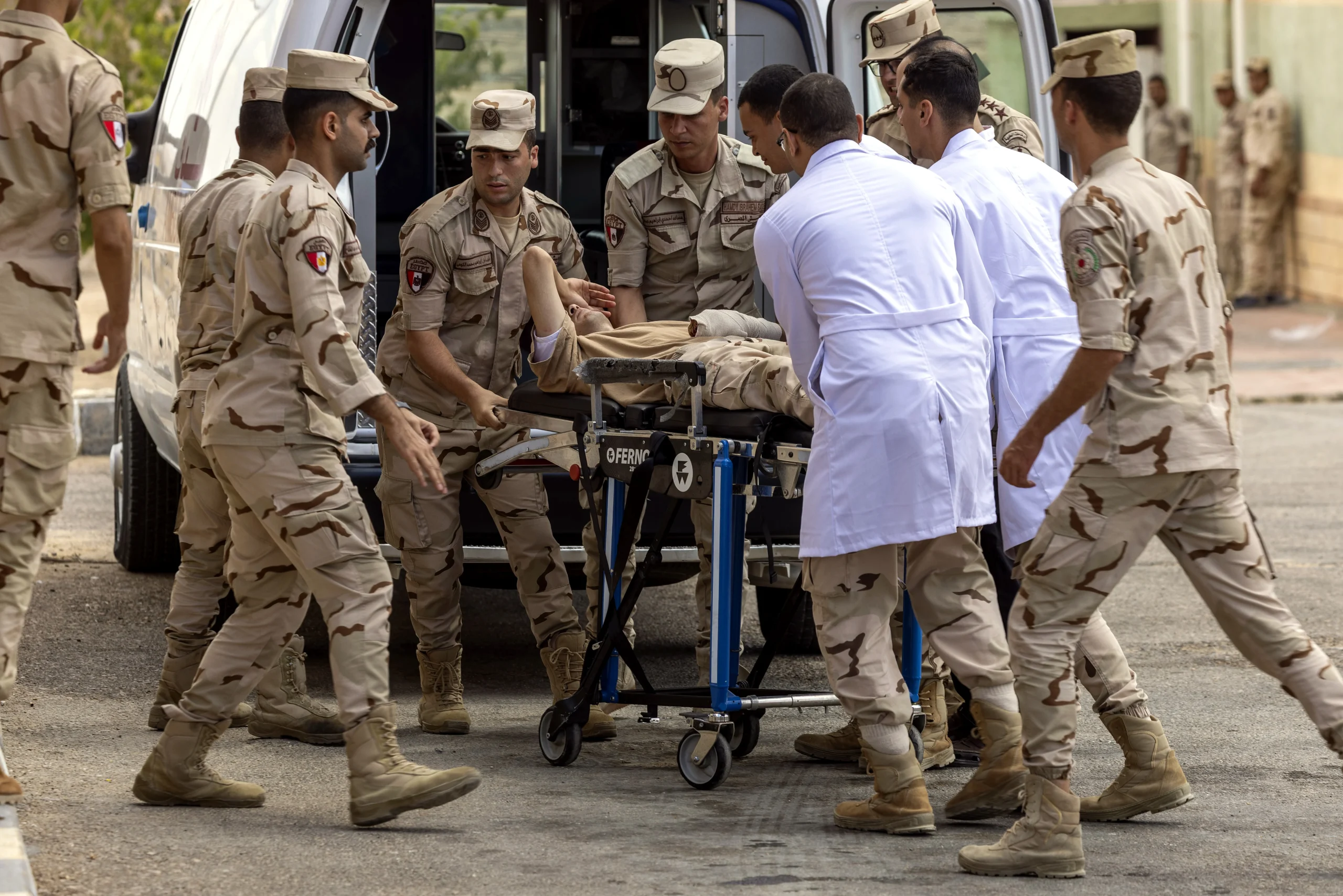
Two senior Egyptian border guard officers have been killed in Operation Southern Shield, the Egyptian armed forces’ campaign against illegal gold mining along the southern frontier with Sudan, the military announced last week. Sudan has opened its own inquiry into deaths among Sudanese miners near the border, Asharq Al-Awsat reported on 7 November.
Military spokesperson Colonel Ahmed Othman named the dead as Colonel Ahmed Samir, chief of staff of the Southern Region Border Guard Forces, and Lieutenant Colonel Ahmed Gouda, operations chief of a border guard battalion. He said they were killed in an exchange of fire with “criminal elements”. The military did not give a date for the clash, and The New Arab noted that a military funeral for Colonel Samir was held on 10 March 2026, before the first phase of the operation began, a discrepancy the army has not explained.
Four phases in the Eastern Desert
Southern Shield began on 14 June west of Marsa Alam and Jabal Eiqat. A second phase covered Wadi Dabour and al-Baramiya in the Eastern Desert, and a third, from 12 to 29 October, searched earlier target areas again. The army announced a fourth phase in early November, after dropping warning leaflets over mining areas.
The military describes illegal mining as “organised criminal activity that threatens national security and fuels arms, drug and human smuggling”. Mining camps in the rugged south use heavy machinery, four-wheel-drive vehicles and modern communications, and include armed Egyptians and foreign nationals. The army reports 691 arrests, 151 Egyptians and 540 foreigners, the seizure of 34 firearms, 6,307 rounds of ammunition and 4,488 tents and shelters, and the identification of 52 gatherings of armed groups inside Egypt. Since June it has also recorded 58 cases of unauthorised prospecting and seized 20 metal detectors, 118 generators and 86 tonnes of gold-bearing rock.
The army has acknowledged using armed drones to strike sites where it says armed men were present, based on intelligence and coordinates. That marks a step up from policing to military action along a border that Egypt has watched closely since war broke out in Sudan in April 2023.
Sudan’s inquiry and the civilian toll
The most contested incident came on 10 October, when strikes hit mining sites at North Wadi in Sudan’s Red Sea state. The Sudanese rights group Emergency Lawyers said 72 civilian miners were killed and blamed the Egyptian air force, while the Sudan Doctors Network reported 13 dead and 28 wounded. Egyptian responsibility has not been independently verified, and Cairo denies targeting civilians.
Sovereignty Council chairman General Abdel Fattah al-Burhan ordered a fact-finding committee on 12 October, made up of representatives of the Public Prosecution, the judiciary and the security agencies. The council has not accused Cairo directly, although Burhan’s adviser Amjad Farid called the incident an “unjustified and unacceptable crime”. On 21 October, eight Egyptian human rights groups called for an independent inquiry, arguing that an armed presence does not make sites with civilian workers lawful military targets.
A border shaped by Sudan’s war
Egyptian officers link the mining boom directly to the collapse of order across the frontier. Retired Major General Samir Farag told Asharq Al-Awsat that Sudan’s instability had weakened border security and let gangs smuggle weapons and drugs and mine gold illegally, while Major General Osama Kabeer said the trade threatens both national security and the economy, including gold reserves and antiquities. Sudanese miners, known locally as “dahaba”, have long worked the gold belt that straddles the border, and the war between the Sudanese Armed Forces and the Rapid Support Forces has pushed more people into the trade.
Cairo is the Sudanese army’s closest regional backer, and Egyptian authorities are reviewing detainees’ cases, deporting those not implicated in crimes and prosecuting those accused of sabotage and smuggling. Egypt has also been strengthening its southern posture more widely, from troop deployments towards Somalia to new purchases such as the 2,020 Javelin anti-tank missiles in an $832 million deal reported in October.
The fourth phase and the Khartoum relationship
The fourth phase of Southern Shield will test whether Egypt can clear the mining camps without further civilian deaths on either side of the border. The findings of Sudan’s fact-finding committee, and whether Sudan’s leadership chooses to publish them, will shape how far the operation strains relations between two governments that otherwise depend on each other in Sudan’s war.