

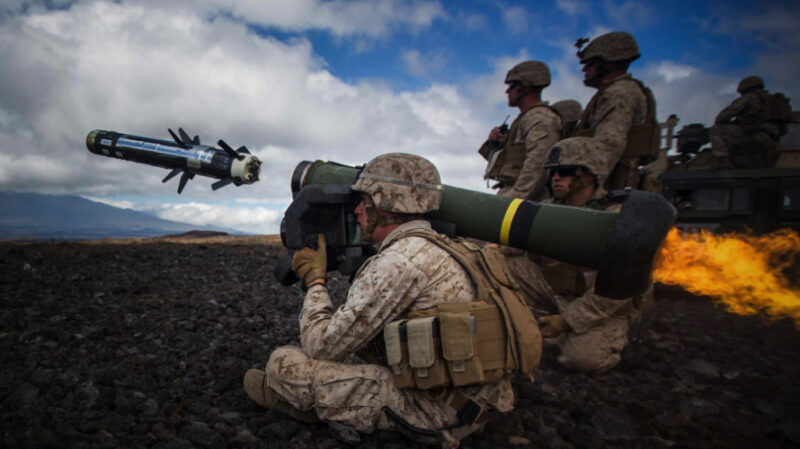
On October 2, 2026, the US State Department approved a possible $832 million Foreign Military Sale of Javelin anti-tank missiles to Egypt, marking Cairo’s first purchase of the system.
The Defense Security Cooperation Agency notification covers up to 2,020 Javelin FGM-148F missiles, including 20 “fly-to-buy” rounds for testing, and up to 200 Javelin Lightweight Command Launch Units (LWCLUs), the shoulder-fired sighting and firing systems used to cue and launch the missile. The package also includes a LWCLU basic skills trainer, missile simulation rounds, battery coolant units, spare parts, technical documentation, and training support from the US government.
Lockheed Martin of Orlando, Florida, and RTX Corporation of Arlington, Virginia, are identified as the principal contractors. Washington states that it is not aware of any offset arrangement at this stage; any such agreement would be negotiated separately between Cairo and the contractors. The sale requires approval from the US Congress before a formal contract can be concluded. Although this step is routine for Foreign Military Sales of this scale, it may take several months.
Notably, the Javelin notification was issued one day after the State Department lifted human-rights-related restrictions on $320 million in Foreign Military Financing for Egypt that had previously been withheld, according to a report by Army Recognition. The timing suggests that the missile sale is part of a broader easing of restrictions on security assistance to Cairo.
The State Department’s standard language concerning the case states that the sale would help “a friendly country that continues to be an important force for political stability and economic growth in the Middle East.” It adds that Egypt would have no difficulty incorporating the equipment into its armed forces and that the sale would not alter the region’s basic military balance.
The Javelin is a man-portable, fire-and-forget anti-tank guided missile developed for the US Army and Marine Corps by the Javelin Joint Venture, a partnership between Lockheed Martin and Raytheon, now RTX. Production began in 1994, and by 2021 more than 50,000 missiles had been delivered to US and international customers, according to DefenceWeb.
Once locked on, the missile guides itself to its target using automatic infrared guidance. This allows the gunner to move to cover immediately after firing, rather than maintaining a line of sight throughout the engagement. Its tandem high-explosive anti-tank warhead can strike armored vehicles from above, where their protection is thinnest. The system can also operate in a direct-attack mode against fortifications or slow-moving and hovering helicopters. A soft-launch mechanism allows the gunner to fire from inside buildings or confined positions, a feature relevant to urban and defensive operations. Flight time to a target two kilometers away is approximately 14 seconds.
Lockheed Martin delivered the first production FGM-148F, an upgraded variant with an improved seeker and software, in May 2020. Egypt would receive this version under the proposed deal.
The sale continues a pattern of Javelin exports across North Africa in recent years. Morocco received US approval in March 2024 for 612 FGM-148F missiles and 200 launch units, valued at approximately $260 million. Tunisia took delivery of a large batch of FGM-148F missiles in 2024 and, in 2025, secured a US Army contract extension worth $900.5 million, reinforcing its position among Javelin operators. At the time, the move was presented as part of efforts to modernize its ground forces amid regional instability.
For Egypt, the Javelin purchase complements a broader series of recent US arms approvals. Washington approved a possible $691 million sale of TOW 2A anti-tank missiles to Cairo in May 2022, authorized the AN/TPS-78 long-range radar system in 2025, and approved a $740 million Stinger air-defense missile package in 2024. In 2024, the State Department also moved to release $1.3 billion in military aid to Egypt that had been withheld over human-rights conditions. Taken together, these deals indicate a steady rebuilding of US-Egyptian defense ties following a period of tension.
Operationally, Javelin missiles would provide Egyptian infantry and mechanized units with a precision anti-armor capability independent of vehicle-mounted platforms. This capability could be useful for counterinsurgency operations in Sinai as well as conventional defense planning. The top-attack mode, in particular, addresses a capability gap against modern main battle tanks fielded by regional actors, whose frontal armor is substantially harder to penetrate than their turret roofs or engine decks.