Turkish defence electronics group ASELSAN showcased its KORKUT self-propelled air defence system at the Bamako International Defence and Security Exhibition (BAMEX 2026), which opened on 9 November at the Bamako Exhibitions Park (FEBAK) in Mali. The KORKUT is designed to provide short-range air defence against low-altitude aerial threats, including helicopters, aircraft and unmanned aerial vehicles (UAVs).
ASELSAN is part of a Turkish industrial delegation of more than 20 companies in Bamako, alongside Baykar, Roketsan and others, at a show that organisers expect to draw delegations from more than 40 African countries. Its stand paired the KORKUT with counter-drone jammers, tactical communications and vehicle-mounted weapon systems, with display boards printed in French for the francophone Sahel audience.
Twin 35mm guns and airburst ammunition
The KORKUT is a gun-based system built around a twin 35mm cannon, the Oerlikon KDC-02, produced under licence in Türkiye by MKE. A standard battery consists of one command and control vehicle and three weapon system vehicles. The command vehicle carries a three-dimensional search radar that builds the air picture and assigns targets, with a reported detection range of around 70 kilometres, while each weapon vehicle has its own fire control radar and electro-optical sensor for automatic target tracking.
Each pair of guns fires up to 1,100 rounds per minute, or about 550 rounds per barrel, out to an effective range of about 4 kilometres, according to European Security and Defence. The linkless feed carries 200 ready rounds plus 200 in reserve and can hold two ammunition types, switching between them in under 15 seconds. Alongside conventional rounds, the system fires ASELSAN’s ATOM 35mm airburst ammunition, which is programmed in flight using the measured muzzle velocity and releases a cloud of tungsten pellets ahead of the target. That makes it well suited to small, low-flying targets such as drones, which are hard to hit with single rounds.
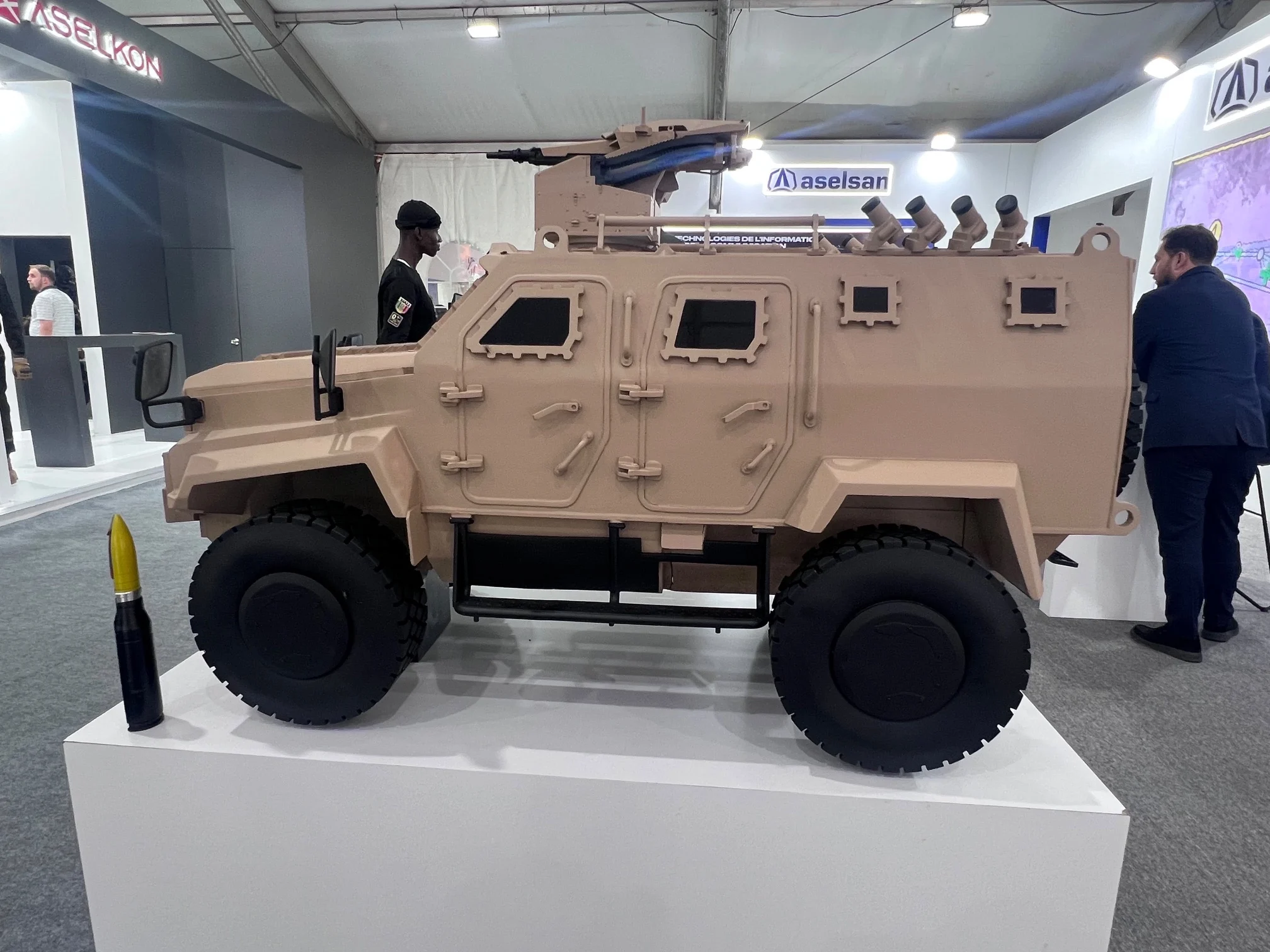
The original KORKUT, mounted on the tracked FNSS ACV-30 chassis, entered Turkish service in 2016. In 2024 ASELSAN unveiled a wheeled version on the Otokar ARMA 8×8 armoured vehicle, a configuration that suits the long road distances and dirt tracks of the Sahel better than tracks. In September 2026, ASELSAN demonstrated the KORKUT 35 to delegations from 12 countries in a live-fire event, engaging fixed-wing, delta-wing, kamikaze and mini and micro UAVs, and hitting a moving ground target while the 8×8 vehicle itself was on the move. The company presents the system as a mobile, cost-effective way to protect manoeuvring forces and critical sites against cheap aerial threats, without firing expensive missiles at them.
Jammers and communications on the stand
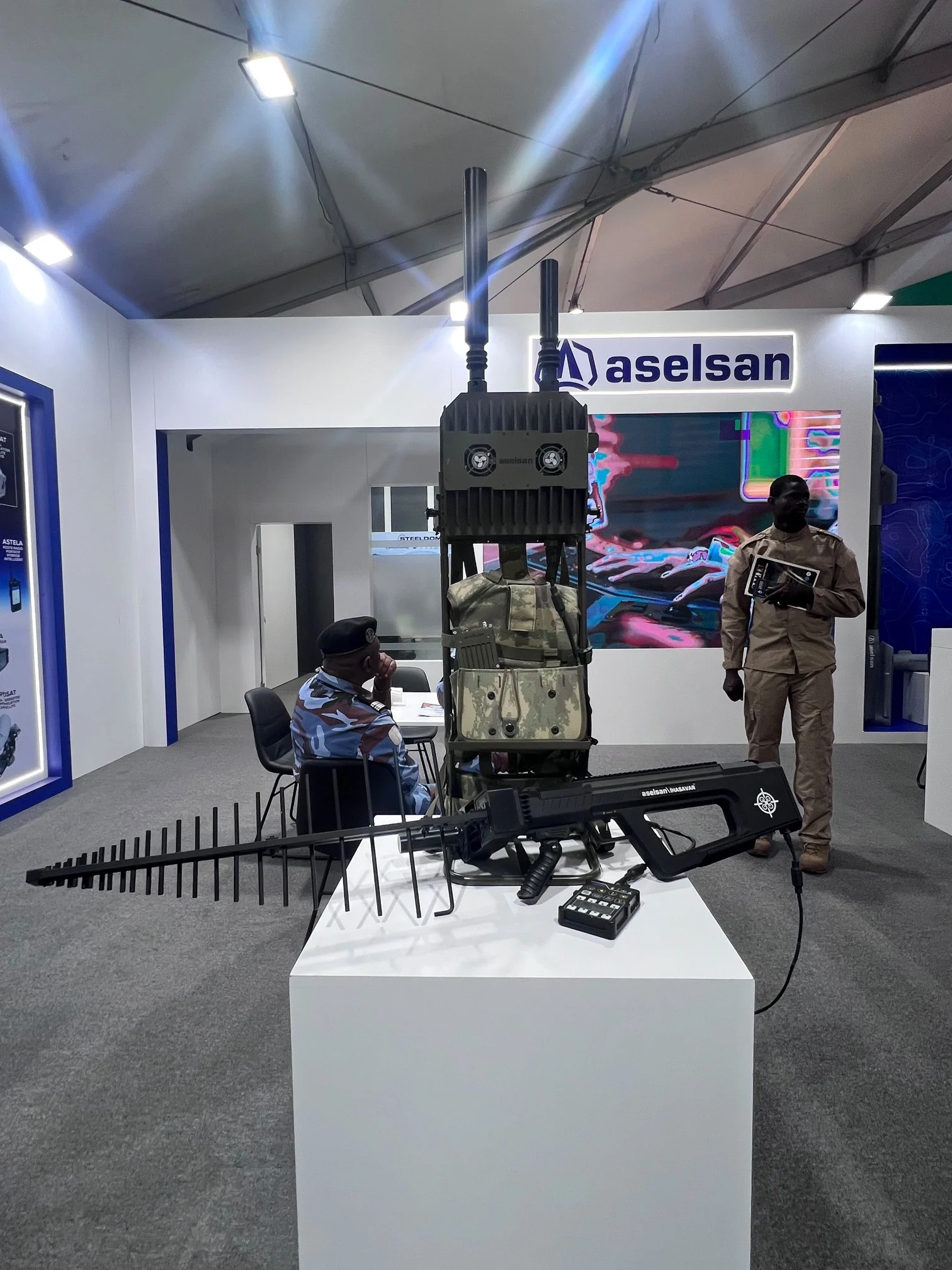
The KORKUT was one layer of a wider counter-drone and communications offer. ASELSAN also displayed its IHASAVAR handheld drone jammer, a rifle-shaped unit with a directional antenna that lets a soldier disrupt a drone’s control and navigation links, alongside a backpack-mounted jammer for dismounted troops. The combination gives a force a cheap, soft-kill option against small commercial drones, with guns such as the KORKUT for larger or more resilient targets.
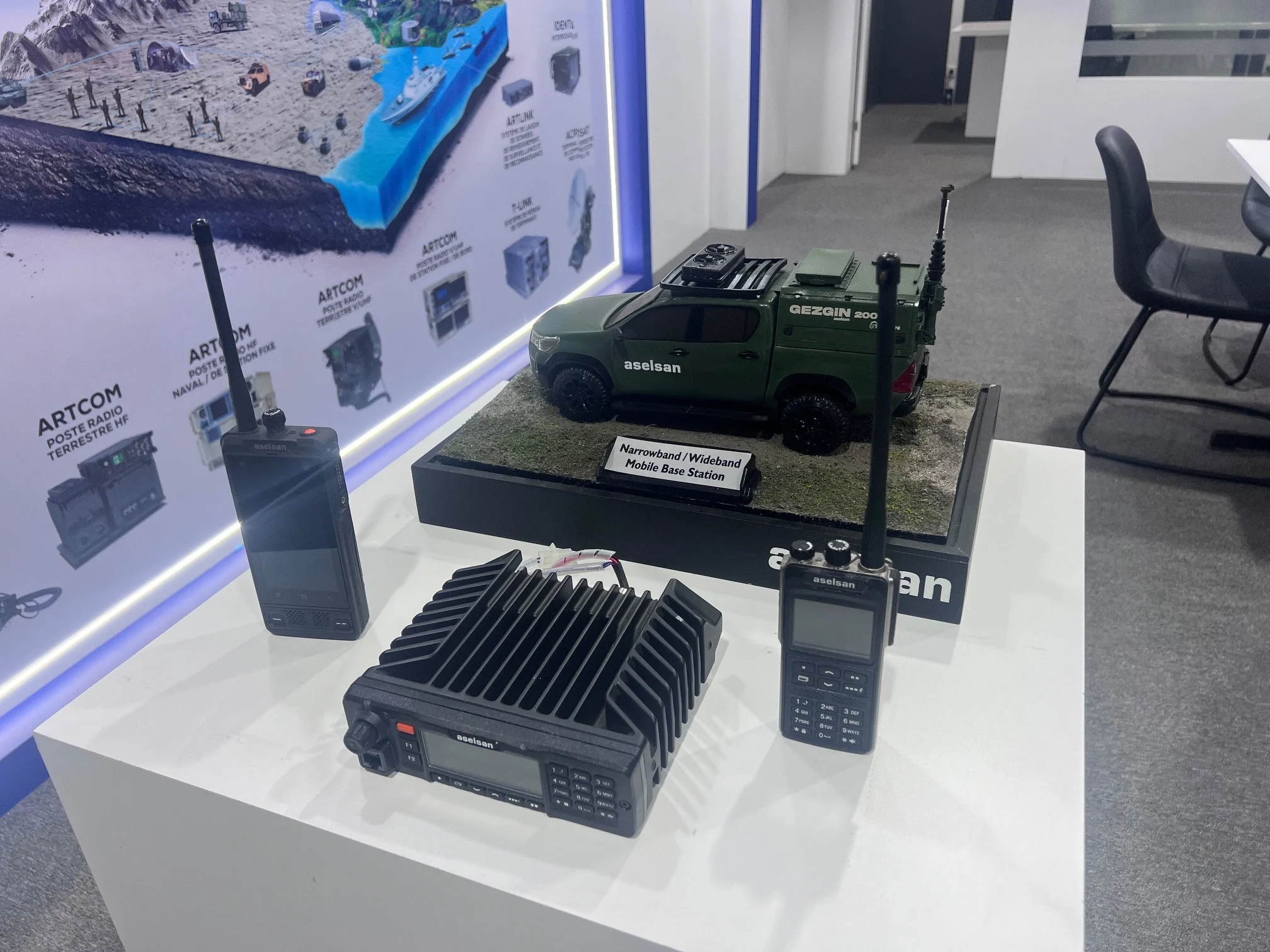
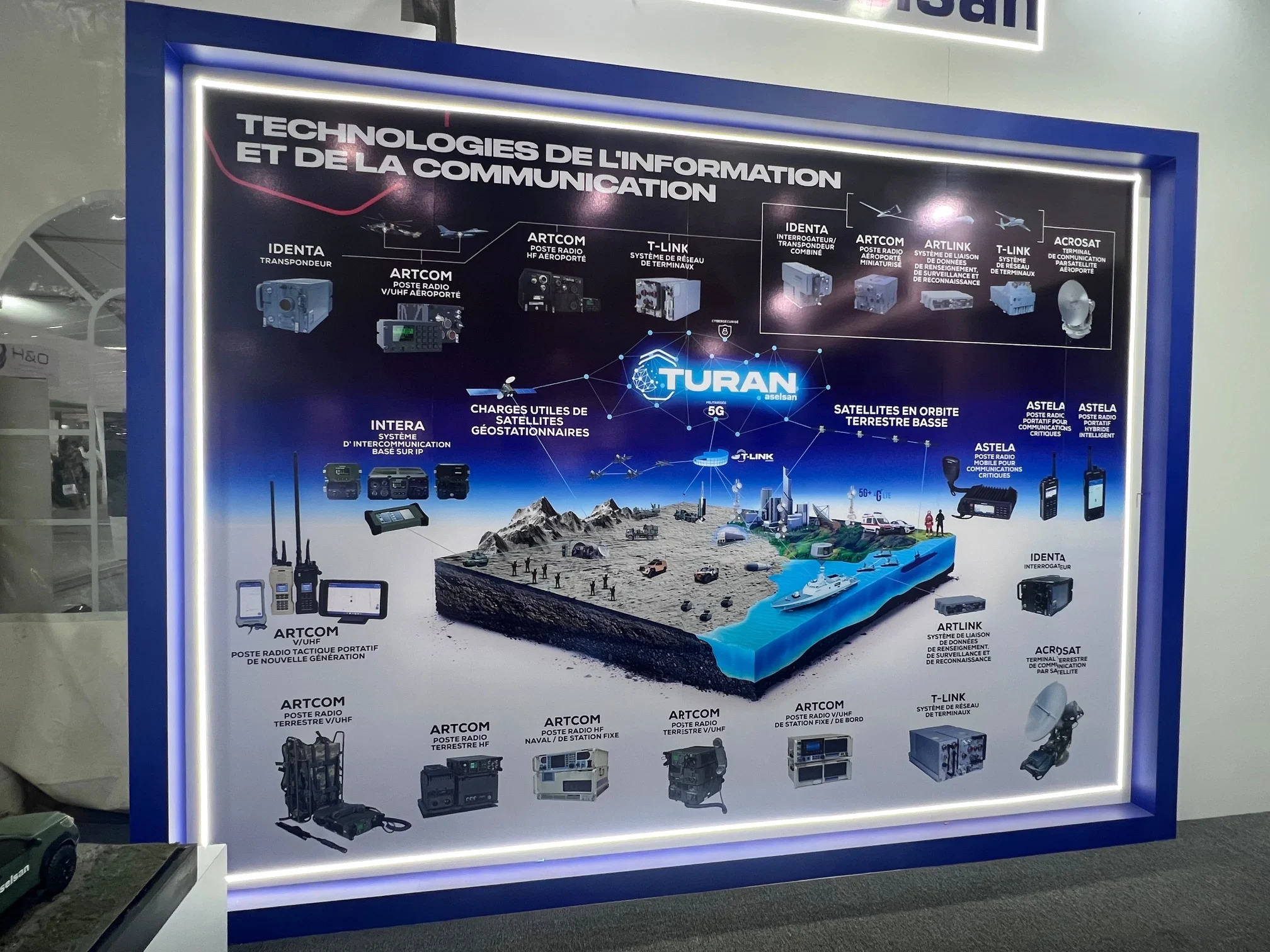
On the communications side, the stand showed handheld and vehicle radios and a model of the GEZGIN 200 narrowband and wideband mobile base station on a pick-up truck, which can bring a secure network to units operating far from fixed infrastructure. A large French-language board set out ASELSAN’s information and communication portfolio, including ARTCOM tactical and airborne radios, ASTELA critical communications radios, the T-LINK terminal network, IDENTA identification friend or foe (IFF) transponders, ARTLINK intelligence, surveillance and reconnaissance (ISR) data links, ACROSAT satellite terminals and the INTERA intercom system, all linked through TURAN, the company’s military 5G network.
Air defence for a drone-heavy Sahel
The pitch comes as drones become central to the fighting in the Sahel and Lake Chad Basin. Mali’s own forces rely on Turkish drones, including the Bayraktar TB2 and the Akinci, and Baykar is using BAMEX to show its jet-powered KIZILELMA in Malian colours. Armed groups have also adopted drones: Islamic State West Africa Province (ISWAP) first used armed drones against a Nigerian Army base at Wajiroko, Borno State, in December 2024, a threat Military Africa examined in Africa’s counter-drone imperative.
For forces facing cheap drones and the occasional helicopter rather than modern combat jets, a gun system with programmable airburst rounds offers a lower cost per engagement than surface-to-air missiles. ASELSAN has made Africa a growth market, and its chief executive, Ahmet Akyol, said in September that the company is seeking a local manufacturing partner in Nigeria. Türkiye’s share of arms deliveries to West Africa has grown in recent years, as Military Africa reported in its analysis of why West Africa’s arms imports are rising.
From the FEBAK floor to Koulikoro
BAMEX runs until 13 November, with three exhibition days followed by live demonstrations at Koulikoro, north-east of Bamako, on 12 and 13 November. No African customer for the KORKUT has been announced, and open sources list the Turkish Armed Forces as its only confirmed operator. Whether the system finds a buyer in the Alliance of Sahel States (AES), or elsewhere on the continent, will depend on cost, financing and whether ASELSAN can offer the in-country maintenance and training that BAMEX organisers have placed at the centre of this year’s show.