

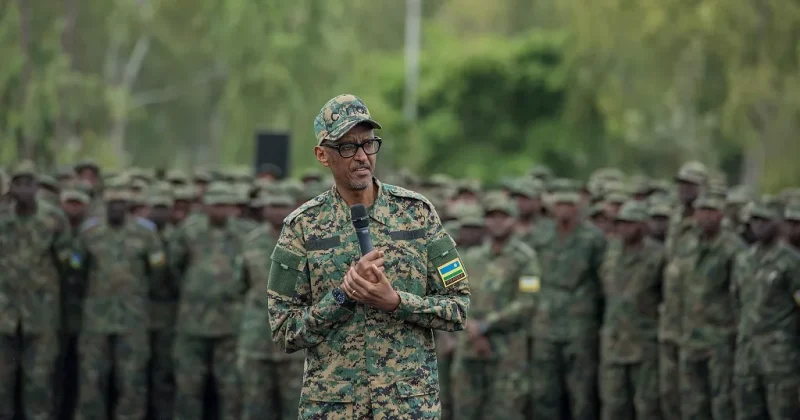
The United States Department of the Treasury’s Office of Foreign Assets Control (OFAC) took formal action on Monday, March 2, 2026, by imposing sanctions on the Rwandan Defense Force (RDF) and four of its senior commanders. This move follows a protracted period of escalating violence in the eastern Democratic Republic of Congo (DRC) and accusations that Kigali provides direct military support to the M23 rebel group. The sanctions target the institutional framework of the Rwandan military and specific high-ranking officers allegedly responsible for directing operations on Congolese soil.
Targets of the OFAC Designation
The individuals named in the latest sanctions package represent the upper echelon of the Rwandan military hierarchy. They include Chief of Defense Staff General Mubarakh Muganga and Army Chief of Staff Vincent Nyakarundi. Also designated is Maj. Gen. Ruki Karusisi and the Special Operations Force (SOF) Commander, Brig. Gen. Stanislas Gashugi. The Treasury Department also identified the commander of the 5th Infantry Division as a key figure in the documented military activities within the DRC.
These designations freeze any assets held by these individuals within United States jurisdiction and generally prohibit American citizens or entities from engaging in financial transactions with them. This action serves as a diplomatic and economic tool intended to pressure the Rwandan government to cease its involvement in the DRC, which Washington asserts has undermined regional stability.
Allegations of Direct Military Intervention
Washington alleges that the RDF is not merely an external observer but is actively supporting, training, and fighting alongside M23. This group is a UN-sanctioned entity that has successfully seized substantial territory in eastern Congo, including the provincial capitals of Goma and Bukavu. Reports indicate that thousands of RDF troops are currently deployed across the region to facilitate M23’s control over strategic areas, particularly mineral-rich mining sites.
The US government has documented the RDF’s role in providing training to M23 fighters at specialised military centres within Rwanda. Furthermore, the Rwandan military is accused of supporting recruitment efforts for the rebel group, which reportedly includes the recruitment of refugees. The involvement of the RDF has changed the tactical landscape of the conflict, as the military provides the organisational structure and combat experience necessary for M23 to sustain a large-scale insurgency against the Congolese armed forces (FARDC).
Advanced Weaponry and Electronic Warfare
A notable aspect of the current conflict is the introduction of sophisticated military hardware into the eastern DRC. The US Bureau of African Affairs and other international observers have noted the presence of advanced Rwandan equipment on the battlefield, which has shifted the technological balance of the insurgency. This equipment includes surface-to-air missile (SAM) systems, which pose a direct threat to Congolese aerial assets and international peacekeeping missions.
Beyond kinetic weaponry, the RDF has utilised electronic warfare capabilities. Specifically, the US has called for Rwanda to cease Global Positioning System (GPS) jamming and disruptions in the region. These disruptions have a wide-ranging impact, affecting both military navigation and civilian aviation operations within the DRC. Such electronic interference complicates the delivery of humanitarian aid and the movement of the United Nations Organization Stabilization Mission in the DRC (MONUSCO).
Breakdown of Diplomatic Agreements
The March 2026 sanctions come in the wake of several failed attempts to secure a lasting peace through diplomatic channels. In December 2025, a US-brokered peace deal was intended to end the fighting between the Congolese and Rwandan governments. However, US Ambassador to the United Nations Mike Waltz recently expressed profound disappointment with the renewed outbreak of violence, labelling those responsible as “spoilers” of the agreement.
The M23 group reportedly captured the city of Uvira in early 2026, a move the State Department characterised as a clear violation of the Washington Accords. This offensive in South Kivu province has led to a deteriorating security situation, with reports of Rwandan special forces operating within Uvira to secure strategic advantages. Despite the Angola-led Luanda Process, which seeks a political resolution, the transition from diplomacy to renewed combat has been swift.
Human Rights and Humanitarian Consequences
The human cost of the conflict in eastern DRC remains high. Since January 26, 2025, the violence has resulted in over 3,000 deaths and nearly 3,000 injuries. The fighting has triggered more than 500,000 new displacements, adding to a total of 6.4 million internally displaced persons (IDPs) within the country.
Reports from the region suggest that with RDF support, M23 has engaged in extrajudicial killings, arbitrary arrests, and torture of civilian populations. In January 2025, the RDF allegedly conducted direct attacks against FARDC positions, the Southern African Development Community (SADC) Mission in the DRC (SAMIDRC), and MONUSCO defensive lines. These clashes have been lethal for international forces; at least 20 peacekeepers, including 14 South African soldiers, have been killed in recent months.
Economic Drivers and Mineral Wealth
The persistence of the conflict is often attributed to the vast mineral wealth found in eastern Congo. The US government asserts that Rwanda has gained access to mineral-rich areas through its alliance with M23. These resources, which include coltan, gold, and tin, are essential for global electronics manufacturing and provide a lucrative revenue stream that helps finance the armed rebellion.
The economic dimension of the sanctions also extends to corporate entities. On February 20, 2025, OFAC sanctioned Lawrence Kanyuka Kingston, the spokesperson for M23, along with two companies linked to him: Kingston Fresh, a food services company registered in the United Kingdom, and Kingston Holding, a mining consultancy based in France. These actions target the logistical and financial networks that allow the insurgency to sustain itself over time.
The Rwandan Response and Security Concerns
Kigali has consistently rejected the accusations levelled by the United States and international monitors. The Rwandan government maintains that the sanctions unfairly target one side and misrepresent the complex reality of the conflict. Rwanda justifies its military posture as a necessary defensive measure to secure its borders against the Democratic Forces for the Liberation of Rwanda (FDLR).
The FDLR is a militia group operating within the DRC that has historical ties to the 1994 genocide against the Tutsi in Rwanda. Kigali views the presence of the FDLR near its border as an existential threat and has accused the Congolese government of collaborating with the militia. While the United States has called on the DRC to stop its support for the FDLR, it maintains that Rwanda’s military presence in the DRC is an unauthorised breach of Congolese sovereignty that exacerbates the humanitarian crisis.
Institutional History of Sanctions
The March 2026 measures are part of a broader trend of US pressure on the Rwandan military leadership. In August 2023, the US government sanctioned Brigadier General Andrew Nyamvumba for his alleged role in leading invasions into the DRC under the cover of M23. For over a decade, analysts have argued that M23 serves as a proxy for the RDF, allowing Rwanda to maintain a presence in the Congo while maintaining a degree of plausible deniability.
M23 itself has been under US sanctions since 2013, yet it has shown a remarkable ability to regroup and re-arm. The introduction of senior government officials into the sanctions list represents an escalation in diplomatic pressure. For example, in February 2025, the US sanctioned James Kabarebe, Rwanda’s Minister of State for Regional Integration and a former Minister of Defence, for his alleged role in escalating the conflict.
Regional Implications for Defence and Stability
The situation in eastern DRC presents a complex challenge for regional defence organisations. The involvement of the SADC Mission in the DRC indicates a multinational effort to stabilise the region, yet these forces often find themselves outmatched by the combined capabilities of the M23 and RDF. The use of drones, GPS jamming, and SAM systems by the rebels demonstrates a shift from traditional guerrilla warfare to a more conventional, semi-technical conflict.
The continued use of these technologies suggests that the M23 is receiving a steady supply of military-grade equipment. The international community remains concerned that the conflict could expand into a broader regional war if diplomatic efforts like the Luanda Process continue to fail. The US requirement for Rwanda to withdraw its personnel and equipment is seen as a prerequisite for any meaningful de-escalation.
Tactical Trade-offs in Modern Insurgencies
The RDF’s tactical approach in the DRC illustrates the trade-offs involved in modern proxy warfare. By providing advanced technology and training to M23, Rwanda can exert influence and secure economic interests without the full political cost of a declared war. However, the footprint left by SAM systems and electronic interference makes it increasingly difficult to hide such involvement from modern satellite imagery and signals intelligence (SIGINT).
The sanctions against the RDF leadership aim to increase the personal and institutional cost for the Rwandan government. By targeting the Special Operations Force and the 5th Infantry Division, the US is specifically identifying the units it believes are most active in the Congo. Whether these financial restrictions will be sufficient to alter Kigali’s strategic calculus remains a central question for defence analysts and policymakers in the region.
The persistent instability in eastern DRC continues to hamper development and fuel a massive humanitarian emergency. As the US and the UN continue to monitor the border regions, the effectiveness of these sanctions will be measured by whether they can force a withdrawal of foreign forces and a return to the negotiating table.