

Africa needs to become more self-reliant and build partnerships that develop African strategic resilience, Nigerian President Bola Ahmed Tinubu told the inaugural Africa International Defence Exhibition (AFRIDEX) in Lagos. The President was represented by Senate President Godswill Akpabio, who delivered the message at the opening ceremony at Eko Atlantic on Monday 26 October 2026.
“Afridex 2026 must become a meeting point where military experience informs innovation, strengthens national capabilities, and partnerships, and delivers practical solutions. Our purpose here is very clear. We have to build an Africa capable of defending its people and securing the peace upon which progress depends,” the message from the President read.
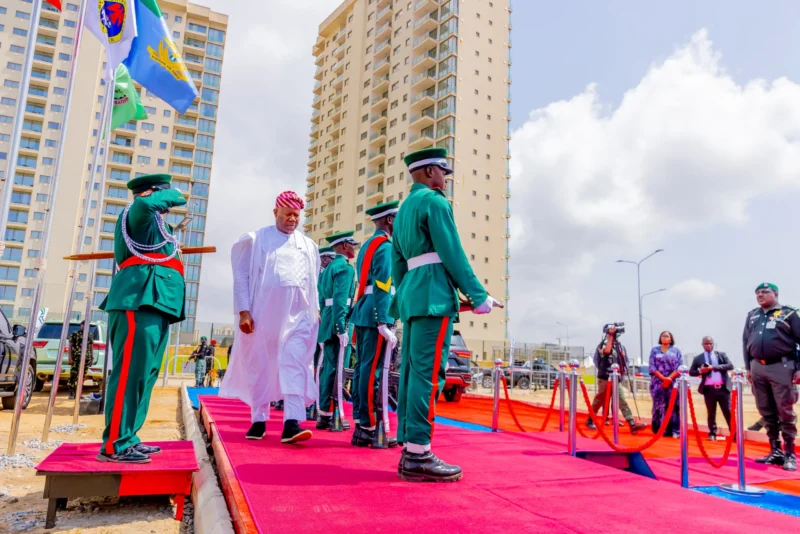
Akpabio spoke to a packed auditorium of delegates from African and international militaries, representatives of defence businesses and diplomats. A brass band played traditional African music to welcome the guests, with particular emphasis on Nigerian hymns, and the audience was filled with high-ranking officers and many people dressed in traditional Nigerian clothes made of Ankara cloth and agbada.
From the Gulf of Guinea to the Sahel
“We gather with a shared responsibility to secure our nations in Africa, protect our people, and safeguard Africa’s future. From the Gulf of Guinea to the Sahel, from our territorial borders to the cyberspace and outer space, the threats confronting us are becoming more complex and much more interconnected. They threaten lives, livelihoods, and disrupt trade. They even weaken the foundations of development of many African countries. Africa’s security must also command our collective attention because there can be no enduring prosperity when fear governs daily life. Nigeria speaks from experience. We know the cause of insecurity, the lives that are lost on a daily basis, the communities that are displaced, the livelihoods that are interrupted, and the opportunities that are denied.”
The message was delivered three days after gunmen attacked the Binari community in Karim-Lamido Local Government Area of Taraba State on Friday 23 October, killing 58 people according to the Taraba State Police Command, including 15 who drowned when their boat capsized as they fled.
The President’s address did not ignore the hardships faced by frontline troops. “Our armed forces have confronted terrorism, insurgency, banditry, piracy, and other transnational threats with courage and sacrifice, almost on a daily basis. We honour their services and remember those who have paid a supreme sacrifice and their souls rest in peace. Their sacrifices place an obligation upon us to provide the leadership, to provide the equipment, the training, and the support that our current men and women in the field need. We have also learned that lasting security requires strong institutions, public trust, reliable partnership, and the industrial capacity to sustain our defence capabilities.”
“The capability it leaves behind”
The importance of international partnerships that benefit Africa, and of shared collective defence for the region, ran through the speech. “Our defence partnership must therefore deliver value. Long after equipment has been supplied, every major acquisition should help develop skills, transfer knowledge, strengthen local industries, deepen our capacity to maintain what we operate. The measure of a successful partnership is the capability it leaves behind. African engineers must gain expertise. African enterprises must grow.”
“African institutions must become stronger. Self-determination must guide our support for African-led peace operations. The courage to respond to crises must be matched by predictable resources. Adequate equipment, rigorous training, sustained institutional support. Those we send to keep the peace must have the means to keep the peace. We must also secure the seas that connect our economies to one another and to the rest of the world.”
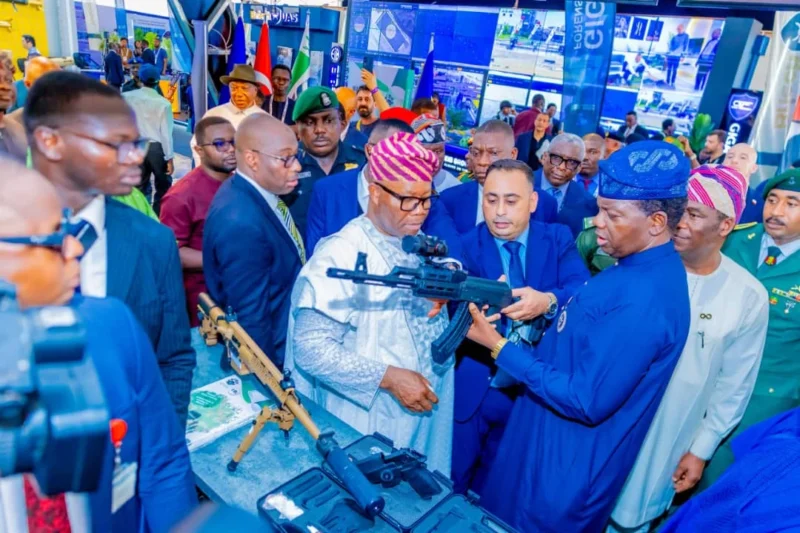
That principle was put into practice at the same show. Turkey’s HAVELSAN signed a technology cooperation memorandum with the Defence Industries Corporation of Nigeria (DICON), and Nigerian firms such as Arridex used the exhibition to unveil locally built unmanned boats. The call to secure the seas also echoed the continental maritime security forum hosted by Ghana days later.
Cyber, space, artificial intelligence and autonomy
Rapidly advancing battlefield technologies took up a large part of the President’s address. “At the same time, we must prepare for the changing character of conflict in the global society. Cyber capabilities, space technologies, artificial intelligence, and autonomous systems are transforming the security environment.”
“Africa must invest in the knowledge and institutions required to understand these technologies, use them responsibly, and develop solutions of our own, particularly for the purposes of maintenance. Our young people have the talents. Our responsibility is to create the opportunities for them. Nigeria is advancing indigenous defence production, strengthening cooperation with trusted partners, and developing capabilities suited to evolving threats. We will continue to support these efforts with a very clear objective.”
ECOWAS: security “not in dependence on others”
The emphasis on mutually beneficial partnerships and collective African security was echoed by an earlier speaker, General Birame Diop, President of the Economic Community of West African States (ECOWAS) Commission and a former Senegalese Minister of the Armed Forces, who took office at the Commission in August 2026. He praised President Tinubu for his leadership in regional security.
“His support for initiatives that promote African self-reliance, defence cooperation, and collective security continues to inspire our collective efforts toward a safer, more secure, and more prosperous West Africa. Nigeria has consistently demonstrated leadership in advancing peace and security across Africa, from the immense sacrifices it made in restoring peace in Liberia and Sierra Leone, to its pivotal role in the operationalisation and deployment of the ECOWAS Standby Force today. This exhibition is yet another testament to Nigeria’s enduring leadership and commitment to regional stability, collective security, and defence cooperation on the continent. By convening Afridex, Nigeria has once again demonstrated visionary leadership, affirming that Africa’s future security lies not in dependence on others, but in our collective ability to design, develop, and provide our own security solutions.”
Diop also set out the changing nature of 21st-century warfare as it affects Africa. “The current security landscape across our continent remains complex and challenging. Terrorist attacks, transnational organised crime, banditry, piracy, and other illicit activities at sea, unconstitutional changes of government, cyber-attacks, and mis- and disinformation continue to threaten peace, stability, and development. These threats are asymmetric, transnational, and deeply interconnected, requiring equally coordinated and innovative responses. At the same time, the geopolitical environment in which we operate is changing rapidly. The world is becoming increasingly multipolar, characterised by growing primacy of national interests, geopolitical competition, shifting alliances, and uncertainty about the future. We must also acknowledge the realities that access to defence equipment, critical technologies, and military capabilities can at times be constrained by the interests and priorities of external powers. Leaders do not wait for crisis to emerge before taking action. They prepare for that. If the future is uncertain, our response must be rooted in readiness, resilience, and self-reliance. This makes initiatives such as Afridex both timely and necessary.”
ECOWAS has been working to operationalise a joint counterterrorism force under the ECOWAS Standby Force, though analysts have argued that West African states will need to fund it themselves if it is to be sustained.
Musa: collective security for hybrid threats
Nigerian Defence Minister General Christopher Gwabin Musa (retired) spoke earlier in the ceremony and placed Nigeria’s defence needs within an African and global context, especially as they relate to AFRIDEX.
“We are all aware of the challenges of insecurity confronting not only Nigeria, but indeed, the entire world. And we need for us to continue to work together for the good of humanity. This gathering offers us that platform and opportunity to engage meaningfully in the pursuit of a safer and more secure world. Afridex started as a strategic mission, and I’m glad to see that today the ideas have come to fruition. The world is faced with tumult and uncertainties that challenge our peaceful existence. The threats we encounter are hybrid in nature and fast evolving across all domains of warfare. The challenge before us is to ensure that our defence policies and institutions remain responsive to these challenges and their realities. We must continue to prepare for the changing character of warfare and develop the requisite capacities to deal with them decisively. The contemporary global realities therefore reinforce the importance of collective security.”
Musa, who took office as Defence Minister in December 2025, has since called for military training for all Nigerian citizens.
Turning Lagos speeches into African capability
The three speeches shared one test for foreign suppliers: what skills, maintenance capacity and local production remain in Africa once equipment has been delivered. Nigeria has pressed that line through DICON and partners such as its industrial joint ventures, and it now has a continental exhibition through which to repeat it. Whether the agreements signed in Lagos deliver the technology transfer and local industry the President described will be the measure of AFRIDEX’s first edition.