

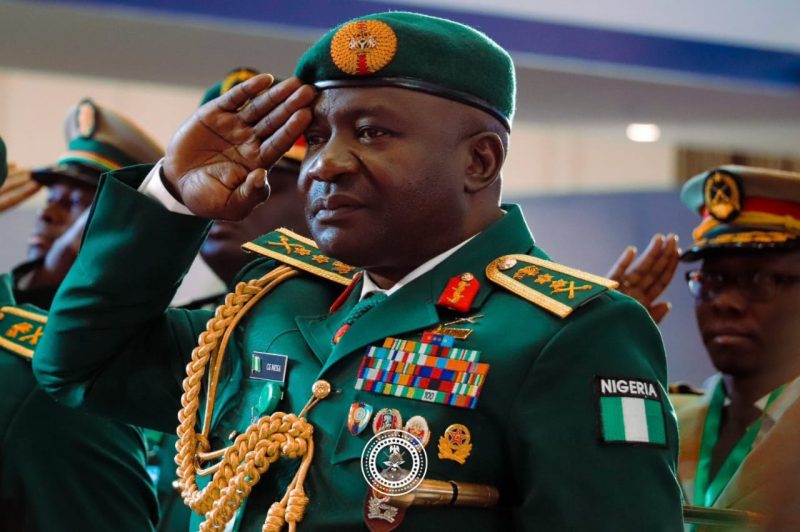
Nigeria’s Minister of Defence, General Christopher Gwabin Musa (retd), has suggested that all Nigerians undergo military training, saying it would give civilians first-hand experience of some of the demands of military service, local media reported. “Every Nigerian should be able to go through military training,” he said.
Speaking on the African Leadership Podcast, hosted by Ken Giami, in an interview reported on 23 September 2026, Musa cited exhaustion, lack of sleep and prolonged physical exertion as examples of what participants would encounter. Military training “will give you a different perspective about life,” he said.
“You will now understand what it means to stay hungry, what it means to walk in days without sleep,” he added. “It will show you what endurance means, when you walk kilometers and you are tired but you still need to keep on going.”

A Defence of the Troops
Musa argued that such an experience could help explain the demands placed on soldiers to people who insult them or question why military operations continue. Troops, he said, often go without food or rest “because of the nature of the thing and because you are doing it to protect,” comparing their sacrifice to the Bible’s teaching that there is no greater love than giving one’s life for a friend. “And that’s exactly what the military men are doing, putting their lives at stake for their country to move around,” he said.
“That’s why sometimes it’s very painful when you see people insulting the military and telling them they don’t need it or we don’t want this to end,” he added.
The remarks reflect pressure on the Armed Forces of Nigeria, which are stretched across counter-insurgency in the North East against Boko Haram and the Islamic State West Africa Province (ISWAP), banditry in the North West and North Central, and separatist violence and oil theft in the South. Musa, who served as Chief of Defence Staff before becoming defence minister, has spent the year seeking more equipment and partners for that fight, from a record ₦3.16 trillion defence budget to closer counter-terrorism ties with the United States and €20 million in European Union support.
No Plan Yet, and an NYSC Being Reformed
Musa did not set out a programme, a legal basis or a budget, and the government has not announced any plan for compulsory training. Nigeria has never had conscription; its armed forces are all-volunteer.
The closest existing scheme is the National Youth Service Corps (NYSC), the compulsory one-year service for graduates created in 1973, which begins with a military-style orientation camp run with soldiers as drill instructors. In June 2026 the Federal Executive Council approved the first comprehensive overhaul of the scheme, News Central reported, extending orientation camp from three to six weeks with a focus on civic values, career and business skills, introducing 11 career streams including a Paramilitary and Security Corps, placing the NYSC under a civilian head and replacing the passing-out parade with a graduation ceremony. The changes drew warnings that the corps’ military character should not be lost. “Under no circumstance should the military training be discarded from the service,” former senator Shehu Sani said, according to Blueprint.

Lessons From Military Service Elsewhere in Africa
If Abuja does take the idea further, it will find mixed precedents on the continent. Morocco reinstated compulsory military service in 2019 for citizens aged 19 to 25 and runs an annual intake. Egypt has long relied on conscription to fill its ranks, while Eritrea’s open-ended national service has driven many young people to flee the country. For Nigeria, with a population of more than 200 million, universal training would require camps, instructors and funding on a scale far beyond the NYSC, which suggests any programme would more likely start as a voluntary or targeted scheme built on the reformed youth service.