

On the first day of the Africa International Defence Exhibition (AFRIDEX) 2026 in Lagos, a Nigerian company showed a type of vessel the country has not built before. According to Unmanned Africa, the ADX-Barra 200, an autonomous surface vessel developed by the Arridex Group, was unveiled on 26 October at Eko Atlantic by the Senate President, Senator Godswill Akpabio, who represented President Bola Ahmed Tinubu.
The vessel is one of two platforms in the ADX-Barra series that Arridex launched at the exhibition. The other is the ADX-Barra 100. Arridex says both were designed, built, and integrated in Nigeria by its own engineers, and it describes the series as Nigeria’s first indigenously developed autonomous surface vessels.
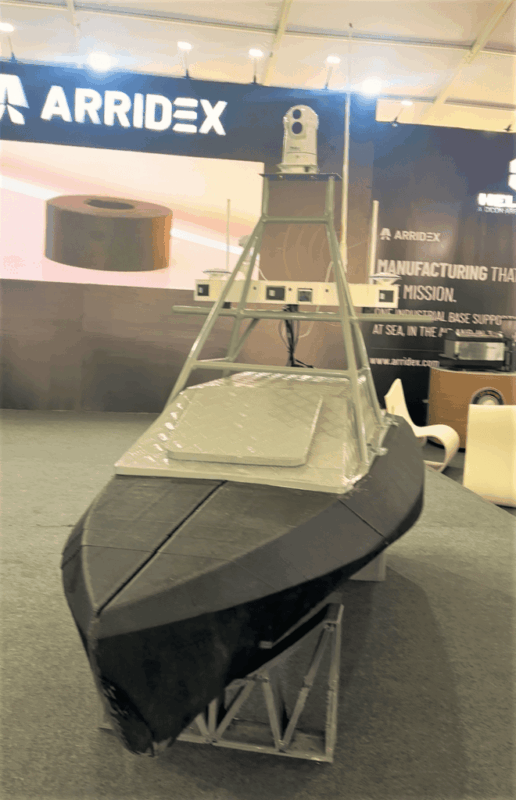
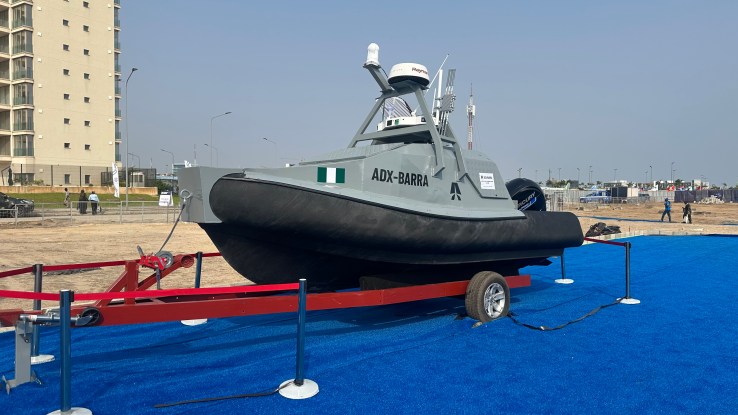
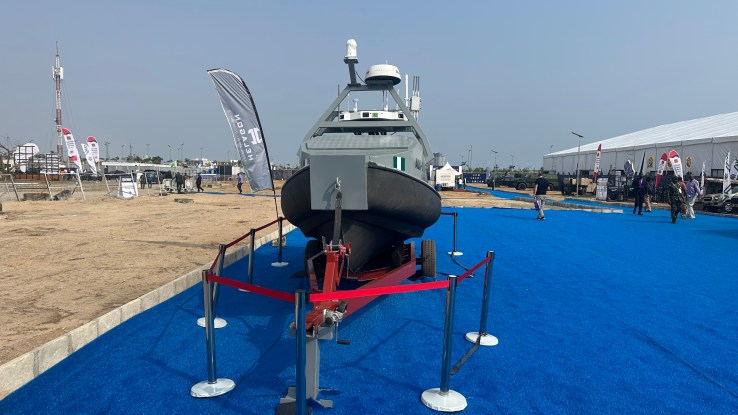
According to Arridex, the ADX-Barra represents the first domestically designed autonomous surface vessel, with both the ADX-Barra 200 and ADX-Barra 100 having been entirely “designed, built and integrated in Nigeria by Arridex engineers.”
The Unveiling
The ceremony drew a large share of Nigeria’s political and defence establishment. Alongside Akpabio were the Deputy Governor of Lagos State, Dr Obafemi Hamzat, the Minister of State for Defence, Dr Bello Matawalle, and the Director-General of the Defence Industries Corporation of Nigeria (DICON), Major General Babatunde Ibrahim Alaya. The Chief Operating Officer of Helagon, Engr. Precious Omo-Agege, and members of Arridex’s senior management also attended.
Akpabio, speaking for the President, said the government has made the growth of the defence industry a priority because security is strongest when a nation can build, maintain, and improve its own capability. He said the vessel showed that capability taking shape, designed and built by local engineers in partnership with DICON, and that it deserved the support of the government and the confidence of the armed forces.
Arridex Group’s Chief Executive Officer, Kayode Adeleke, presented the series and tied it to the geography of the Gulf of Guinea. He described the region’s waters as carrying its trade, supporting its coastal communities, and holding much of its energy wealth, and he argued that protecting them calls for capability that Nigeria can build, sustain, and improve itself. He then invited the armed services and other interested parties to see the vessels at work through demonstrations arranged at their convenience, and to help shape each later generation of the platform.
Two Vessels, Two Roles
Arridex has described the two vessels as follows. The ADX-Barra 100 is said to be the first 3D-printed unmanned surface vessel on the African continent, built for intelligence, surveillance, and reconnaissance (ISR). The ADX-Barra 200 is described as the first unmanned surface vessel designed, developed, and manufactured in West Africa and the Gulf of Guinea, and as a dual-use platform for ISR and tactical missions. These descriptions come from a post by Adeleke, and they are the company’s claims. Arridex has also said that it launched four unmanned platforms at the show, two of them surface vessels. The sources reviewed do not identify the other two.
The 3D-printing claim fits the company’s background. Arridex is an African industrial technology company whose business lines include asset integrity solutions, autonomous systems, and additive manufacturing, the industrial term for 3D printing. Adeleke said his company’s additive manufacturing work had previously produced critical spares and components that kept important assets running, parts that once waited months at a port. The company says the name Arridex means the rising of the skilled hand.
The public record on the vessels is thin. Arridex did not release technical specifications for the ADX-Barra 200 in its media statement. The sources reviewed give no dimensions, displacement, speed, endurance, range, propulsion, sensor suite, payload, or level of autonomy for either vessel. They also name no customer, and no order from the Nigerian Navy or any other service has been announced. The statement says the vessels were designed, built, and integrated in Nigeria. It does not say which components, such as engines, sensors, communications equipment, or autonomy software, were sourced locally.
Helagon and the DICON Partnership
Arridex delivers its defence platforms and services through Helagon, a joint venture with DICON, the state-owned corporation that manufactures and procures defence equipment for Nigeria’s armed forces. Adeleke thanked DICON and its Director-General for a partnership that, in his words, walked with the company to the unveiling, and he described Helagon as Arridex’s defence subsidiary.
The arrangement is an example of the model the Nigerian government has encouraged since the DICON Act of 2023: a state corporation that pairs with private firms to produce equipment at home. Military Africa reported in June that AFRIDEX was built around live capability demonstrations, with maritime displays on the Eko Atlantic waterfront. The ADX-Barra series is a product that fits that pitch, as a domestic design shown at a show that was organised partly to promote domestic industry.
Arridex
In June, Arridex, formerly known as RusselSmith, has commissioned West Africa’s first multi-technology additive manufacturing facility in Lagos, Nigeria. The “Omnifactory” was inaugurated on 10 June 2026, with Lagos State Governor Babajide Sanwo-Olu cutting the ribbon at an event. The plant is designed to print spare parts and components for clients across oil and gas, maritime, aerospace, defence, and construction sectors that have long relied on imports to keep operations running. The commissioning also marks the conclusion of a corporate rebranding. The name change took effect on 19 May 2026, when RusselSmith formally became Arridex.
Why Unmanned Boats Matter in the Gulf of Guinea
The attraction of autonomous vessels for a navy is simple. They extend the reach of patrol forces on the water, and they keep crews out of harm’s way in dangerous missions. The Gulf of Guinea is a large area with oil and gas infrastructure, shipping lanes, and coastal fisheries, and navies in the region cannot keep crewed ships on station everywhere. An unmanned vessel can stay out at sea for long periods at a lower cost than a patrol ship, and it can send images and tracks back to a command centre.
Nigeria is already moving in that direction. The Nigerian Navy has introduced Turkish-made AYBARS-2 tactical unmanned aerial vehicles for surveillance in the Gulf of Guinea, and it commissioned three new fast patrol vessels at its 70th anniversary fleet review in Lagos. A surface drone would add a third layer that works at the waterline, where small boats, illegal fishing vessels, and theft from offshore facilities are found.
Unmanned naval systems have been used in recent conflicts. It noted that Ukraine, which has no large conventional navy, has used unmanned vessels to sink or damage a large part of the Russian Black Sea Fleet, which it said is approximately one third of the fleet. That comparison involves different threats and tactics from those in the Gulf of Guinea, and the strategic value of unmanned systems in general terms. Arridex has not said the ADX-Barra vessels are armed, and the company speaks of ISR and tactical missions without detailing either.
The Argument for Building at Home
Arridex’s statement made a specific case for domestic production. A vessel designed and built in Nigeria, it said, can be supported, adapted, and improved by the team that made it for as long as it remains in service. That argument applies directly to the problem facing many African navies: imported craft arrive with a foreign supply chain, and when spare parts or software updates are slow, the craft stay at the quay.
Home-built equipment does not remove that risk, since engines, electronics, and sensors are often imported. Its advantage is that the people who know the design are close to the customer, and changes can be made quickly. That advantage depends on whether a navy buys the product and supports the company over time.
From Display Stand to Navy Service
The ADX-Barra vessels were shown at Stand 1130 and in the static display area, and Arridex said both would remain on display through the exhibition’s close on 29 October. Several things will show whether the platforms become operational equipment.
The first is the technical data. Specifications, endurance, sensor options, and a description of the autonomy system would let naval staffs judge what the vessels can do. The second is demonstrations. Adeleke invited services to arrange them, and trials at sea, with the Nigerian Navy or other Gulf of Guinea navies, would be the first test of performance. The third is an order, even a small one, from a military or security customer. The fourth is the local content. Arridex has said the vessels were integrated at home, and a breakdown of locally made and imported parts would show how deep the indigenous claim goes.
Seen in that light, the unveiling is a start. A Nigerian company has put two unmanned vessels in front of the country’s leaders and invited its navy to test them. What happens next will determine whether they are a prototype on a stand or the first of a fleet.