

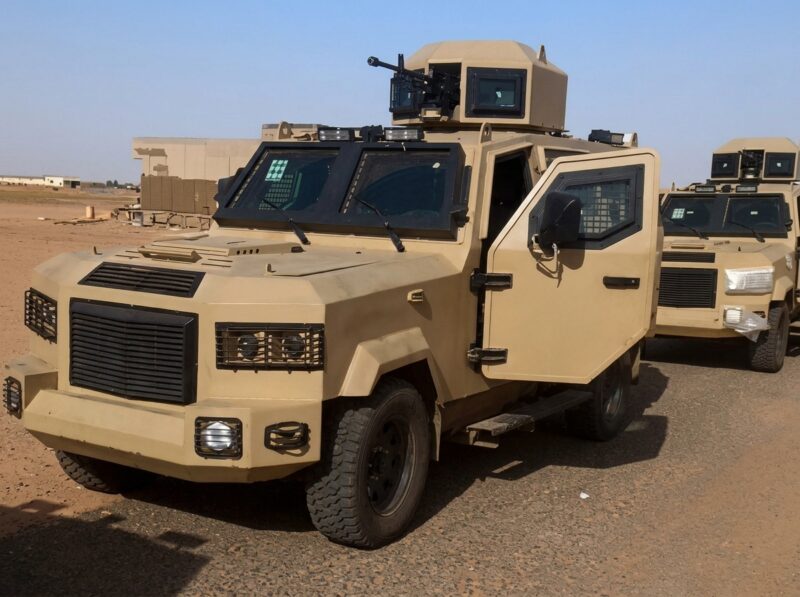
A convoy of light armoured vehicles rolled through Khartoum on 3 August 2026, and the Sudanese Armed Forces (SAF) had something new to show. The vehicles were Mohafiz-V infantry mobility vehicles, built in Pakistan, and they appeared in public for the first time during a military parade in the capital. Sudanese military sources say about 100 of them arrived in July and August, delivered in successive batches to support operations against the paramilitary Rapid Support Forces (RSF).
The sighting gave the first visual confirmation that Pakistani equipment has reached the Sudanese army, and it put a face on a defence relationship that had, until then, existed mostly as reporting about a contract. This February, the Sudanese Armed Forces (SAF) said they are in the final stages of securing a 1.5 billion dollar military procurement deal with Pakistan, a move that promises to alter the tactical landscape of the ongoing Sudanese civil war.
What Arrived, and What Is Confirmed
Two Sudanese army officers told Sudan Tribune on 6 August that the army had received 100 of the vehicles the previous month, in batches. Local media reporting indicated that the vehicles would be deployed across Kordofan and Darfur. Neither Khartoum nor Islamabad has published the terms of the sale, and neither government has confirmed the financial arrangements.
The report that the vehicles were paraded in Khartoum was carried widely by Pakistani, Indian, and international outlets. One widely cited version came from India’s News18, which relied on Indian intelligence sources, so readers should treat the parade detail as reported and not as an official Sudanese announcement. The figure of 100 is likewise approximate, since it comes from unnamed officers.
The Mohafiz Vehicle
The Mohafiz series is a family of internal security and infantry mobility vehicles built by Heavy Industries Taxila (HIT), a Pakistani state-owned enterprise founded in 1971 as a heavy rebuild factory for Chinese-designed tanks. Reports on the Sudanese delivery also name Pakistan Ordnance Factories as the manufacturer. Later models were developed with the Pakistani firm Cavalier Group.
The variant delivered to Sudan is the Mohafiz-V, built on a Toyota Land Cruiser LC79 chassis. One account of the delivery says the vehicle sits on a Toyota Land Rover Defender chassis. That is incorrect, since Toyota and Land Rover are separate manufacturers. The earlier Mohafiz-II used the Land Rover Defender, and vehicles supplied to Iraq used a Land Rover 110, while the later Mohafiz models, including the V, moved to the Land Cruiser 79 series.
The Mohafiz-V is about five metres (16 feet) long and accommodates up to eight personnel, including the driver and commander. Its aluminium armour body carries B6-level ballistic protection, which Pakistani and Sudanese-delivery reporting describes as sufficient against standard AK-47 fire. Some descriptions of the Mohafiz family also cite B7 protection, a higher level that addresses armour-piercing rifle rounds. Reports on the Sudanese vehicles add eight firing ports, a 360-degree rotating turret, and run-flat tyres said to allow movement for up to 50 kilometres after being hit. The platform is powered by a 200-horsepower turbo diesel engine, with a reported top speed of 120 kilometres (75 miles) per hour and a range of 600 kilometres (373 miles).
These figures come from the manufacturer’s catalogue and secondary reporting. They describe the vehicle as designed, and they have not been tested against RSF weapons in any public account.
Why a Light Vehicle Matters in Kordofan and Darfur
The design philosophy is high mobility and low maintenance in rugged terrain. A Land Cruiser chassis offers a spare-parts and repair chain that exists across much of Africa and the Middle East, and a crew can service it without specialist tooling. For an army fighting across the semi-arid plains of Kordofan and Darfur, those traits matter as much as the armour.
Military experts cited by Sudan Tribune describe the Mohafiz as a tactical counter to the RSF’s reliance on fast, open-top four-wheel-drive pickup trucks, the armed vehicles commonly called technicals. The intended roles are urban clearance operations and the protection of convoys along state highways. In practice, the vehicle gives an infantry section the ability to move under rifle fire, which a pickup truck cannot do, and it gives supply columns an escort that matches the speed of the trucks they protect.
Its limits are equally clear. A B6 vehicle protects against rifle rounds and shell fragments. It does not protect against heavy machine guns, anti-tank weapons, or mines of any size, and it offers little against the drones that now dominate the war. Al Jazeera reported on 19 October that a wave of drone attacks had killed more than 160 people across western Sudan in a few days, and the Sudanese army itself is conducting a near-daily air and drone campaign against RSF-held towns in Darfur and Kordofan, according to Sudan Tribune on 22 October. A light armoured carrier is a useful tool in that war, but it is not the decisive one.
Where the Mohafiz Sits in the Pakistani Package
The vehicles are described as part of a $1.5 billion expansion of Khartoum’s arsenal announced in January. Military Africa reported in February that the Sudanese Armed Forces were in the final stages of securing the deal. The package consists of Pakistani Shahpar tactical reconnaissance and strike drones, spare parts for the SAF’s existing Chinese-Pakistani K-8 Karakoram light attack aircraft, and the Mohafiz vehicles. Other reports describe a larger arrangement that includes more than 200 unmanned aerial vehicles, Super Mushshak trainers, and possibly JF-17 Thunder fighter jets. The sums are the estimates of outside analysts, and Islamabad and Khartoum have not confirmed them.
Financing is the least settled part of the story. Reuters reported in January that Saudi Arabia had brokered the deal. In April, Reuters reported that Pakistan had put the arrangement on hold after Riyadh asked for it to be terminated and said it would not finance it. Yet the deliveries went ahead in the summer. Sudan Tribune’s military sources said the drones and vehicles reached the army through separate deals, and some reports have named Qatar as well as Saudi Arabia as possible backers, without comment from either country. The available evidence does not show who is paying, or whether the arrangement announced in January remains intact in its original form.
The deliveries also fit a wider pattern. Reporting this autumn describes the SAF shifting from Iranian to Turkish, Egyptian, and Pakistani drones and equipment, and one assessment says the army halted Iranian purchases in mid-2026. Pakistan is described in that reporting as the newest and largest supplier.
An Army Replacing Its Older Inventory
Before the Pakistani deliveries, the SAF relied on a mixed inventory of Soviet-era systems, Russian Sukhoi and Mikoyan jets, Mil helicopters, Iranian Mohajer drones, and locally built or modified armoured vehicles such as the Sarsar from the Defence Industries System. The Sarsar-2 is a Sudanese-made armoured personnel carrier produced by the state-run Military Industry Corporation, and it has been the army’s standard light armoured vehicle in recent years. The Mohafiz adds a second, foreign-built light armoured option with a global parts supply, which eases a logistics problem that locally modified vehicles cannot solve alone.
The Battlefield and the Embargo
The vehicles arrive in a war that has settled into an east-west division. The army holds Khartoum and Sudan’s centre, north, and east, while the RSF holds almost all of Darfur, including El Fasher, which fell on 26 October 2025. The active fronts are in Kordofan and Blue Nile. El Obeid, the capital of North Kordofan, has been under repeated RSF drone and artillery attack, and the UN has described the war as one that has displaced more than 13 million people.
The Mohafiz deployment to Darfur also touches a legal question. The UN Security Council’s Resolution 1591 regime prohibits the supply of arms to parties in Darfur, and the council extended it on 8 October for two months, until 11 December 2026, after the United States withdrew a proposal to widen the embargo to the whole of Sudan under opposition from Russia and China. Sudan’s government rejects any expansion and has accused the United Arab Emirates of breaching the existing embargo by supplying the RSF, a charge that is disputed. No reporting reviewed for this article alleges that the Pakistani deliveries breach the embargo, but vehicles destined for Darfur will draw the attention of the UN Panel of Experts.
What the Next Months Will Show
Three questions will decide whether the Mohafiz deliveries matter. The first is whether the vehicles move into combat units and appear in operations around El Obeid and the Kordofan highways, not only on parade squares. The second is whether Pakistan can keep the supply chain flowing for spares, ammunition, and training, given the uncertainty over who is paying. The third is whether the army can pair this light protected mobility with the air defence and counter-drone capability it needs against an enemy that now fields drones in volume.
The vehicles themselves are modest, proven, and cheap to run. The Mohafiz-V will not change who holds El Fasher, but a hundred of them can change how an infantry brigade moves along a highway that the RSF has contested for three years.