

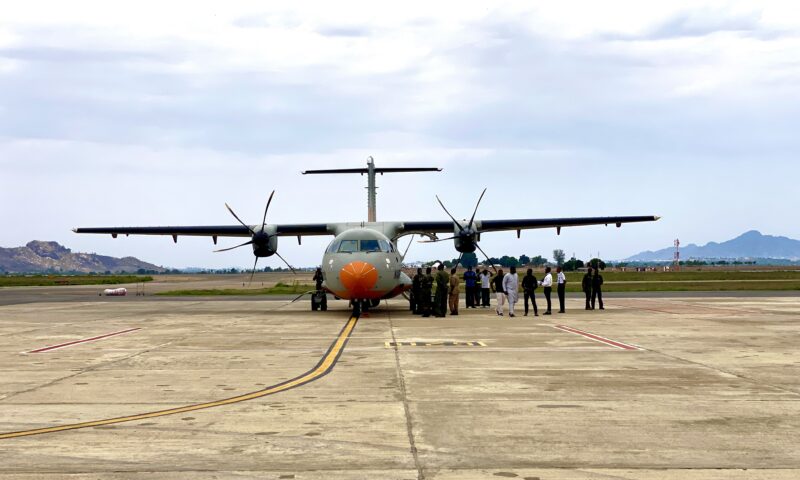
The Nigerian Air Force (NAF) has lost one of its two ATR 42-500 maritime patrol aircraft following the crash of NAF 931 in a swampy mangrove area near Igbokoda in Ondo State on 5 October 2026. The accident killed all 25 people aboard and removes one of Nigeria’s dedicated crewed intelligence, surveillance and reconnaissance (ISR) platforms, increasing pressure on the service’s remaining surveillance aircraft and unmanned aerial vehicle (UAV) fleet.
The aircraft, operated by the NAF’s 81 Air Maritime Group in Benin City, Edo State, was flying on a routine mission from Benin to Lagos when air traffic controllers lost contact with it at approximately 9:13 a.m. local time. The wreckage was subsequently located near the naval base at Igbokoda, in the coastal region of southwestern Nigeria.
“The aircraft was on a routine mission from Benin to Lagos when the accident occurred,” said Ehimen Ejodam, the NAF’s Director of Public Relations and Information.
The incident initially generated conflicting reports about the number of people aboard. Aviation Minister Festus Keyamo announced on 5 October that preliminary information indicated 32 occupants, comprising 25 passengers and seven crew members. The presidency also issued a statement referring to those preliminary figures.
However, the NAF corrected the passenger manifest the following day, confirming that 25 people were aboard, comprising 20 passengers and five crew members. The Air Force reported that nobody survived the crash. Reuters subsequently reported that the victims included 19 military personnel and six civilians. Authorities have not publicly explained the discrepancy between the initial figures and the corrected manifest.
President Bola Tinubu ordered an investigation into the accident and declared three days of national mourning. The loss has also renewed attention to the availability, maintenance and operational demands of Nigeria’s military aviation fleet.
Investigation Underway as Recovery Efforts Continue
The NAF established a 12-member Aircraft Accident Investigation Board on 13 October to determine the circumstances and cause of the crash and recommend measures to prevent a recurrence. Air Vice Marshal F.O. Ankeli heads the board, while Air Vice Marshal E.O.E. Ebiowe leads the Investigation and Recovery Team.
The Air Force has not publicly established the cause of the accident. Reuters reported on 16 October that military teams were still searching the swampy crash site for wreckage and human remains, while families of the victims sought more information about the investigation and recovery process.
The same Reuters report described a separate account from a relative of a deceased NAF sergeant, who said the sergeant had messaged the family about a reported aircraft fault during the group’s journey before the crash. According to the relative, the group had stopped in Benin City after travelling from Abuja, and the sergeant had considered continuing the journey by road because of delays.
That account has not established a causal link between any reported fault and the accident. Investigators will need to examine the aircraft’s technical records, maintenance history, operating condition, flight data and other available evidence before determining what happened.
Nigeria’s ATR-42 Fleet and Its Operational Role
Before the crash, the Nigerian Air Force operated two ATR 42-500MP maritime patrol aircraft, NAF 930 and NAF 931. Both aircraft were configured primarily for maritime patrol and intelligence, surveillance and reconnaissance missions, although they could also perform search-and-rescue (SAR) operations and limited transport duties.
The aircraft served with the 81 Air Maritime Group, based in Benin City, Edo State. The NAF also deployed them in support of operations in northeastern Nigeria, including missions associated with the campaign against Boko Haram and Islamic State-linked insurgents. Military Africa previously reported that the aircraft routinely supported the 75 Strike Group in Yola as part of the air component of Operation Lafiya Dole.
Their operational value extended beyond conventional maritime patrol. Equipped with surveillance sensors, the aircraft could monitor activities over Nigeria’s territorial waters, coastline and wider maritime domain. These missions support maritime situational awareness, the monitoring of suspicious vessel movements and the detection of activities that threaten shipping, coastal communities and offshore infrastructure.
The aircraft could also conduct surveillance over land, making them useful for reconnaissance in conflict zones where commanders need a broader picture of insurgent movements and other ground activity.
The ATR-42 platform therefore provided the NAF with a crewed surveillance capability that could support both maritime security and counter-insurgency operations. Its loss reduces the number of dedicated aircraft available for these tasks.
Surveillance Systems Equipped on the ATR-42
The Nigerian ATR-42s carried a Galileo Avionica Airborne Tactical Observation and Surveillance System (ATOS). This mission suite included a search radar and an EOST-45 electro-optical surveillance and tracking sensor.
The search radar allowed operators to detect and monitor surface activity over maritime areas, while the electro-optical sensor supported visual observation and tracking. Together, these systems enabled the aircraft to collect information from a broad area and provide commanders with a clearer operational picture.
The Nigerian configuration also differed from the version operated in Italy. The NAF aircraft featured a hatch in the cabin floor that operators could open in flight for search-and-rescue tasks and airdrop operations. This feature gave the aircraft additional flexibility beyond routine surveillance.
Although the ATR-42 airframe originated as a regional turboprop transport design, its mission configuration allowed the NAF to use it as a dedicated surveillance platform. Its cabin could accommodate mission equipment and personnel needed to manage sensors, interpret collected information and relay observations to operational commanders.
A $73 Million Acquisition Dating to 2007
The NAF acquired both aircraft from Italian aerospace company Alenia Aeronautica under a contract signed in March 2007. The approximately $73 million agreement covered the delivery of two aircraft, crew training and logistics support.
The first aircraft, NAF 930, arrived in Nigeria in December 2009. Alenia Aeronautica delivered the second aircraft, NAF 931, in March 2010. The acquisition package included provisions for the aircraft’s maritime patrol configuration and the training required to operate their surveillance systems.
Alenia configured NAF 930 for maritime patrol at its facilities in Caselle, Italy, before delivering it to Nigeria. By the time NAF 931 crashed, the two airframes had accumulated more than 16 years of service in the Nigerian military.
Their age alone does not establish a cause for the accident, but their maintenance history provides important context for understanding the fleet’s availability and sustainment requirements.
NAF 930’s Maintenance History in Germany
After approximately a decade of service and 5,000 flight hours, NAF 930 travelled to Rheinland Air Service (RAS) in Mönchengladbach, Germany, in September 2019 for major maintenance, repair and overhaul (MRO).
The aircraft had supported Nigerian military operations, including operations against Boko Haram, before the NAF sent it to Germany for depot-level work. The maintenance programme aimed to restore the aircraft’s serviceability and sustain its surveillance capability.
NAF 930 returned to Nigeria in July 2020 after undergoing deep maintenance and overhaul. Air Vice Marshal Oladayo Amao, then Chief of Policy and Plans, received the aircraft at the flight line of the 307 Executive Airlift Group at Nnamdi Azikiwe International Airport in Abuja. He received it on behalf of the then Chief of the Air Staff, Air Marshal Sadique Abubakar, who was in northeastern Nigeria overseeing the ongoing subsidiary Operation LONG REACH II.
The maintenance period also coincided with the NAF’s continued need for airborne surveillance in both the maritime environment and the northeastern counter-insurgency theatre. The prolonged absence of one of its two dedicated ATR-42 aircraft had already placed additional demands on the service’s available surveillance resources.
NAF 931 Returned After Nearly Four Years in Germany
The NAF subsequently sent its second ATR-42 surveillance aircraft, NAF 931, to the RAS facility in January 2022 for maintenance. According to Military Africa’s January 2025 report on the aircraft’s return, the aircraft spent almost four years at the German facility before returning to Nigeria in late December 2024.
The precise reason for the extended maintenance period has not been established publicly. The NAF nevertheless involved its own engineers and technicians in the aircraft’s reactivation process in Germany.
The return restored the second ATR-42 to Nigeria’s available inventory after a lengthy absence. Less than two years later, however, NAF 931 crashed near Igbokoda, removing it from service and leaving the service without one member of its two-aircraft ATR-42 fleet.
The maintenance history is relevant to understanding the fleet’s availability, but it does not by itself indicate that maintenance problems contributed to the crash. Investigators will need to establish whether the aircraft experienced any technical or operational issues before the accident.
Why the Loss Matters for Nigeria’s ISR Architecture
The loss of NAF 931 reduces Nigeria’s dedicated crewed maritime patrol and ISR capacity at a time when the military needs airborne surveillance across both its coastal environment and internal security theatres.
The aircraft’s role went beyond the collection of imagery. Crew members and mission systems operators could process sensor information aboard the aircraft, assess detected activity and communicate relevant intelligence to ground commanders or other operational units. This arrangement offered a mobile surveillance and command-support capability that could contribute to time-sensitive decisions.
According to Unmanned Africa’s August 2026 analysis, “Layered ISR: Why African Defense Forces Need Manned Aircraft and Drones,” crewed turboprop surveillance aircraft offer payload capacity and onboard processing capabilities that many uncrewed systems cannot fully replicate.
Aircraft in this category can accommodate multi-sensor suites weighing several hundred kilograms. Depending on the platform and its configuration, these may include electro-optical/infrared (EO/IR) sensor gimbals, maritime search radars and synthetic aperture radar (SAR) systems. The ATR-42’s maximum take-off weight is around 18 tonnes, placing it in a class capable of carrying heavier mission equipment than many smaller tactical UAVs.
These general capabilities should be distinguished from the equipment confirmed on the Nigerian aircraft. Military Africa’s reporting identifies the ATOS mission system, search radar and EOST-45 electro-optical sensor as components of the NAF’s ATR-42 configuration.
Crewed surveillance aircraft also carry their mission personnel inside the cabin. Operators can examine sensor imagery, assess the movements of vessels or ground targets and relay information directly to commanders. This arrangement can reduce dependence on high-bandwidth satellite communications for some onboard processing and reporting tasks, although communications requirements vary by mission.
UAVs provide complementary strengths, particularly endurance. Medium-altitude, long-endurance platforms can remain over an area for extended periods, making them suitable for persistent monitoring of known insurgent routes, border areas and infrastructure. Their performance, however, depends on payload capacity, sensor fit, communications links and the mission they must perform.
Unmanned Africa’s assessment identifies Nigeria’s wider ISR architecture as including Beechcraft King Air 350i surveillance aircraft and Wing Loong II unmanned aircraft alongside its ATR-42 platforms. The loss of NAF 931 therefore does not mean Nigeria has lost all airborne ISR capability. It does, however, remove one of the country’s two dedicated ATR-42 maritime patrol aircraft and places greater demands on the remaining platforms.
Rebuilding Nigeria’s Airborne Surveillance Capacity
Following the crash, the NAF will need to rely more heavily on its remaining surveillance aircraft and UAVs to sustain intelligence collection while it assesses its longer-term requirements. Drones can help cover selected missions, particularly persistent observation over defined areas, but they cannot automatically replace every function previously performed by a crewed maritime patrol aircraft.
Nigeria will need to preserve the availability of its remaining crewed ISR assets while ensuring that surveillance information from manned aircraft and UAVs reaches commanders in a timely and usable form. It must also consider the long-term implications of fleet age, access to depot-level maintenance, technical support and spare parts when planning future acquisitions.
The crash investigation remains central to that process. Establishing the circumstances surrounding the loss of NAF 931 will help the Air Force determine any necessary safety measures, while an assessment of the resulting surveillance gap will inform decisions about replacement aircraft, upgrades and the future balance between crewed platforms and uncrewed systems.