

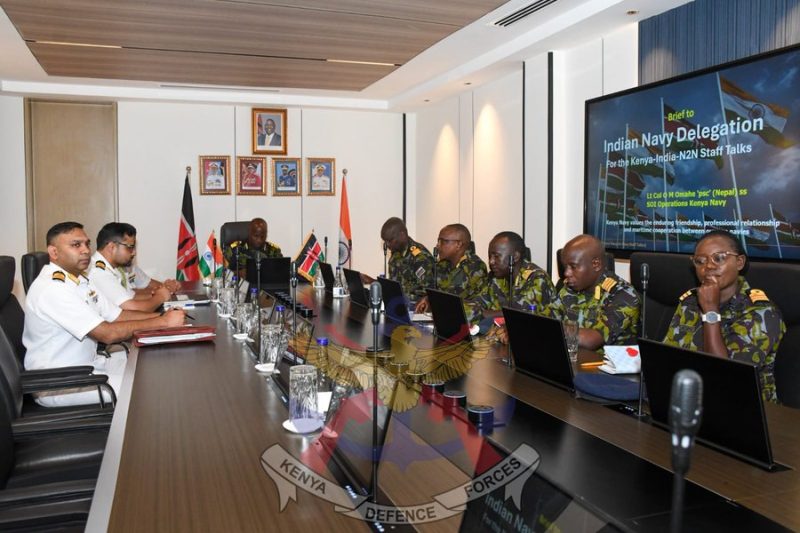
An Indian Navy delegation led by Commodore Kartik Srimal paid a courtesy call on Commander Kenya Navy, Major General Paul Otieno, at Kenya Navy Headquarters on 5 October 2026, days after an Indian frigate concluded a four-day stop in Mombasa.
The visit followed the arrival of INS Tarkash, a Talwar-class guided-missile frigate, which docked in Mombasa from 29 September to 2 October for what the Indian Navy called an operational turnaround, a routine stop for crew rest, resupply and maintenance between deployments. During the port call, Indian and Kenyan sailors held professional exchanges and joint activities meant to sharpen coordination between the two navies.
Commodore Srimal’s delegation included India’s Defence Attache to Kenya, Captain Arjit Pandey, and other officials. The sides reviewed shared maritime interests and looked at ways to widen cooperation between the Kenya Navy and the Indian Navy, according to a statement from Kenya’s Ministry of Defence.
Major General Otieno said sustained professional interaction helps strengthen bilateral defence ties and improves partner navies’ ability to respond to threats in the maritime domain. He added that the engagements open room for knowledge exchange, professional development and sharing of operational experience, while building institutional links between the two forces.


INS Tarkash is one of six Talwar-class frigates built around a modified Krivak III design from Russia, displacing roughly 4,000 tonnes fully loaded and carrying BrahMos supersonic anti-ship cruise missiles, a surface-to-air missile system and a medium-range naval gun. The class has a top speed near 30 knots and can operate for about 30 days without resupply, which suits the kind of long-endurance patrol and escort work India has leaned on it for in the Western Indian Ocean. Tarkash itself has recent operational credentials; it took part in an anti-piracy interception off the Horn of Africa in March 2024.
The courtesy call and frigate visit are the latest in a run of naval engagements that has picked up pace since late 2023. INS Sumedha, a Saryu-class patrol vessel, made the first-ever visit by an Indian warship to Kenya’s port of Lamu on 9 December 2023, the same month Presidents William Ruto and Narendra Modi issued a joint maritime vision known as BAHARI. That same year, Goa Shipyard Limited and Kenya Shipyards Limited signed a memorandum of understanding on ship design, construction and wider defence industrial cooperation, part of Kenya’s push to build a shipbuilding and repair base on the East African coast.
The cooperation has since broadened beyond port calls. In April 2025, India hosted the first Africa-India Key Maritime Engagement exercise off Tanzania, bringing in nine African navies including Kenya’s. Major General Otieno travelled to India in September 2025 for high-level talks, and the fourth Joint Defence Cooperation Committee session between the two countries met in Nairobi from 24 to 26 February 2026. In April 2026, the frigate INS Trikand called at Mombasa for a four-day visit, and Indian officials handed over 100 INSAS rifles and 50,000 rounds of ammunition to the Kenya Defence Forces on 8 April that year.
For Kenya, the relationship offers access to training support, simulators and shipyard expertise as the navy works to expand its long courses and reposition itself as what officials have called a maritime centre of excellence. For India, the steady cadence of port calls, exercises and committee meetings forms part of a broader push, branded MAHASAGAR, to deepen naval diplomacy with Indian Ocean littoral states and maintain an operational presence along trade routes that run past the Horn of Africa. Analysts tracking India’s Africa posture have also linked the push to concerns in New Delhi about China’s growing footprint on the continent, a dynamic not stated in Kenyan or Indian official statements but widely discussed in regional security literature.
The Indian Ocean carries a large share of the world’s seaborne trade, and both Nairobi and New Delhi have framed naval cooperation there as a shared interest rather than a response to any single threat. Kenya’s statement on the latest courtesy call cast it as part of continued naval diplomacy aimed at building institutional capacity and contributing to peace and stability across the region.