

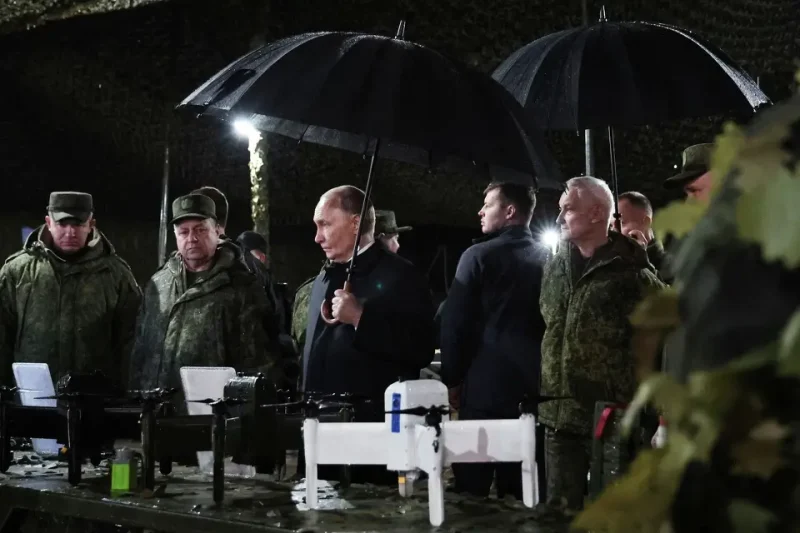
Defence officials from several African countries attended Russia’s Center-2026 strategic exercise at the Chebarkul training ground in the Chelyabinsk region, which ran from 28 September to 3 October 2026, according to Russian state media.
Center-2026 was a strategic command-staff exercise, a drill that tests commanders and headquarters as much as front-line units. Russian President Vladimir Putin watched the final phase on Friday, 2 October, and met foreign military attachés.
In a report carried by Sputnik, Russia’s Defense Ministry said about 200 defence officials, military diplomats and observers from 69 countries joined exercise-related events. The guests toured command posts and facilities for supporting and repairing military equipment.
Who was there from Africa
The Sputnik-based account names Algeria, Egypt, Libya, Mali, Namibia, Niger, Nigeria, Uganda, the Central African Republic, Ethiopia, and South Africa as African attendees.
Defense Minister Andrei Belousov told President Putin that the Republic of Congo’s defense ministry “is represented by an operational group.” That usually means a staff element, not a combat unit.
The headcounts differ between sources. Defense Minister Belousov said nearly 60 countries took part, seven sent military contingents and 51 sent observers. The Sputnik account cites 69 nations and six contingents. The gap may come from counting attachés, observers and units separately.
Scale and hardware
President Putin said the full exercise involved 47,000 troops, who trained to repel an attack at 11 firing ranges and in the Caspian Sea. The final phase at Chebarkul drew just over 6,000 personnel, according to the Defense Ministry via TASS: 4,600 Russian, and 1,479 foreign, including 634 from the Collective Rapid Reaction Forces of the Collective Security Treaty Organization (CSTO), a Russia-led security alliance.
The ministry listed Belarus, China, Kyrgyzstan, Mongolia, Pakistan and Tajikistan as the other national contributors. China Central Television (CCTV) said the Chinese troops came from the Central Theater Command and included members of the 82nd Group Army and a combined-arms brigade. The South China Morning Post reported that the scenario was repelling external aggression in the Central Asian direction.
The Russian side of the force came from several branches. Defense Minister Belousov listed troops of the Central Military District, Aerospace Forces and Airborne Forces units, formations under central command and the Caspian Flotilla. The same range hosted three separate CSTO drills, named Interaction-2026, Search-2026 and Echelon-2026, between 24 September and 3 October, RBC reported.
The main stage ended on 2 October with a staged counterattack. The Defense Ministry said the coalition force freed a populated area and destroyed a retreating enemy after a massive strike by operational-tactical aviation, artillery, heavy flamethrower systems and a group of UAVs. Chinese tanks and combat vehicles, backed by artillery, covered the flank while Russian motorized rifle and tank units moved forward.
RBC also reported that President Putin was shown jet-powered versions of the Geran strike drone. The ministry has not published performance figures for that variant.
Defense Minister Belousov put the equipment at about 700 pieces of hardware, more than 600 uncrewed aerial vehicles (UAVs) and over 60 robotic systems. The ministry said the drills applied lessons from the war in Ukraine.
The ground robots drew the most detail. The Bogomol, Impuls and Depesha systems moved ammunition and supplies to assault units. The Kurier carried a rocket infantry flamethrower module and fired on enemy shelters and fortified positions in buildings. The Chelnok drone, built for rougher terrain and heavier loads, also took part.
The drone count is the figure for visiting planners to study. With more than 600 UAVs among roughly 6,000 troops at the range, the ratio works out to about one drone for every ten personnel. The South China Morning Post also said the drills featured new anti-drone systems, a sign that Russian planners now treat drone defence as a core task, not an add-on.
These machines keep supply runs and some close-in fire away from exposed crews. The trade-off is their reliance on radio links, which electronic warfare can jam. The ministry did not say how the exercise handled that threat.
Why Africa matters to Moscow
Russia has built military ties with African states through training, arms sales, security agreements and officer exchanges. Algeria and Egypt have bought Russian equipment for years. Since 2023, a defence ministry-run Africa Corps has taken over tasks once held by the Wagner Group in parts of the Sahel; its current footprint was not re-checked for this article.
For African governments, closer ties with Moscow offer a second option beside Western suppliers. Observing a drill costs little. Buying equipment depends on budgets, export licences, payment terms and spares, and none of that was reported from Chebarkul.
Several attendees on the reported list, including Mali, Niger and the Central African Republic, already host or have hosted Russian military personnel. For them, the visit extends an existing relationship. Delegations from countries such as Nigeria, Uganda and Namibia are a different case, since they would be weighing Russian options against long-standing Western ties; this article found no public statement from any of them on what they saw.
Russia also gains from the audience. Showing drones and ground robots that were developed under combat conditions lets Moscow market its latest ideas to buyers who may lack the money for Western systems. Whether Russian industry can spare export volumes while it equips its own forces is an open question.