

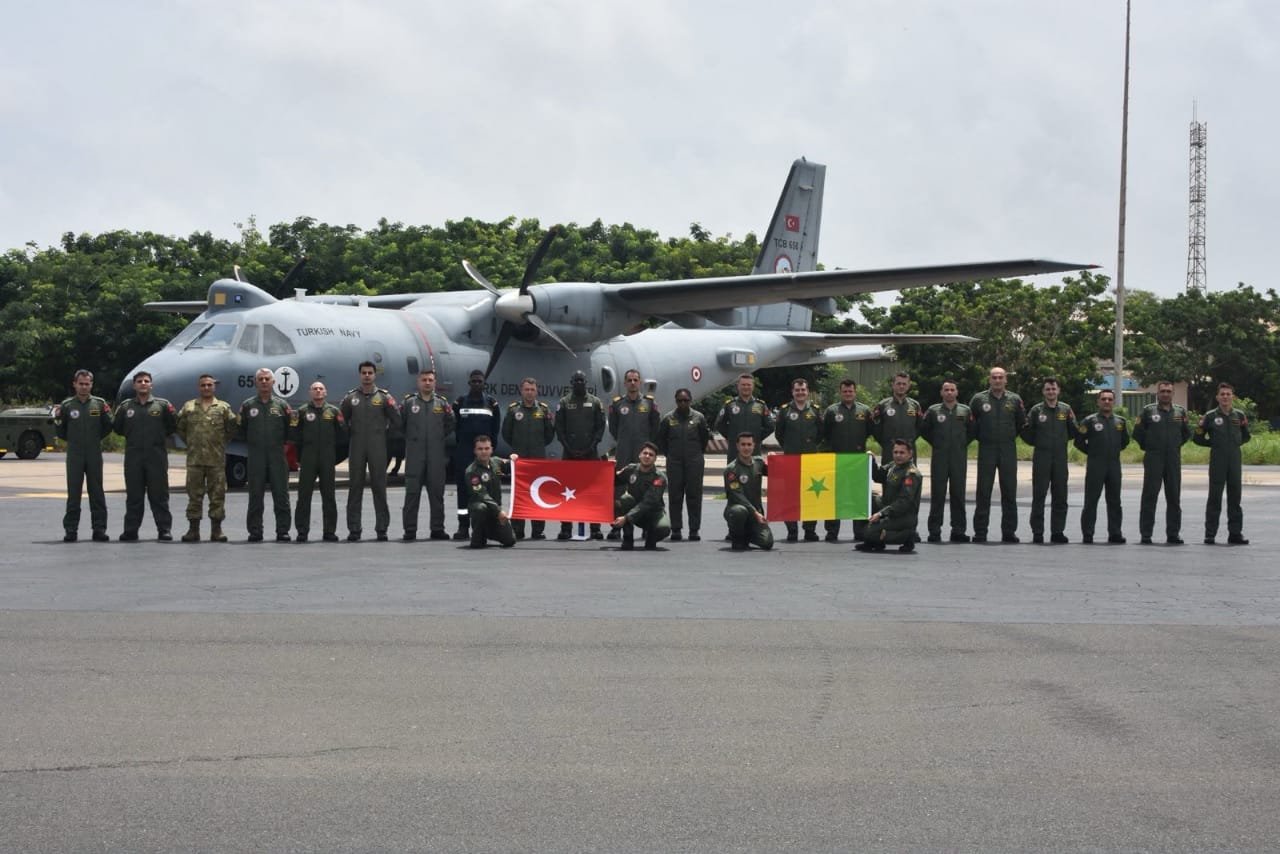
Since 2025, the Turkish Navy has kept a rotating team based in Dakar to fly regular search, rescue, and surveillance missions over Senegal’s waters and airspace. Working alongside Senegalese aircrews, this joint operation has continued without interruption, with the latest round of flights taking place in September 2026.
The aircraft involved includes Turkey’s P-72 maritime patrol aircraft (MPA), a militarized version of the ATR-72/600 turboprop developed under the MELTEM-III programme. They belong to 301 Filo, based at Cengiz Topel Naval Air Base near Kocaeli in northwest Turkey, and typically reach Senegal via Rota in Spain and Gran Canaria before the final leg into Dakar. The outgoing Turkish aircraft met a handover flight over the Mauritania-Senegal border in May 2026, allowing a seamless crew and aircraft rotation without a coverage gap.
By 18 May 2026, Turkish patrol aircraft had flown 76 sorties and more than 358 hours over Senegal’s airspace and maritime zones since the deployment began, according to Turkish reporting on the mission. The Turkish Ministry of National Defence has framed the flights as reconnaissance, surveillance and maritime surveillance support, with Senegalese aircrews taking part directly rather than acting only as observers.
Turkey maintains a standing rotation of aircraft and flight crews through Dakar, so training coverage continues without long breaks, and the ministry said the goal is to build Senegal’s own search-and-rescue capacity, improve coordination between the two navies, and strengthen bilateral trust. Senegal’s coastline runs roughly 700 km along the Atlantic, and the country has struggled for years to police it consistently given a small air and naval inventory relative to the size of its exclusive economic zone.
The current air deployment sits on a broader defence relationship that has grown steadily rather than appeared overnight. In August 2025, Senegalese Prime Minister Ousmane Sonko led a delegation to Ankara, where he met President Recep Tayyip Erdogan and toured the Aselsan and Havelsan defence-industry campuses. The visit produced 4 agreements, including a military financial cooperation accord signed by Turkish Defence Minister Yasar Guler and his Senegalese counterpart, General Birame Diop. Erdogan told reporters at the time that the two sides had discussed “joint steps that we can take in the areas of security, the defence industry and the fight against terrorism”.
Havelsan, Turkey’s military software and systems house, has worked with the Senegalese navy since at least 2020 on projects aimed at protecting offshore fisheries and hydrocarbon assets, an area where illegal fishing fleets have long cost West African states revenue and food security. Aselsan has pursued its own contracts with Dakar since roughly the same period. France’s PIRIOU delivered the second of 3 OPV 58S offshore patrol vessels, named Niani, to the Senegalese navy in 2023, and Indonesia’s PT Dirgantara has supplied Senegal’s air force with CN-235 maritime patrol aircraft of its own. Senegal is building a layered coastal surveillance capability by drawing on several suppliers at once rather than relying on one country alone.
The P-72 is a capable modest tool for this kind of mission. Derived from the ATR-72-600 airframe, it carries a maritime surveillance radar, electro-optical sensors and, in its full anti-submarine warfare fit, sonobuoys and lightweight torpedoes, though the aircraft flying over Senegal are performing surveillance and training roles rather than armed patrols. Turkey has slowly built up this fleet after a long procurement delay; a sixth P-72 ASW aircraft entered service with the Naval Air Command earlier in 2023, giving the navy more flexibility to sustain overseas deployments like the Dakar rotation without stretching its home patrol commitments in the Aegean and eastern Mediterranean too thin.
Turkey’s interest in Senegal fits a wider pattern across Africa. Ankara has signed defence agreements with states including Somalia, Libya, Kenya, Rwanda, Ethiopia, Nigeria and Ghana over the past decade, often pairing political outreach with sales of drones and other relatively affordable hardware. Erdogan has visited Senegal twice, in 2018 and 2020, and Turkish Airlines now flies direct to Dakar, a commercial link that has helped keep the relationship active between high-level visits.
Turkish training and equipment arrive with fewer political strings than some legacy partnerships, at a moment when several West African governments are reassessing ties with former colonial powers. Regional maritime security threats, from oil pollution incidents like the tanker scare off Dakar in November 2025 to piracy risk in the wider Gulf of Guinea, require more than patrol flights: coast guard vessels, port security and legal enforcement capacity all matter as much as overhead surveillance.