

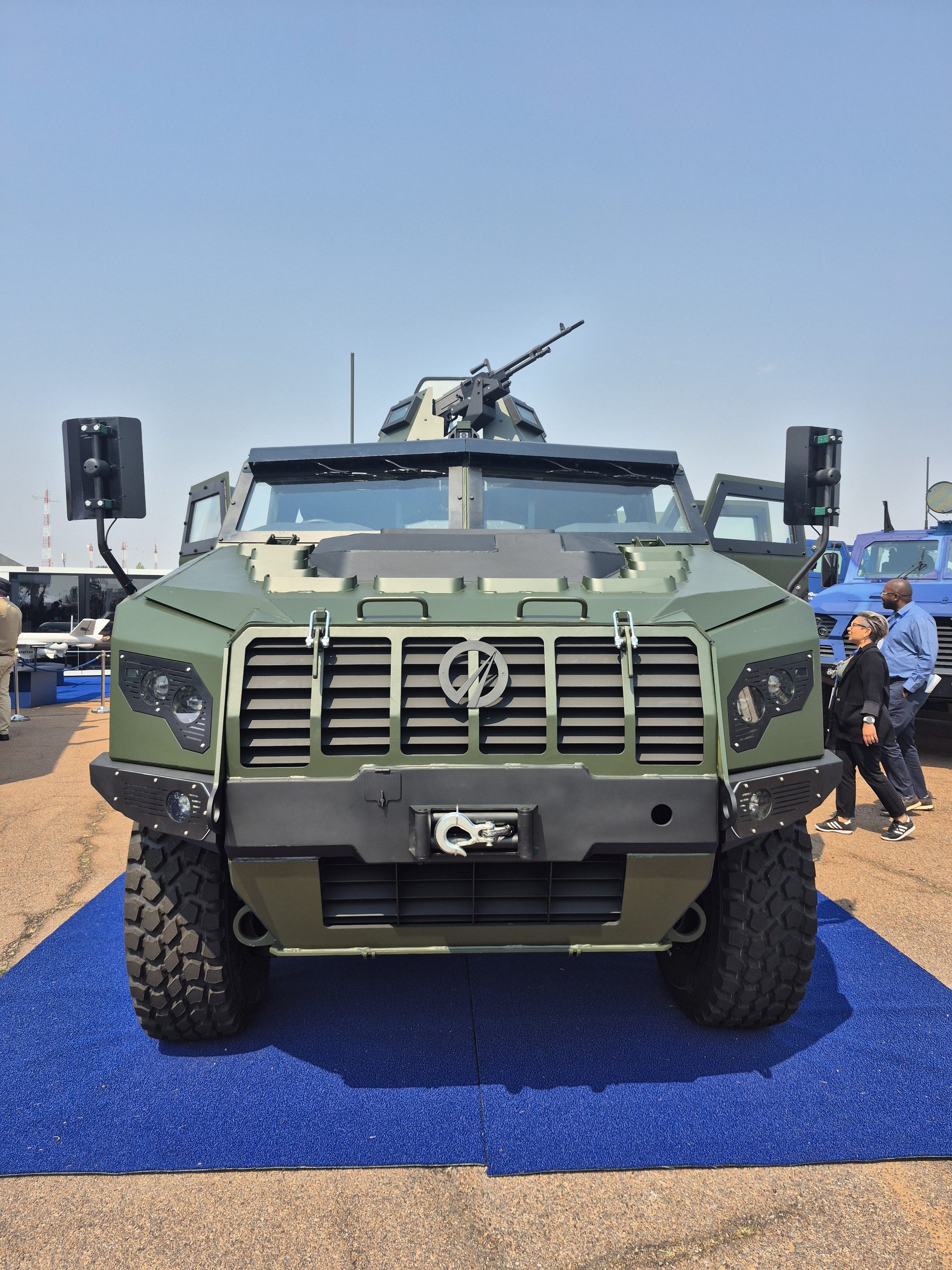
Paramount and Kalyani Strategic Systems Limited (KSSL) unveiled the Mbada, a new 4×4 light armoured modular vehicle (LAMV), at the Africa Aerospace and Defence exhibition (AAD 2026) at Air Force Base Waterkloof on 17 September, giving the platform its first public showing at an international defence exhibition. The name is new, but the vehicle underneath it is not entirely so.
A Familiar Platform Under a New Name
Military Africa reported in June 2026 that Paramount and KSSL first unveiled this same platform at Eurosatory in Paris on 16 June, under the name Simha, Sanskrit and Hindi for lion, aimed at Indian and other global buyers. Mbada is the Shona word for leopard, and the two companies have confirmed the vehicles share an identical underlying design, with the naming split reflecting regional marketing rather than any difference in engineering. Paramount and KSSL describe the branding choice as intentional: where Simha evokes the animal’s association with India and South Asian markets, Mbada is meant to signal the vehicle’s fit for African operating conditions specifically, built around what the companies call the leopard’s combination of lightweight build, speed, agility and adaptability.

The partnership behind the vehicle predates both launches by several years. KSSL, the wholly owned defence subsidiary of Bharat Forge Limited and part of India’s Kalyani Group, has worked with Paramount since at least February 2021, when the two companies agreed to manufacture Paramount’s Marauder-derived Kalyani M4 protected vehicle in India. That collaboration has already seen real African deployment: Indian peacekeepers fielded the Kalyani M4 in Abyei, Sudan, from April 2023 as part of United Nations peacekeeping operations there, giving the Paramount-KSSL relationship a documented operational track record on the continent well before Mbada’s unveiling. The Kalyani M4 shares a broadly similar drivetrain torque figure to the new Mbada, at 1,627 newton-metres, though the M4 is a heavier, more specialised extraction and occupant-protection vehicle rather than the multi-role platform Mbada is designed to be.
What Mbada Offers
At approximately 10 tonnes kerb weight, Mbada is built around a 450 horsepower (336 kilowatt) six-cylinder turbo-diesel engine producing 1,627 newton-metres of torque, paired with a six-speed automatic transmission, a two-speed lockable transfer case, and independent front and rear suspension, a configuration intended to give the vehicle strong off-road capability without the weight penalty of a heavier armoured platform. Top road speed is rated at 110 kilometres per hour.
A comprehensive range of optional mission and survivability systems can be integrated, including weapons and ammunition racks, communications and intercom systems, C4I, antenna mounts, roof-mounted searchlights, wire cutters, central tyre inflation systems, run-flat tyres, shooting ports, winches, snorkels, FLIR night-driving systems and parking sensors.
Protection is built around a fully welded monocoque hull rated to STANAG 4569 Level 1 and Level 2 for ballistic protection, the North Atlantic Treaty Organization’s standard scale for assessing armoured vehicle survivability, with Level 2a and 2b blast protection covering a 6-kilogram TNT-equivalent mine detonating beneath either the wheel or the hull. That places Mbada toward the lighter end of the protection spectrum among vehicles in its weight class, a deliberate trade-off in favour of mobility and payload rather than maximum survivability, consistent with its positioning as a light rather than heavy protected platform. The vehicle carries a crew of four, a driver, commander and two additional crew members, accessed through four side doors, and includes a turret ring for mounting a weapon station. Paramount and KSSL list an extensive range of optional equipment available for integration, including weapons and ammunition racks, communications and intercom systems, command, control, communications, computers and intelligence (C4I) systems, antenna mounts, roof-mounted searchlights, wire cutters, a central tyre inflation system, run-flat tyres, firing ports, a winch, a snorkel for wading, forward-looking infrared (FLIR) night-driving cameras and parking sensors, allowing individual customers to configure the base vehicle toward reconnaissance, internal security, border protection, special forces support, troop transport, logistics, command and control, surveillance or weapons carriage roles. Rated for operation between minus 20 and plus 45 degrees Celsius without additional preparation, and available in both left- and right-hand-drive configurations, the vehicle is aimed squarely at export markets with varied climates and driving conventions rather than a single domestic customer.
As with the Simha unveiling in June, Paramount and KSSL have disclosed no signed government contract or named launch customer for Mbada, and neither company has published a timeline for production trials or customer evaluation. Lindiwe Tshabalala, Chief Executive Officer of Paramount South Africa, framed the vehicle’s development around a broader shift in demand she described among armed forces facing dispersed and unpredictable operating environments, which she said increasingly call for lighter, more agile armoured vehicles able to integrate new technology and weapons systems quickly. Neelesh Tungar, Chief Executive Officer of KSSL, described the vehicle as combining KSSL’s engineering and manufacturing base with Paramount’s protected mobility experience into what he called a future-ready platform. Both statements reflect the companies’ own framing of the launch and should be read as such rather than as independent assessment of the vehicle’s performance, which has not yet been demonstrated through disclosed testing or trials.
Part of a Broader Push
Mbada’s unveiling extends KSSL’s expansion beyond its original M4 programme into a wider vehicle and weapons portfolio. At the same Eurosatory show where Simha debuted, KSSL also displayed the MArG 39, a 155-millimetre, 39-calibre howitzer mounted on a truck chassis, described as the first of a planned family of artillery systems built around a shared 4×4 platform, suggesting the Paramount-KSSL partnership is positioning itself to offer a more complete family of mobility and firepower products rather than a single vehicle line. For Paramount, the launch adds to a portfolio already anchored by its Mwari multi-mission aircraft and its established protected-mobility lineage, giving the company two active axes, aerial and ground, through which it is pursuing both African and international export markets simultaneously at AAD 2026.