

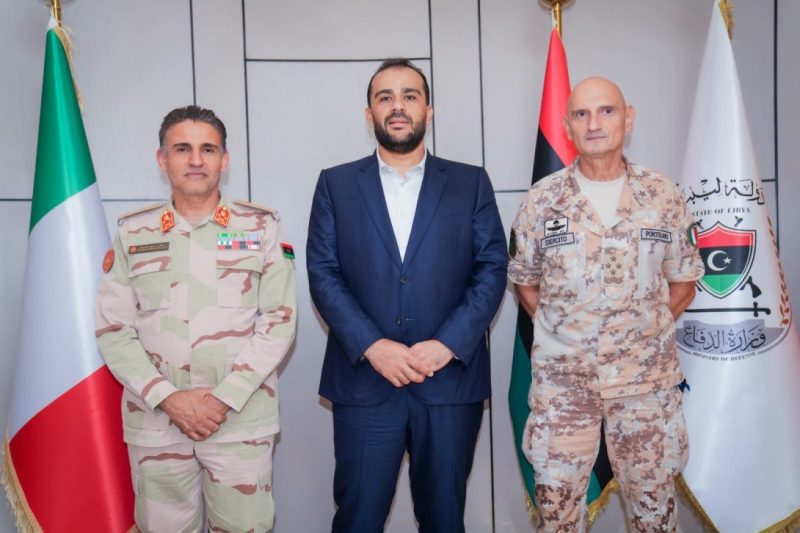
On September 10, 2026, Italy’s Chief of Defence Staff, Lieutenant General Luciano Portolano, met his Libyan counterpart, Lieutenant General Salah al-Din al-Namroush, in Tripoli to discuss deeper military cooperation, with training and professional development at the top of the agenda.
Portolano was received at the General Staff headquarters of Libya’s Government of National Unity (GNU), where the two generals held bilateral talks following a welcoming ceremony. The Discussions covered training, capacity-building, and exchange of military expertise between the two forces. Both sides reviewed progress made under existing cooperation programs and agreed to build on those results. After the General Staff meeting, al-Namroush and Portolano traveled to the Libyan Defence Ministry, where they met Deputy Defence Minister, Major General Abdulsalam al-Zoubi. The 3 officials discussed strengthening cooperation across military and defence fields broadly, according to a statement from the Libyan General Staff.
The Tripoli visit follows a similar meeting in Rome in July 2026, when al-Namroush traveled to Italy and met Portolano at the Italian General Staff headquarters. That visit produced an agreement to broaden the 2020 Italian-Libyan defence cooperation pact with new elements, including cyber defence training and Italian-language instruction delivered in Tripoli to prepare Libyan personnel for courses at Italian military institutions. Al-Namroush also visited Italy’s Joint Special Forces Command in Rome, where he discussed expanding training for Libyan special operations units with Vice Admiral Paolo Pezzutti.
In March 2025, the Italian and Libyan air forces signed a technical agreement to train Libyan pilots in Italy. Italy’s Air Force chief of staff, General Luca Goretti, signed for Rome, while Libya’s air force chief, Brig Gen Emhamed Goujil, signed on behalf of Tripoli. The deal builds on a foundation laid in December 2020, when Libya’s then-defence minister Salaheddin al-Namroush and his Italian counterpart signed a joint military-technical cooperation agreement in Rome covering training, maintenance, border security, and disaster response.
In 2018, Rome donated 12 patrol vessels (including Corrubia-class vessels) to the Libyan Navy, part of an effort to build up Libya’s coast guard and maritime security capacity. Italy also maintains the bilateral Miasit mission, which deploys roughly 100 personnel across Tripoli and Misrata to support reform of Libya’s defence institutions, according to Italian reporting on the mission’s role.
An Italian Air Force MQ-9A Predator B drone, an unmanned aircraft used for surveillance and precision strikes, crashed near Tarhunah in western Libya in November 2019 while flying a maritime surveillance mission known as Operazione Mare Sicuro. Rome confirmed the loss and said it had informed Libyan authorities of the flight beforehand, though it never made the cause of the crash fully public.
More recently, a UN panel of experts alleged in an April 2026 report that Italian training activity in Libya had breached the UN arms embargo. Italy’s foreign ministry rejected the finding, saying training for the Libyan armed forces falls under exemptions written into UN resolutions and had been notified in advance to the Defence Ministry. The dispute shows how closely Libya’s fragmented security sector remains tied to international sanctions law, even as individual states pursue bilateral training deals.
Russia has expanded its footprint at six Libyan air bases, Al-Jufra, Al-Khadim, Al-Qardabiyah, Brak al-Shati, Maaten al-Sarra, and Tamanhint, according to satellite analysis published by the US National Geospatial-Intelligence Agency’s Tearline Project, in August 2026. Those sites reportedly host MiG-29 fighter jets, drones, and air-defence systems, operated by Russian military personnel and Africa Corps mercenaries who succeeded the Wagner Group after its 2023 mutiny. Personnel numbers at some bases have grown substantially since late 2024.
Italy’s training push in Tripoli functions, in part, as a counterweight to that presence. Rome cannot match Moscow’s basing and hardware commitments, but it can offer Libyan officers a parallel institutional track, one built on professional education rather than deployed hardware. Analysts describe this as an attempt to give Libya’s armed forces an alternative to Russian-linked infrastructure without directly confronting Moscow’s position in the country.
None of this cooperation resolves Libya’s underlying political fracture. The country still operates under two rival governments, the GNU in Tripoli and a parallel administration backed by the House of Representatives in the east, and its military remains split accordingly. Portolano’s visit dealt only with the western-based GNU chain of command, leaving Rome’s relationship with eastern forces loyal to the Libyan National Army largely untouched.