

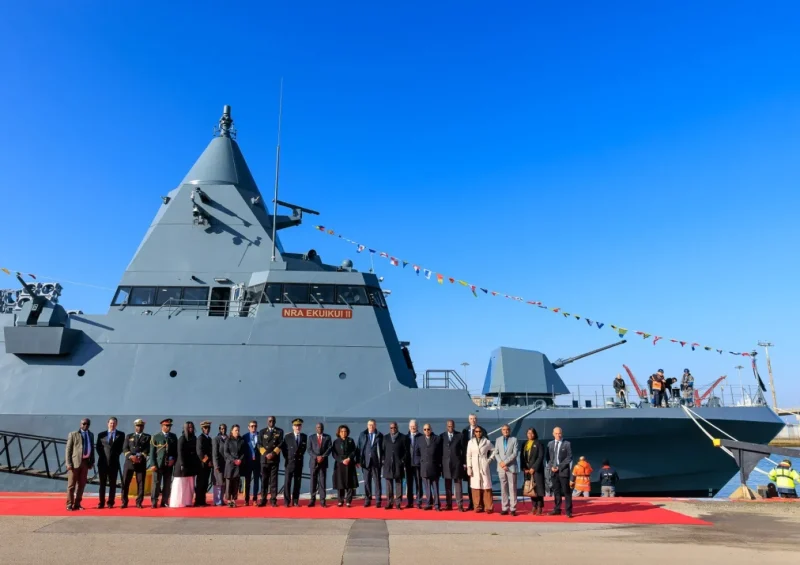
French shipbuilder CMN Naval launched the NRA Ekuikui II (F300), the first of three BR71 MKII Combattante corvettes for the Angolan Navy, during a ceremony in Cherbourg on March 4, 2026.
The launch marks a primary milestone in a 1-billion-euro contract signed in February 2023 between the Angolan government and the UAE-based EDGE Group. Under this agreement, Abu Dhabi Ship Building (ADSB) serves as the prime contractor for a fleet modernisation program that includes the three 71-meter corvettes, several smaller tactical interceptors, and unmanned systems. While ADSB manages the overall program, CMN Naval is building the first and third vessels in France, while the second will be constructed in Abu Dhabi to facilitate technology transfer to the UAE shipyard.
Steel for the Ekuikui II was first cut in December 2023, with the hull laid down in March 2024. Following the recent launch, the vessel will undergo outfitting and sea trials before its scheduled delivery in October 2026. The remaining two ships are expected to join the fleet in April and October 2027. These vessels will eventually operate alongside seven ADSB-built high-speed interceptors already delivered to Luanda, part of a larger order for up to 12 small patrol craft.
Littoral capability and mission systems
The BR71 MKII is a 900-ton light corvette evolved from the Baynunah-class design used by the UAE Navy. It features a steel hull and aluminium superstructure with a focus on stealth through a reduced radar cross-section. Measuring 70.3 meters in length with an 11-meter beam, the platform is designed specifically for littoral warfare, maritime border security, and intelligence gathering. Its propulsion system uses four MTU diesel engines driving four Kongsberg waterjets, allowing the ship to reach 30 knots. It maintains a 2,500-nautical-mile range at a cruising speed of 12 knots.
Angola has opted for a heavy armament package that provides air defence and anti-surface capabilities rare for vessels of this displacement. The primary weapon is a Leonardo 76/62mm Super Rapido main gun, supported by two Leonardo Lionfish 20mm remote weapon stations for close-in defence. For surface engagements, the ships carry eight MBDA Exocet MM40 Block 3C anti-ship missiles. Air defence is managed via an eight-cell vertical launching system for VL MICA missiles, complemented by two MBDA Simbad-RC launchers firing Mistral 3 short-range missiles.
The sensor suite is equally sophisticated for the region. The corvettes will utilise a Leonardo Kronos family 3D multi-function radar, capable of simultaneous surveillance and target tracking. Elettronica (ELT Group) provides the integrated electronic warfare suite, including the ELT/332 system for radar and communications intelligence. This setup is integrated into a combat management system that also controls the ship’s organic unmanned assets.
Each corvette will deploy two ANAVIA HT-100 Naval unmanned helicopters. These Swiss-designed, turbine-powered vertical take-off and landing (VTOL) systems have a six-hour endurance and carry electro-optical/infrared sensors for extended over-the-horizon surveillance. The inclusion of these drones allows the 50-person crew to monitor Angola’s 1,600km coastline without the high operating costs associated with the 5-ton manned helicopters, and the flight deck is also rated to support.
The delivery of the Ekuikui II will significantly shift the maritime balance in the Gulf of Guinea. Currently, the Angolan Navy relies on ageing Soviet-era fast attack craft and smaller offshore patrol vessels with limited reach. The new corvettes provide a persistent, high-end presence capable of countering piracy, illegal fishing, and protecting offshore oil infrastructure. This procurement shows a clear intent by Luanda to transition from a green-water force to one capable of sustained operations throughout its exclusive economic zone.
The next major step for the program will be the commencement of sea trials for the Ekuikui II later this year, alongside the continued construction of the second vessel at the ADSB shipyard in Abu Dhabi.
Angola’s partnership with CMN extends to local assembly and maintenance. Angola officially inaugurated a new production line dedicated to the assembly and maintenance of naval vessels at the Lobinave shipyard. This development represents a notable shift in the maritime defence strategy of the West African nation as it seeks to localise technical expertise and sustainment. The project operates in close partnership with the French shipbuilder Constructions Mécaniques de Normandie (CMN), part of the Privinvest group. This will handle a range of Angolan Navy equipment such as WP18 interceptors, stealth assault and ultra high-speed special operations vessels, as well as frigates and corvettes.
It appears the Lobinave yard will manufacture DV15 interceptor vessels: television news coverage of the inauguration event showed a mould for the DV15 in a new shed at the yard and an incomplete DV15 hull. The 15 metre long DV15 is capable of exceeding 50 knots.