

On January 12, 2026, Angola officially inaugurated a new production line dedicated to the assembly and maintenance of naval vessels at the Lobinave shipyard. This development represents a notable shift in the maritime defense strategy of the West African nation as it seeks to localize technical expertise and sustainment. The project operates in close partnership with the French shipbuilder Constructions Mécaniques de Normandie (CMN), part of the Privinvest group. General Francisco Furtado, who serves as the Minister of State and Chief of the Military Household of the President of the Republic, led the ceremony. His office advises President João Lourenço on military affairs and commands the presidential security forces, making his presence a clear indicator of the strategic priority placed on naval self-sufficiency.
General Furtado stated during the launch that, “The world is facing geopolitical and geostrategic challenges that require each country to create the capacity to defend itself.”
This push for modernisation is driven by the requirement to secure a coastline extending 1,650 kilometres alongside an expansive Exclusive Economic Zone (EEZ). The Angolan government intends to transform the Navy into a force capable of meeting modern security demands, including anti-piracy, fisheries protection, and the safeguarding of offshore energy assets.


Infrastructure Upgrades at Lobinave
The Lobinave shipyard in Lobito is undergoing a comprehensive physical and technical transformation to support these new responsibilities. Hermenegildo dos Santos, the chairman of Lobinave, confirmed that the facility is currently receiving upgrades to its pier and an expansion of its repair park. A central feature of this modernisation is the installation of a new floating dock, which will allow the yard to service larger vessels. While the primary focus of the new production line is the Angolan Navy, the yard will continue to provide maintenance and repair services for civilian commercial vessels, ensuring the facility remains economically viable through a dual-use model.
The partnership with CMN involves the French firm overseeing the assembly of specialised equipment and the transfer of technical knowledge to the local workforce. This collaboration has already yielded results over the last several years. Since 2018, the yard has facilitated the delivery and support of various assets, including DV15 and HSI32 interceptors, Ocean Eagle 43 long-range surveillance trimarans, and LCT 200-70 landing craft.
Local Production of Interceptor Craft
Evidence from the inauguration ceremony suggests that the Lobinave facility will now take a more active role in the physical construction of hulls rather than just final assembly. Television footage of the new production sheds showed a mould for the DV15 interceptor and a hull in an incomplete state. The DV15 is a 15-meter vessel designed for high-speed maritime interdiction and coastal patrol. It is capable of speeds exceeding 50 knots, making it an ideal platform for countering fast-moving asymmetric threats.
Beyond the DV15, the yard is expected to manage a diverse portfolio of equipment. This includes WP18 interceptors, which are ultra-high-speed vessels used for special operations and stealth assaults. The long-term vision for Lobinave includes the maintenance and support of larger surface combatants, such as the frigates and corvettes currently being added to the Angolan fleet.
The BR71 Mk II Corvette Program
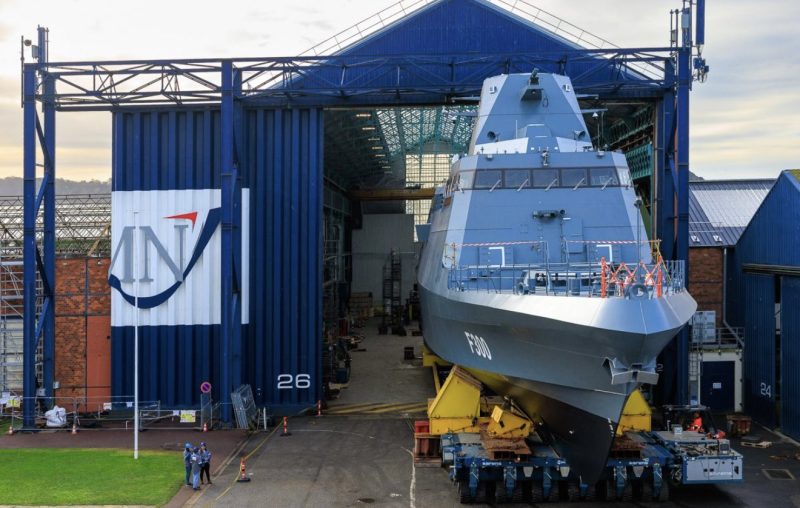
The centrepiece of Angola’s naval surface combatant expansion is the acquisition of three BR71 Mk II corvettes. This program is a collaborative effort between CMN and Abu Dhabi Shipbuilding (ADSB). The BR71 Mk II is an evolution of the Baynunah-class corvettes originally developed for the United Arab Emirates. These 71-meter ships are among the most capable combatants in CMN’s current portfolio.
The lead ship of the class was recently rolled out at the CMN facility in Cherbourg, France. It is currently undergoing the fitting-out phase, which includes the installation of the 76 mm main gun mount. The armament suite for these corvettes is substantial for their size, featuring Exocet MM40 anti-ship missiles and VL MICA surface-to-air missiles for point defence. They also carry Simbad RC launchers for short-range air defence. These vessels are designed for multi-mission flexibility and can operate a medium-sized helicopter, an unmanned aerial vehicle (UAV), and high-speed rigid hull inflatable boats (RHIBs) for boarding operations.
The lead corvette is scheduled for launch in March 2026, with sea trials to follow immediately. The Angolan Navy expects delivery of the first vessel in October 2026. While CMN is building the first two ships, ADSB is constructing the third vessel in the United Arab Emirates. Current projections indicate that all three corvettes will be fully operational in Angolan service by 2027.
Integrated Maritime Domain Awareness
The expansion of the fleet is being paired with a robust investment in Maritime Domain Awareness (MDA). Modernisation efforts include the establishment of several maritime surveillance coordination centres. The first of these facilities was inaugurated two years ago at the Soyo naval base in Zaire Province. Two additional centres are nearing completion in Lobito and Namibe. To link these hubs, the government is installing a network of maritime surveillance antenna centres and repeater stations to ensure seamless communication across the entire coastline.
The aerial component of this surveillance network reached a major milestone in late 2025. Two Airbus C295 maritime patrol aircraft (MPA) arrived in Angola in October 2025 to begin operations. These aircraft, operated through cooperation between the Navy and the Air Force, provide the long-range “eyes” necessary to direct the high-speed interceptors and corvettes toward potential threats.
The 2021 contract with the CMN Group has already resulted in the delivery of two 70-meter LCT-200-type tank landing craft and three Ocean Eagle 43 patrol boats. The final vessels in this order arrived in Angola in early 2025 via the semi-submersible heavy-lift vessel Yacht Servant. With the inauguration of the Lobinave production line, Angola is positioning itself to not only operate these advanced platforms but to sustain them domestically for decades to come.