
Future naval warfare will not wait for African fleets to finish yesterday’s shopping list. The next decade will reward navies that can see first, decide fast and strike or intercept without putting a frigate on every contact. That is not an argument against ships. It is an argument against treating hull count as strategy. Of Africa’s 54 states, 38 have a coastline, and most of their navies must police an exclusive economic zone (EEZ) many times larger than their land territory with a handful of seaworthy vessels.
A hybrid fight is already at sea
The fight that matters to Africa is already hybrid. Pirates, oil thieves, industrial illegal fishers, smugglers and, in some theatres, armed groups with cheap drones now share the same water with tankers, subsea cables and offshore energy. In the Gulf of Guinea, illegal, unreported and unregulated (IUU) fishing may equal 65% of the legally reported catch by some estimates, and the region carries about a quarter of Africa’s maritime traffic.
Red Sea disruption and the return of Somali piracy have shown how quickly a distant crisis can raise insurance costs and empty African ports. Houthi attacks on shipping from late 2023 diverted traffic around the Cape of Good Hope, and Egypt’s President Abdel Fattah al-Sisi said in late 2024 that the Suez Canal had lost about $7 billion in revenue that year. Off Somalia, pirates have returned to the hijacking business. The International Maritime Bureau (IMB) recorded only 51 piracy incidents worldwide in the first nine months of 2026, the lowest since 1992, but Somali gangs carried out all eight hijackings and held 94% of the crew taken hostage, Baird Maritime reported. Five crew of the tanker Honour 25 were killed before Puntland forces freed it in September. A navy built only for coastal patrol against yesterday’s skiff will be late to tomorrow’s problem.
Buy the sensors and the connectors first
The highest-value purchase is not always a new corvette. It is maritime domain awareness (MDA) that actually works: coastal radar, automatic identification system (AIS) fusion, satellite and radio-frequency data, ship-launched and shore-launched unmanned aircraft, and unmanned surface vessels (USVs) that can stay on station when sailors cannot.
Nigeria’s mix of patrol ships, AYBARS-2 drones and SwiftSea Stalker USVs points in the right direction. The Navy received two SwiftSea Stalkers, rated at more than 45 knots and 40 hours’ endurance, in January 2024, and in January 2026 integrated the AYBARS-2 vertical take-off drone, which flies for seven to eight hours from a patrol vessel or coastal site. Seychelles has shown that long-range surveillance aircraft and drones can police a vast EEZ, about 1.4 million square kilometres, without a large combat fleet, trialling AI-enabled drones with fisheries intelligence partners under its FishGuard project.
The next buy should include counter-drone guns and sensors for patrol vessels, secure radios that talk across national maritime operations centres, and a modest stock of precision munitions for the few ships that can carry them. Gun-based options such as MKE’s TOLGA 20mm dual revolver system or ASELSAN’s KORKUT 35mm system, now marketed in Africa, show how much cheaper it is to shoot a drone down with shells than with missiles. Buying another platform that cannot share a common operating picture is buying a liability.
Build what must be sustained at home
African navies cannot assemble destroyers next year. They can build and maintain the boats they use every week. Nigeria’s Seaward Defence Boats, three of which are in service with two 44.2-metre hulls under construction in Lagos, Egypt’s small USV programme, which produced the armed USV-AIO-001 shown at the Egypt Defence Expo (EDEX) 2025, and South Africa’s local surface-drone and mine-warfare experiments, from the Sea Serpent USV to the REMUS A100 underwater vehicle, are the right scale.
The industrial task is to standardise patrol-craft designs, keep engines and electronics supportable, and grow yards that can also refit a neighbour’s ship, as Lagos has begun to do for Benin. Naval Dockyard Limited has returned three refitted Benin Navy vessels and is working on three more. Private money can help: the security support vessel Kali 3, built in Delta State, is the first of ten funded by an oil company.
Containerised payloads, modular guns and unmanned-system control rooms should be designed into new hulls from the start, so a patrol vessel can carry a drone detachment one month and a mine-hunting module the next. A 2035 fleet that still depends on a foreign yard for every dry-docking will miss the war it was bought to deter.
Train for the network, not the parade
Hardware fails first in the human layer. Officers must learn to command mixed manned and unmanned units, to treat a maritime operations centre as a weapon, and to prosecute cases after an interdiction so arrests become convictions. Ratings need maintainers for drones, USVs and combat-management software, not only for diesels.
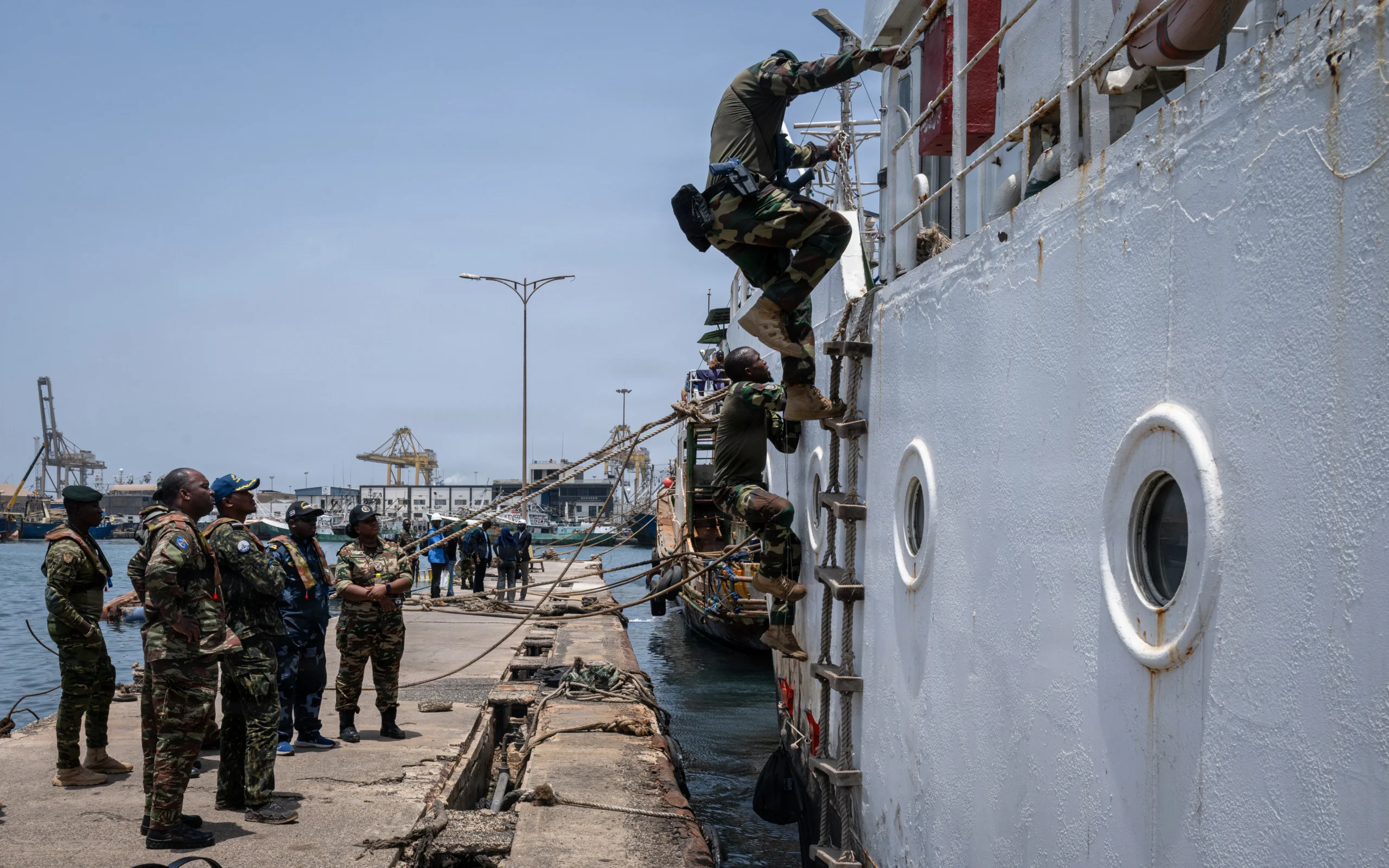
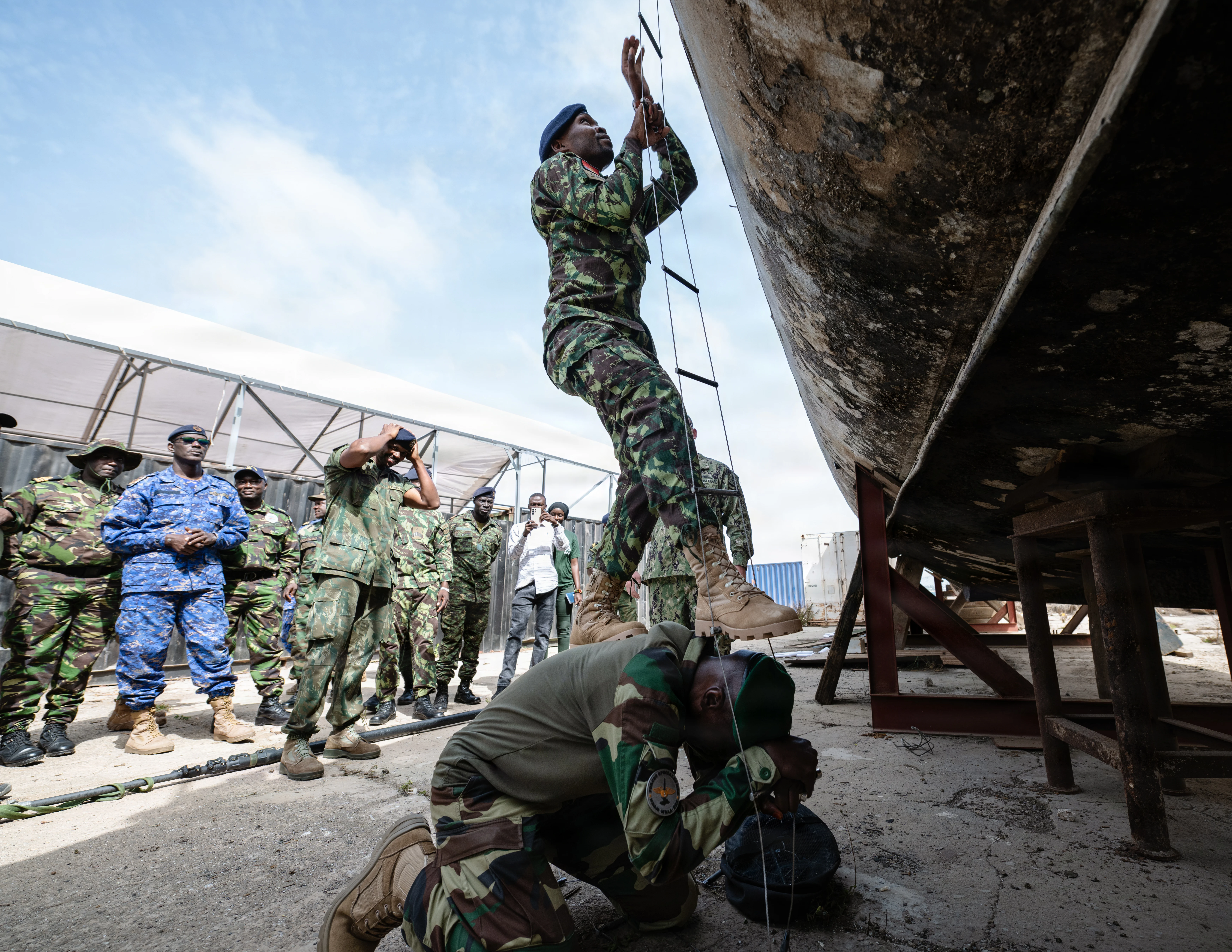
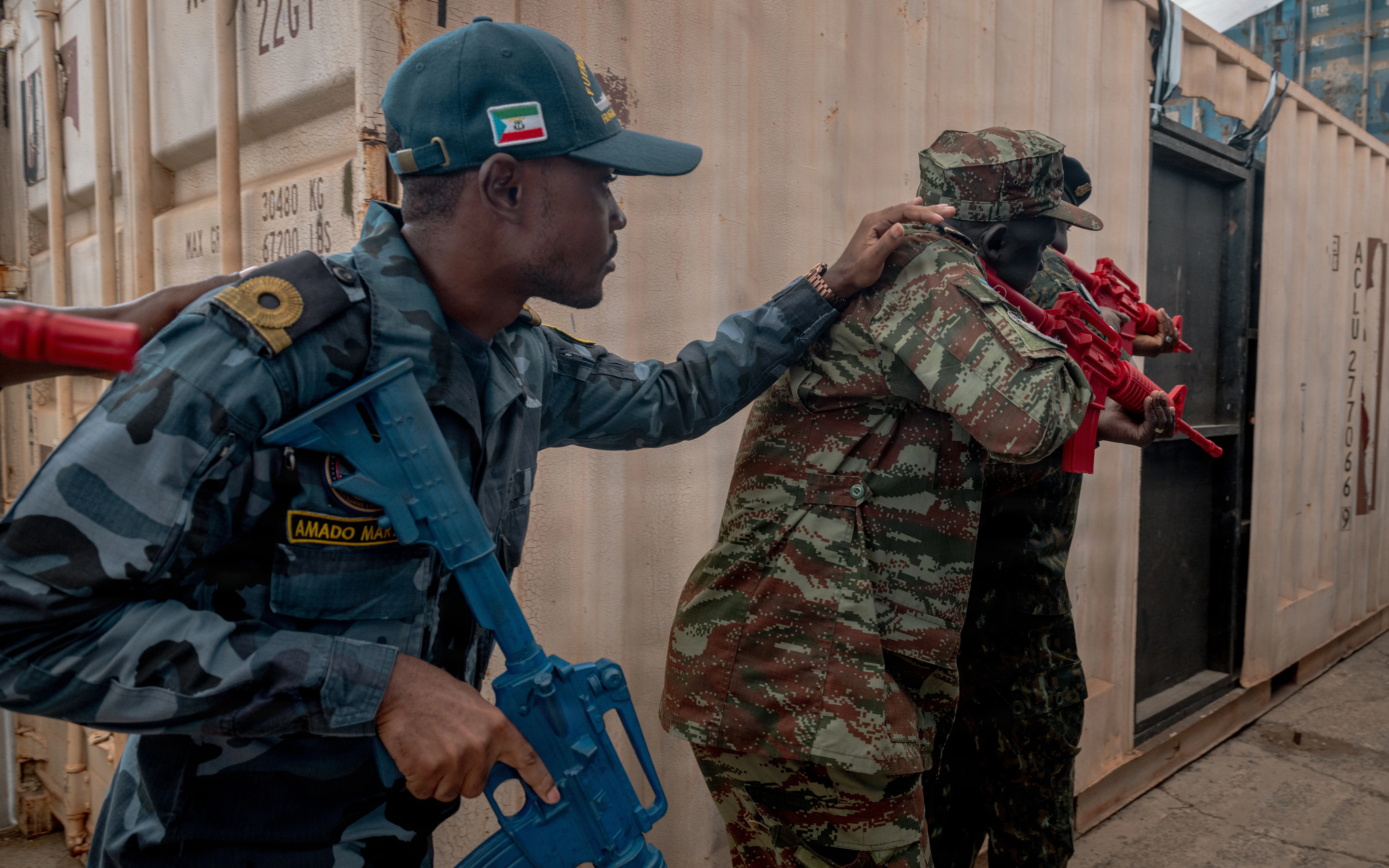
Regional exercises, including Obangame Express, Grand African Nemo and the drills of the new African Union Combined Maritime Task Force for the Gulf of Guinea, should stop treating uncrewed systems as guest technology and start writing tactics around them. At Obangame Express 2026, boarding teams from 17 nations, including 11 Gulf of Guinea states, trained in Senegal on tactical ship entry, evidence handling and fisheries inspection, U.S. Sixth Fleet said, while U.S. unmanned surface vessels were demonstrated separately in Douala. “In the face of the proliferation of increasingly complex, hybrid and transnational maritime threats, it has become essential for states to develop robust, credible and interoperable VBSS capabilities,” said Lieutenant Commander Alimamy Mbaye Bassene of the Senegalese Navy. The next step is to put African operators on the drone and USV consoles, not only on the boarding ladders.
Legal and rules-of-engagement training for autonomous patrol is overdue. So is staff work that links navy, coast guard, fisheries and prosecutors, the “state action at sea” model that Grand African Nemo has been rehearsing. A cheap drone that finds a trawler is wasted if no court will try the master.
Three traps already visible
First, prestige platforms that cannot be crewed or repaired. Africa’s coastline is littered with frigates and corvettes that spent more years alongside than at sea. Second, unmanned systems bought without communications, spare parts or doctrine; Nigeria’s nine Aerostar tactical drones, acquired years ago and now reported inoperable, are a warning. Third, dependence on extra-regional partners for the data layer that makes African waters visible. Foreign maritime patrol aircraft, such as the Turkish P-72s that have flown surveillance missions from Dakar since 2025, and foreign satellite services fill real gaps. Partners will still matter. Ownership of the picture must not.
Holding the sea by 2035
By 2035 the useful African navy will be a smaller number of reliable patrol and offshore ships, a larger number of unmanned scouts, a working regional picture, and people who can fight from a screen as well as a bridge. Buy persistence. Build sustainment. Train decision. That is the next leap: not a catalogue of imported steel, but a force that can hold the sea it claims.