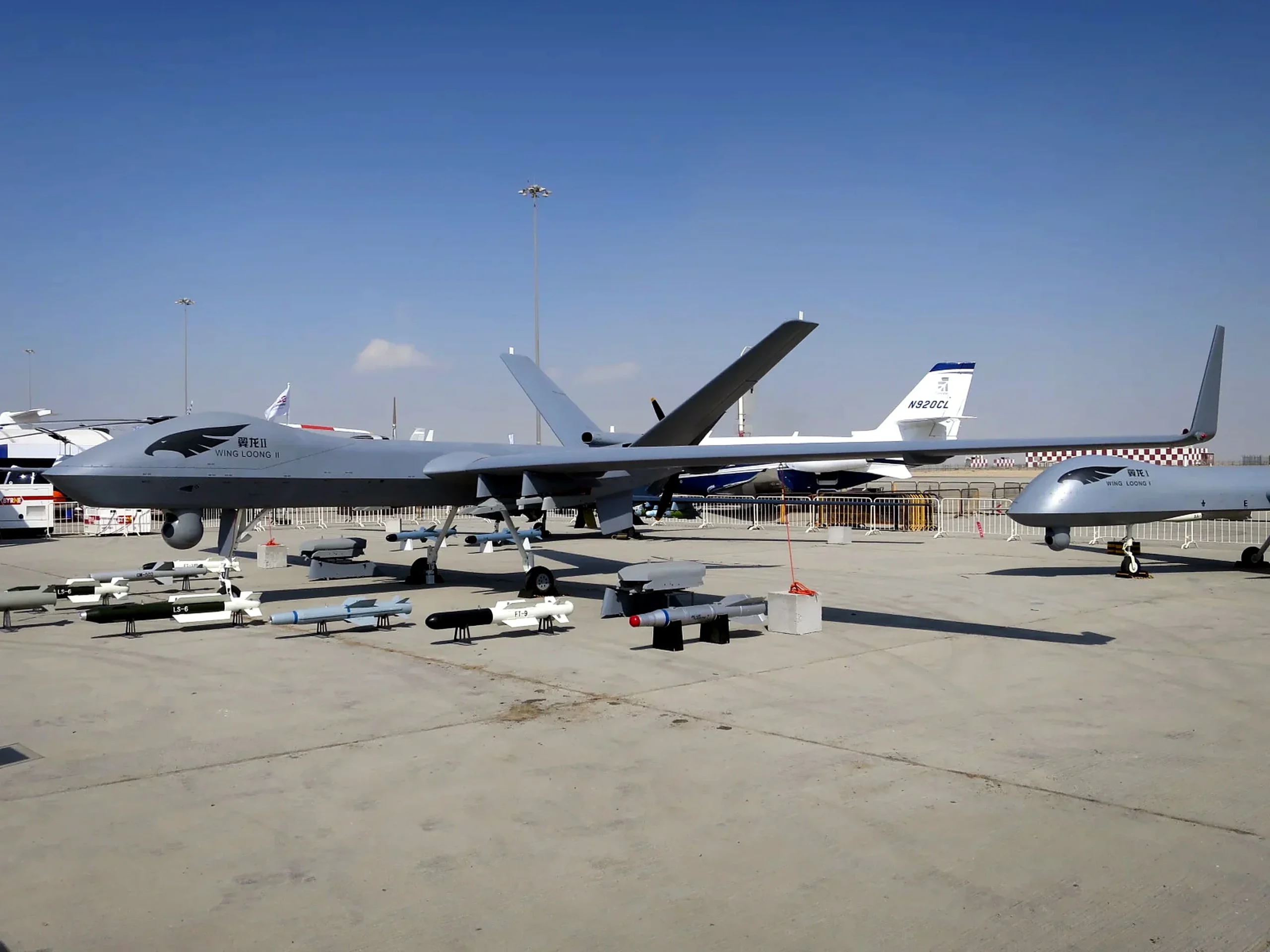
China is moving its arms sales to Africa up the value chain, from rifles and trucks to air defence systems, armed drones and radar, as Russia is drawn into its war in Ukraine and Western suppliers step back from parts of the continent. The South China Morning Post pointed to Mali’s Yitian-L air defence systems, Burkina Faso’s Norinco Sky Dragon systems and Côte d’Ivoire’s Wing Loong II drones as examples, in a report carried by Azerbaijan’s Report.az on 2 November.
The shift shows up in the numbers. According to the Stockholm International Peace Research Institute (SIPRI), China supplied 17 per cent of Africa’s major arms imports in 2021 to 2025, behind the United States at 19 per cent and ahead of Russia at 15 per cent. In sub-Saharan Africa, China was the largest supplier at 22 per cent.
Mali’s Yitian-L air defence
Mali has taken delivery of Yitian-L short-range air defence systems from China North Industries Corporation (Norinco), shipped through neighbouring Guinea in deliveries running into early 2026 under a contract signed in September 2024. The Yitian-L is mounted on a Dongfeng Mengshi 4×4 vehicle and carries four TY-90 infrared-guided missiles, with a range of 500 metres to 6 kilometres and an intercept altitude of 15 metres to 4 kilometres. A folding X-band radar detects fighter-sized aircraft at about 18 kilometres, and a passive thermal and laser sensor suite lets the crew engage without switching the radar on. The deliveries came with VN22 infantry fighting vehicles and the VN22B fire-support variant with a 105mm gun.
Burkina Faso’s Sky Dragon
In Burkina Faso, a presidency video released on 1 September 2026 showed a radar-supported missile system firing, which Janes identified as Norinco’s Sky Dragon 30. Norinco gives the system a range of 30 kilometres, a maximum engagement altitude of 18 kilometres and the ability to engage up to 12 targets at once. It is the first radar-cued air defence the Burkinabe armed forces have shown, adding to the Norinco armoured vehicles, artillery and rocket launchers delivered since 2024.
Côte d’Ivoire’s Wing Loong II drones
Côte d’Ivoire confirmed in August 2026 that it operates Wing Loong II medium-altitude, long-endurance (MALE) drones, becoming the second West African operator after Nigeria. The aircraft were bought under a June 2024 contract with the China National Aero-Technology Import and Export Corporation (CATIC), the trading arm of the state-owned Aviation Industry Corporation of China (AVIC), which also reportedly covers three K-8 jet trainers. The Wing Loong II can stay airborne for about 32 hours on surveillance missions and carry up to 480 kilograms of weapons on six hardpoints. For Abidjan, which has long relied on France, the deal is part of a broader effort to diversify its suppliers.
Why African buyers are turning to Beijing
Chinese suppliers offer African governments systems that are cheaper than Western equivalents, available without the political conditions attached to many Western sales, and increasingly capable. The three examples share a theme: air defence and drones, the two capabilities most in demand as armed groups and states across the Sahel adopt unmanned aircraft. China’s reach now extends from the Sahel to the Horn of Africa, where Ethiopia has just pledged deeper military cooperation with Beijing, and to Nigeria, where Norinco is working with the Nigerian Army in Bauchi.
Russia, by contrast, has struggled to deliver at scale, with its industry absorbed by the war in Ukraine, even as it lands headline deals such as Ethiopia’s Su-35 fighters. In the Alliance of Sahel States (AES), Mali, Burkina Faso and Niger now buy from both Moscow and Beijing, with Russia supplying aircraft and the Africa Corps while China provides much of the wheeled armour and air defence.
Sustaining Chinese systems in the Sahel
Selling more complex systems brings a new test for Chinese industry: keeping them working. Air defence radars, missile stocks and drone fleets need spare parts, technicians and training over many years, in conditions of heat and dust that punish electronics. Whether Norinco and AVIC can provide that support in Bamako, Ouagadougou and Abidjan will decide whether China’s move up the value chain becomes a lasting position in Africa’s arms market.