

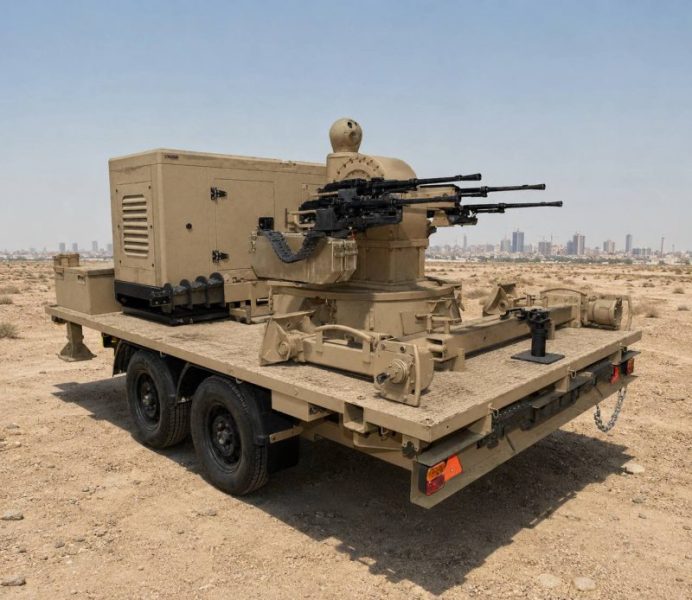
Russia has offered its “Bizon” counter-drone system to Egypt, an approach that comes weeks after Cairo confirmed what it described as an unprecedented drone strike on its Damietta Port, the first attack on Egyptian soil since the outbreak of the wider Iran-Israel-US conflict. The offer, reported by Defence Blog, was made without Rostec disclosing the system’s cost or a proposed delivery timeline.
What Happened at Damietta
On 29 July 2026, a drone strike set fire to two vessels at Damietta Port on Egypt’s Mediterranean coast, one of the country’s primary liquefied natural gas (LNG) import hubs. The affected ships included the Energos Winter, a US-owned, Marshall Islands-flagged floating storage and regasification unit that Egypt had chartered in mid-2025 under a five-year agreement to convert imported LNG back into usable gas, and the GasLog Salem, an LNG tanker. No casualties were reported, and no party claimed responsibility. Egypt’s cabinet confirmed a day later that preliminary investigations had identified a drone as the cause, and Prime Minister Mostafa Madbouly said technical teams had recovered and were analysing drone wreckage to determine its origin.
The strike landed squarely inside the wider regional war between Iran, Israel and the United States, which had escalated further that month after renewed US strikes on Iran following the collapse of a ceasefire framework. Iran’s Foreign Minister, Abbas Araghchi, publicly distanced Tehran from the attack, calling Egypt “an important friend” and warning instead of possible Israeli “false-flag operations.” Yemen’s Houthi movement separately denied targeting any vessel at Damietta. Egyptian authorities launched a high-level investigation specifically into how the drone had penetrated what analysts described as several existing layers of Egyptian air defence protecting a facility the government has characterised as both economically vital and heavily guarded, a framing one regional analysis described bluntly as exposing “flawed defense of critical energy infrastructure” and a wake-up call for Egyptian air defence more broadly.
What Bizon Offers
The TKB-1167 Bizon, developed by Rostec subsidiary High-Precision Systems, is the export variant of the Zubr short-range air defence system already in Russian military service. The system autonomously detects and tracks small, low-flying aerial targets and engages them using 7.62mm PKT machine guns, while reserving the final engagement decision for a human operator rather than acting on full autonomy. Bekhan Ozdoev, industrial director of Rostec’s Armaments Cluster, described Bizon as a “last line of defense,” saying it can interact with external detection networks or operate independently as a standalone layer within a broader counter-drone architecture. Ozdoev said the system is “already on combat duty and successfully engaging real targets, demonstrating a high reaction speed to the emergence of aerial threats,” a claim that, like most manufacturer statements about combat performance, has not been independently verified.
The positioning matters given what the Damietta incident exposed. A gun-based, human-supervised interceptor designed specifically to catch small, low-flying threats that have already slipped past longer-range detection and engagement layers addresses precisely the kind of gap a successful drone strike on a guarded facility implies, whether or not Rostec designed the pitch with Damietta specifically in mind.
A Long Pattern of Russian Counter-Drone Outreach to Cairo
The Bizon offer is not Russia’s first attempt to sell Egypt on its counter-drone technology, and situating it within that history is useful for judging how seriously Cairo might take it. Russia and Egypt signed a licensed production agreement in December 2023 at the Egypt Defence Expo (EDEX) for the Zashchita system, developed by Rostec’s Vector Research Institute, with Vega Group General Director Vyacheslav Mikheev noting Russia was simultaneously negotiating with other foreign customers for related electronic reconnaissance equipment. That agreement carried added significance as, according to Military Africa’s reporting at the time, the first Russia-Egypt defence deal reached after Cairo had previously cancelled a planned Su-35 fighter jet purchase under the threat of American sanctions, a reminder that Egypt’s defence procurement with Moscow operates under constant pressure from Washington’s own export relationship with Cairo. Russia followed with the SERP-VS6 counter-UAV system, developed by the Ruselectronics-affiliated Vector Research Institute, unveiled at the World Defense Show in February 2024, and continued its Egyptian outreach through EDEX 2025, where Rosoboronexport organised Russia’s national exhibit.
That pattern reached its fullest expression most recently at the El Alamein International Airshow in September 2026, where Rosoboronexport organised a Russian pavilion featuring the KUB-10ME loitering munition, the Lancet-E strike drone, a modernised Ka-52E attack helicopter and the modernised Yak-130M combat trainer, all pitched, according to Rosoboronexport’s own statement, as “combat-proven Russian products for Egypt, Africa and the Middle East.” Taken together with Egypt’s own parallel counter-drone development, including the domestically produced DJ-400 jamming system first shown at EDEX 2021 and the German-sourced Diehl SkyWolf high-power electromagnetic system integrated more recently, the Bizon pitch arrives as one more offer inside an already crowded field of suppliers Cairo has spent several years cultivating rather than a singular, urgent response unique to Damietta.
An Offer, Not Yet a Deal
Rosoboronexport describes itself as handling more than 85 percent of Russia’s arms and military equipment exports and maintaining military-technical cooperation with more than 100 countries, giving it both the institutional reach and the sales infrastructure to make a credible pitch to a government as experienced in evaluating Russian defence offers as Egypt’s. Whether the Bizon offer translates into anything more than a sales conversation will likely depend on factors well beyond the system’s technical merits, including how Cairo’s ongoing investigation into the Damietta strike’s origin ultimately concludes, and how much appetite Egypt has for adding yet another Russian counter-drone system to an already diversifying layered air defence architecture drawing on German, domestic and now a growing list of Russian sources at once.