

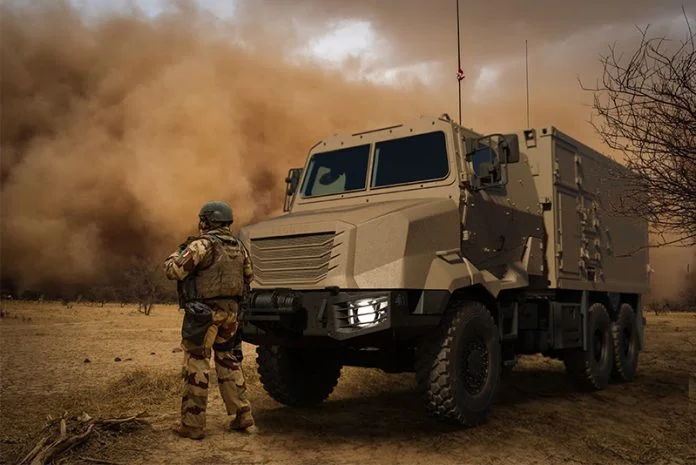
French defence manufacturer Arquus has won a contract worth more than €50 million to renew the logistics vehicle fleet of the Chadian army, according to reporting that credits the deal to a broader thaw in Franco-Chadian military relations after a bitter, very public rupture less than two years ago. The contract, negotiated under Arquus Chief Executive Officer Emmanuel Levacher, arrives at a moment when Paris and N’Djamena are cautiously rebuilding a security partnership that Chad’s government tore up in November 2024.
Neither Arquus nor the Chadian Ministry of the Armed Forces has published an official statement confirming the contract’s value or scope at the time of writing, and the figures and timeline below should be read as reported rather than independently confirmed by Military Africa.
From Rupture to Rapprochement
To understand why a French arms contract with Chad counts as news beyond the vehicles themselves, it helps to recall how abruptly the relationship collapsed. Chad and France had maintained a defence cooperation agreement for close to 65 years, one of the last such arrangements standing in the Sahel after Mali, Burkina Faso and Niger expelled French forces following military takeovers earlier in the decade. On 28 November 2024, Chadian Foreign Minister Abderaman Koulamallah announced that N’Djamena was ending the pact outright, saying Chad had “grown up, matured” and no longer needed the arrangement. President Mahamat Idriss Déby framed the decision as fulfilling a promise made at his inauguration that May, arguing that six and a half decades of French military ties had done little to address Chad’s actual security threats. France withdrew its roughly 1,000 troops over the following weeks, and the last French position, the Kossei base in N’Djamena, was formally handed back on 30 January 2025, ending France’s final military foothold in the Sahel.
The chill deepened through much of 2025. French President Emmanuel Macron’s remarks in January 2025 accusing African states of “ingratitude” for France’s counterterrorism deployments drew a sharp response from N’Djamena, and a French judicial investigation into alleged embezzlement by Déby added further strain. The turn came at the very end of January 2026, when Macron hosted Déby at the Élysée Palace for what both sides called a “revitalised partnership based on mutual respect and shared interests.” According to analysis published by the Institute for Security Studies on 19 August 2026, “all signs point to a resurgence in relations” from March 2026 onward, and a limited contingent of French military personnel quietly returned to Chad in April 2026 to conduct training and intelligence-sharing activities, a sharply reduced presence compared with the roughly 2,300 troops France maintained before the 2024 split. Chad’s Minister of the Armed Forces, Issakha Malloua Djamous, met his French counterpart, Catherine Vautrin, on the margins of the Eurosatory defence exhibition in Paris on 15 June 2026, a meeting French magazine Jeune Afrique described as symbolic of the deeper economic and security engagement developing behind the scenes. Analyst Aleksander Olech, writing for Defense24, has characterised the new arrangement as “a cautious attempt to return through the side door, with fewer soldiers, less visibility and more dependence on Chadian political consent” rather than a genuine restoration of the old model.
Arquus’s contract fits squarely inside that pattern: a commercial and industrial relationship advancing even as the two governments keep the security relationship deliberately low-key.
Arquus’s Long History With Chad
This is not Arquus’s first attempt to win Chadian business. Reporting from 2021 indicates the French manufacturer, then still trading as Renault Trucks Defense in earlier years, submitted several light armoured vehicle bids to Chad’s military as the Chadian army sought to modernise its equipment. Some of that earlier groundwork was already visible on Chadian parade grounds. Chad’s Direction Générale des Services de Sécurité des Institutions de l’État, the country’s elite presidential guard formation, has displayed Arquus Bastion armoured personnel carriers at national parades, the same variant the European Union supplied to Mali and Burkina Faso in support of the now-defunct G5 Sahel Joint Force, of which Chad was a member. Chad’s broader protected-mobility fleet also includes Nigerian-made Proforce Ara 2 mine-resistant vehicles, six of which appeared in a 2021 parade alongside Turkish-made Ejder Yalçin armoured vehicles, and Terrier LT-79 light armoured vehicles built on a Toyota Land Cruiser 79 chassis, of which we reported Chad had ordered 60 units. Against that backdrop, a newly confirmed logistics vehicle order gives Arquus its most substantial single commitment yet from N’Djamena, and the first to arrive since the diplomatic rupture and its subsequent repair.
A Manufacturer on a Genuine Upswing
The Chad order lands at a markedly different moment for Arquus than the one described in earlier reporting on the company’s finances. Levacher told a French Senate Committee for Foreign Affairs and Defence hearing that Arquus’s revenue had declined to around €550 million in 2022 from €569 million the year before, a drop from the record €569 million the company posted in 2019, and warned that reaching the company’s target of a $1 billion annual turnover would require winning major new contracts.
Arquus has since done exactly that, on a scale that reframes the Chad deal as one data point within a broader recovery rather than a rare bright spot. The company, now part of Belgian industrial group John Cockerill after a 2024 acquisition, supplies roughly 90 percent of the French Army’s wheeled vehicle fleet. In April 2024 it secured a €120 million contract for 70 new-generation Camion-Citerne Nouvelle Génération fuel tankers, the first tranche of a programme intended to deliver 376 vehicles to the French Army, Air and Space Force by 2030. Then, in January 2026, Arquus and Germany’s Daimler Truck were awarded what French trade press has already nicknamed the “contract of the century” in French military vehicles: the Porteurs Logistiques 6 Tonnes programme to supply up to 7,000 logistics trucks over more than a decade, a deal reported to be worth in the region of €5 billion. Arquus needed Daimler Truck’s financial scale to even qualify as a bidder, since the French procurement agency requires prime contractors to demonstrate €600 million in turnover over three years, a threshold Arquus’s own 2023 figures fell just short of on its own. Taken together, the Chad contract, however modest by comparison to the domestic French programmes, arrives as one thread in a company whose fortunes have shifted considerably since the lean years Levacher described in that Senate hearing.
Nigeria as a Parallel African Footprint
Chad is not the only African army currently taking delivery of Arquus hardware. The Nigerian Army formally received 30 Arquus Dagger HD light tactical vehicles in early March 2026, alongside a separate batch of Nigerian-made Vanquisher light armoured personnel carriers produced domestically by the Defence Industries Corporation of Nigeria and Vanquish Industries Limited. The Dagger, previously known as the Panhard Petit Véhicule Protégé before Arquus absorbed the Panhard brand, is a 4×4 light armoured vehicle built for command, liaison and support roles rather than front-line assault, and its delivery to Nigeria’s counter-insurgency effort in the country’s northeast demonstrates the same logistics-and-mobility niche Arquus is now pursuing with Chad. Seen together, the Nigeria and Chad deals point to a deliberate push by Arquus to convert its French domestic recovery into export momentum across the Lake Chad Basin, a region where both countries face overlapping threats from Boko Haram and the Islamic State West Africa Province, and where Chad additionally contends with spillover from Sudan’s civil war along its eastern border.
What the Deal Signals
For Chad, a logistics vehicle renewal addresses an unglamorous but genuinely limiting problem. Chad’s armed forces field roughly 33,000 to 45,000 active personnel depending on the source consulted, and rank among the more capable militaries in Central Africa by most open-source assessments, yet sustaining operations across the country’s vast, arid geography and multiple active fronts, the Lake Chad Basin in the southwest, instability along the Libyan border to the north, and the Sudanese frontier to the east, depends as much on serviceable trucks and support vehicles as on combat platforms. A renewed logistics fleet from a supplier Chad’s forces already know, on chassis compatible with equipment already in service, offers a lower-risk upgrade path than introducing an entirely new vendor.
For France, the commercial win carries weight beyond Arquus’s own balance sheet. It offers tangible evidence that the low-key, consent-based model Paris and N’Djamena have been negotiating since January 2026, training and intelligence cooperation rather than permanent bases, procurement and industrial ties rather than garrisons, can produce results a more confrontational posture could not. Whether that model proves durable will depend on factors well beyond one vehicle contract, including how Chad’s neighbours in the now fully Russia-aligned Alliance of Sahel States interpret N’Djamena’s return to Paris’s orbit, and how Chadian public opinion, shaped by the same anti-colonial sentiment that drove the 2024 rupture in the first place, receives the reversal. For now, the Arquus contract stands as the clearest commercial signal yet that the freeze between Paris and N’Djamena has genuinely begun to thaw.