

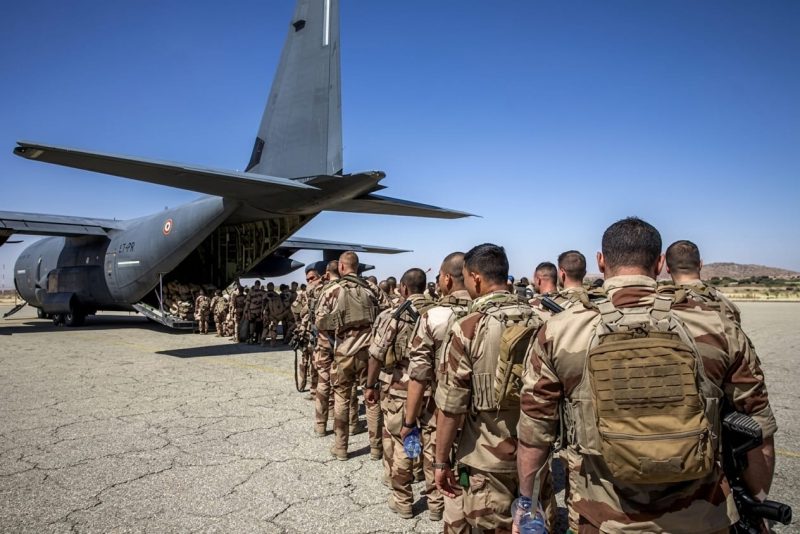
Chad and France have renewed military cooperation nearly 18 months after N’Djamena ordered French forces out of the country in a dispute over intelligence sharing in the Lake Chad Basin. French personnel returned to Chad in April 2026 to resume training, intelligence work and limited deployments.
France has no plans to reopen permanent bases in Chad, according to officials briefed on the talks. Instead, small teams will deploy as needed and with N’Djamena’s approval, a shift from the roughly 1,000 troops France once kept in the country. The rupture dates to November 2024, when Chad’s government announced it would end its defense cooperation agreement with Paris, last revised on 5 September 2019. Anti-French sentiment was rising across the Sahel at the time, and Chadian officials framed the move as a step toward greater sovereignty over security decisions.
Two Mirage 2000D fighter jets and a tanker aircraft left Kossei airbase in N’Djamena on 11 December 2024, the first visible sign of the pullout. France handed over its first base later that month, and a Ukrainian-operated An-124-100M transport aircraft helped move equipment and personnel out of the country in the weeks that followed. By 31 January 2025, the last French soldiers had departed, ending a military presence that has lasted since Chad’s independence in 1960. Chad did not stay unaligned for long; N’Djamena turned to Russia, Turkey and the United Arab Emirates (UAE) for support, but each partnership ran into problems. Russia’s Africa Corps mercenaries struggled to contain insurgents in neighboring Mali, which made Chadian commanders wary of relying on similar support. Turkish Aerospace Industries had supplied Chad with ANKA-S and Aksungur attack drones in 2024, but the aircraft proved too costly for the Chadian air force to sustain. The UAE, meanwhile, drew suspicion over its reported support for Sudan’s Rapid Support Forces (RSF), including through use of an airport on Chadian soil; Abu Dhabi denies backing the paramilitary group.
A defense analyst from Defense24 described the new arrangement as limited by design. “France is trying to rebuild military cooperation with Chad, but not in the old format”, he wrote. He argued that the areas where Chad has struggled most since the French departure, casualty evacuation, air support for ground troops, and intelligence collection are precisely where French assistance mattered most in the past.
Air support looks likely to be the first area of renewed cooperation. Chad’s military has lacked a reliable medical evacuation capability and close air support for units in the field since 2025, gaps that French aircraft and crews previously filled. One detail under discussion carries symbolic weight: the revived agreement could give France limited access to its former Sergeant Adji Kosseï base in N’Djamena, the last facility handed over to Chad during the 2025 withdrawal.
Chad faces pressure on two fronts: Boko Haram and Islamic State West African Province fighters operating in the Lake Chad region, and spillover risk from Sudan’s civil war along its eastern border. Neither threat has eased since 2024, and Chad’s alternative partners have not delivered the capabilities N’Djamena needs to answer them.
For France, the return offers a way to preserve some strategic footing in the Sahel after being pushed out of Mali, Burkina Faso and Niger in preceding years. Chad was the last country in the region to host French forces, and its 2024 expulsion order left Paris without a base in the central Sahel for the first time in 6 decades. A cautious re-entry, focused on training and air support rather than garrisons, allows France to remain engaged without reviving the basing arrangements that had become politically toxic across the region. The approach also signals a broader adjustment in how France works with African militaries. Rather than stationed brigades and fixed installations, the emerging model relies on smaller footprints, shorter deployments and agreements that Chadian authorities can calibrate or withdraw at will. That fits a wider pattern across the Sahel, where France’s Operation Barkhane, launched in 2014 under President François Hollande to fight Islamist militants across the region, gave way over the past 4 years to a series of forced exits from Mali, Burkina Faso and Niger.
The Chadian Army began looking beyond its traditional Eastern-bloc suppliers as early as 2021, the same year it took delivery of French ERC-90 armored cars as the French Army itself moved to retire the type in favor of the newer Jaguar combat vehicle. That history of partial, secondhand equipment transfers helps explain why Chad’s leadership has been willing to entertain multiple suppliers at once rather than lean on any single partner, and why the current opening to France comes without the exclusivity of the old defense pact.