

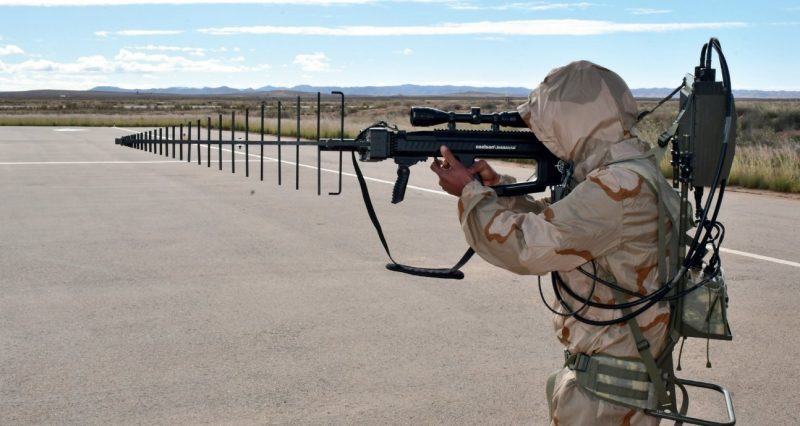
The Tunisian Air Force has integrated Aselsan’s IHASAVAR man-portable counter-drone jammer into its force protection toolkit, adding a close-in electronic warfare layer to complement the medium-altitude Anka-S unmanned systems it already operates from Turkish Aerospace Industries (TUSAŞ).
Tunisia’s security environment has grown more demanding since the 2011 Libyan collapse. Its southern and western borders face persistent cross-border smuggling, armed group movement, and low-cost drone surveillance – threats that outpace what conventional air defence radars are designed to handle. Consumer-grade quadcopters flying below 150 metres present almost no radar cross-section and can reach a forward outpost or convoy before any intercept is possible. Man-portable jamming systems address exactly that gap.
Although, the IHASAVAR’s presence in Tunisian service has been reported by regional defence media outlets but has not been confirmed by the Tunisian Ministry of National Defence, TUSAŞ, or Aselsan in official communications as of 26 June 2026.
Aselsan’s IHASAVAR man-portable counter-drone jammer
The IHASAVAR is a counter-unmanned aerial system (C-UAS) developed by Aselsan, Turkey’s principal defence electronics company. It was first shown publicly at the Langkawi International Maritime and Aerospace (LIMA) exhibition in 2017, when an Aselsan account manager told Jane’s the system had been developed in roughly six months in response to the proliferation of commercial drones.
The hardware is split across two components. A backpack unit weighing around 11.5 kg houses the electronics, signal generator, and two lithium-ion batteries. The operator carries a rifle-style directional antenna weighing about 2 kg, aimed visually at the target drone. Total combat-ready weight for a single operator is therefore under 14 kg – lighter than a standard infantry radio loadout.
The jammer simultaneously overwhelms three frequency classes: radio control links in the 400 MHz to 3 GHz band and the 5.7-5.9 GHz range used by commercial quadcopters; data link and telemetry channels; and Global Navigation Satellite System (GNSS) signals including GPS, GLONASS, Galileo, and BeiDou. The jamming itself uses Direct Digital Synthesis (DDS) techniques with Field-Programmable Gate Array (FPGA)-controlled swept jamming – a software-defined architecture that allows operators to select from more than 100 pre-programmed jamming profiles to handle different drone types or tactical situations.
Output power sits at a typical 60 W. Once the target drone loses its command link and navigation fix, its onboard safety protocols take over, forcing either an automatic return-to-launch or a controlled vertical landing. Neither outcome involves fragmentation risk – relevant for protecting VIP convoys or crowded checkpoints where kinetic intercept would be dangerous.
Battery life is around 1.5 hours of continuous jamming. The system operates between -30°C and +50°C, making it viable across North Africa’s climate range from winter mountain operations to summer desert deployments. By January 2019, Aselsan had delivered 500 IHASAVAR units – across the combined IHASAVAR and Kangal family – to Turkish armed and security forces, and the company projected deliveries beyond 1,000 units that year. The Turkish Presidential Protection Unit has used the system operationally, which Aselsan has cited as a reference deployment. Azerbaijan’s Air Force adopted the IHASAVAR by 2017, deploying it along the then-disputed border with Armenia.
At the ASDA 2025 exhibition, Aselsan re-introduced an updated mobile version of the IHASAVAR described as drawing on the Kangal anti-drone system platform.
The type has once been recovered by Malian and Burkina Faso troops from Sahelien terror group.
Tunisia’s Turkish Procurement Track
If confirmed, the IHASAVAR acquisition is one part of a broader pattern. Tunisia signed a contract in March 2020 with TUSAŞ for three Anka-S Medium Altitude Long Endurance (MALE) unmanned combat aerial vehicles and three ground control stations, at a cost of US$80 million, financed 85% by Turkey’s Eximbank. The first Anka-S was handed over in November 2021. According to TUSAŞ marketing statements cited by the TURDEF defence tracker, five Anka-S platforms have since been delivered to Tunisia (verified via TURDEF, June 2026).
The Anka-S carries a 200 kg payload, has an endurance of 24 hours, and can reach 9,000 metres. It carries an Aselsan synthetic aperture radar (SAR) and ground moving target indication (GMTI) radar for wide-area surveillance, and can be armed with MAM-L guided munitions or Cirit 70 mm rockets. Its satellite communications link – a key differentiator over rival systems – enables long-range operations beyond line-of-sight ground control, which mattered to Tunis when it evaluated the TUSAŞ offer against the Bayraktar TB2 in 2019.
Tunisia also operates BMC Kirpi Mine-Resistant Ambush Protected (MRAP) vehicles and Nurol Makina Ejder Yalcin armoured personnel carriers, both procured from Turkey. Five Turkish defence companies exported roughly US$150 million worth of equipment to Tunisia in 2020 alone, according to Turkey’s Presidency of Defence Industries.
Layered Defence, Diversified Suppliers
The IHASAVAR fills a tier that the Anka-S cannot: immediate, zero-notice protection against low-altitude commercial drones operated by non-state actors or criminal networks at close range. The Anka-S surveys the border at altitude and feeds intelligence to ground commanders; the IHASAVAR gives a soldier on a checkpoint or convoy escort the ability to neutralise a threat drone in seconds, without calling for support.
Tunisia’s overall procurement posture, however, deliberately avoids dependence on a single partner. When Tunisia issued a tender for long-range radar to replace ageing systems, the bidding field included Lockheed Martin, Thales, Leonardo, and Spain’s Indra – all Western firms competing for a contract requiring coverage out to 360 km. Aselsan lobbied hard with its Kalkan II system.
Washington remains Tunisia’s primary partner for fixed-wing capability and ISR. The Tunisian Air Force took delivery of a fourth C-130H Hercules transport from U.S. Excess Defense Articles stock in January 2026, and the service has received eight Beechcraft T-6C Texan II turboprop trainers under a Foreign Military Sales contract. Four Textron Aviation C-208B Grand Caravan EX intelligence-configured aircraft arrived in September 2024, adding a persistent overwatch platform suited to southern border monitoring.
Tunisia’s approach is straightforward: use Turkish tactical systems – drones, armoured vehicles, and now reportedly portable C-UAS – to cover the asymmetric and low-cost threat spectrum, while keeping Western suppliers for high-end surveillance and strategic airlift. That split allows Tunis to manage both cost and political relationships without becoming reliant on any single defence partner.
The next visible milestone will be whether Tunisia formally expands its Anka-S fleet beyond five aircraft. TUSAŞ has publicly described ongoing discussions, and a potential follow-on order would confirm that Tunis is satisfied enough with Turkish platform performance to deepen the relationship at the high-capability end – not just at the portable electronic warfare tier.