
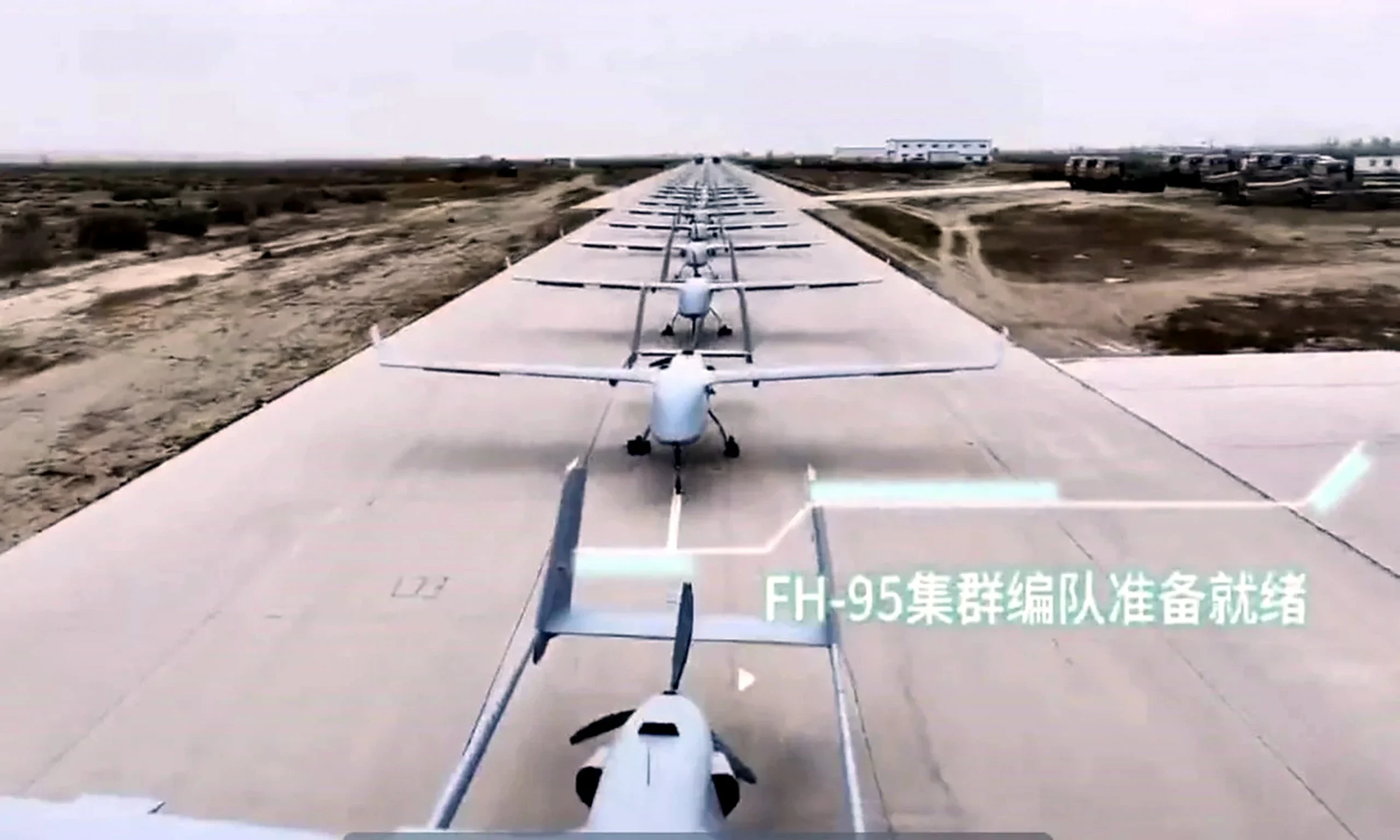
The Sudanese Armed Forces (SAF) say their air defences shot down a Chinese-made FH-95 long-endurance drone east of Wad Banda in West Kordofan around midday on Saturday, 7 November 2026, the fourth drone they have claimed over the state in seven days, Anadolu Agency reported on 8 November.
The army’s short statement described the aircraft as “hostile” but, as in earlier cases, did not say who had launched it. The interception came as the SAF and its allies pushed towards Al-Khuwei, a town that links central Sudan with West Kordofan and serves as a livestock trading hub in the country’s gum arabic belt.
Four claimed kills in seven days
The latest claim caps a busy week for Sudanese ground-based air defence in Kordofan. On Monday, 2 November, the army said it had intercepted an FH-95 south of Wad Banda. On 7 November, according to Sudan Tribune, the military said it had taken the town of Iyal Bakhit (also spelled Ayal Bakhit) and shot down another FH-95 over it, which it described as the second drone downed in Kordofan within 72 hours. A further statement reported a long-range drone shot down near Wad Banda, which Sudan Tribune counted as the third in 72 hours and Anadolu as the fourth in a week.
The SAF has given no details of the weapons used in these engagements. Earlier this year it fielded several layers against the Rapid Support Forces’ (RSF) drones. In July, Military Africa reported that the army had downed an FH-95, also known by its export designation CH-95, using a Turkish-built Bayraktar Akıncı combat drone, and in August open-source analysts documented wreckage of a Turkish HİSAR-A surface-to-air missile in Khartoum, the first evidence that Sudan had fielded the system against drones.
What the FH-95 brings to the RSF
The FH-95 is built by Aerospace Times Feihong Technology Company (ATFTC), a subsidiary of the state-owned China Aerospace Science and Technology Corporation (CASC). According to China’s Global Times, the type first flew in 2017, was delivered to a key client in 2019 and won its first export contract in 2021. The paper describes a drone with a take-off weight of around one tonne, a payload of more than 250 kilograms and an endurance of more than 24 hours, built for armed reconnaissance, surveillance and electronic warfare. Other published figures are lower; Sudan Tribune has cited an endurance of 12 hours and a maximum take-off weight of 850 kilograms, and reported specifications vary by source.
The Sudanese army never names the operator of the drones it shoots down, but the RSF, the paramilitary force it has fought since April 2023, is the only known user of the FH-95 in Sudan. Satellite imagery from December 2024 and January 2025, cited in a report carried by AllAfrica, showed three aircraft assessed as FH-95s. Sudan Tribune has described the type as the only drone the RSF uses for long-range missions, giving the group the reach to strike deep into government-held territory.
Ground offensive around Al-Khuwei
The drone claims accompany the heaviest fighting in Kordofan in more than a year, according to Asharq Al-Awsat. The Joint Force of Armed Movements, which fights alongside the army, said it captured 82 combat vehicles and destroyed 68 belonging to the RSF around Iyal Bakhit. The RSF-led Tasis alliance gave a very different account, saying the attacking force numbered about 250 combat vehicles and that its fighters destroyed more than 120 and captured 81. Neither side’s figures, nor control of Iyal Bakhit, could be independently verified, and witnesses quoted by the paper said both sides suffered heavy losses.
Military sources told Anadolu that army units and allied forces destroyed RSF vehicles in a three-hour engagement near Al-Khuwei. The army also said it had taken Umm Marahik, in the north-west of Al-Khuwei district.
A drone war spreading across borders
Drones have become a central feature of the war. The United Nations said in May that drone attacks killed at least 880 civilians across Sudan between January and April 2026, with Kordofan hit hardest. On 1 November, Sudan’s Foreign Ministry filed complaints with the UN Security Council and the African Union accusing Ethiopia of allowing the RSF to launch drone strikes from its territory against civilian infrastructure and power stations. Addis Ababa has not publicly responded to the complaint in the reports reviewed by Military Africa.
The pattern seen in Sudan, with Chinese-made drones on one side and Turkish platforms and missiles on the other, mirrors wider supplier competition across the continent, where Military Africa’s drone procurement tracker lists China as the largest supplier of military drones to Africa by volume, with Türkiye’s Baykar now a major competitor.
Air Defence and the Race for Al-Khuwei
For the SAF, keeping long-endurance drones out of the Kordofan sky matters as much as the ground advance. An FH-95 overhead can spot columns moving on Al-Khuwei and the roads west towards Darfur, and the RSF has used the type for strikes far behind the front. Four claimed kills in a week suggest the army has pushed air defence units forward with its ground forces, though without wreckage photographs or details of the weapons used, the claims remain the army’s own. Whether the RSF can replace lost airframes, and how quickly, will shape how much freedom of manoeuvre the army enjoys as it presses into West Kordofan.