
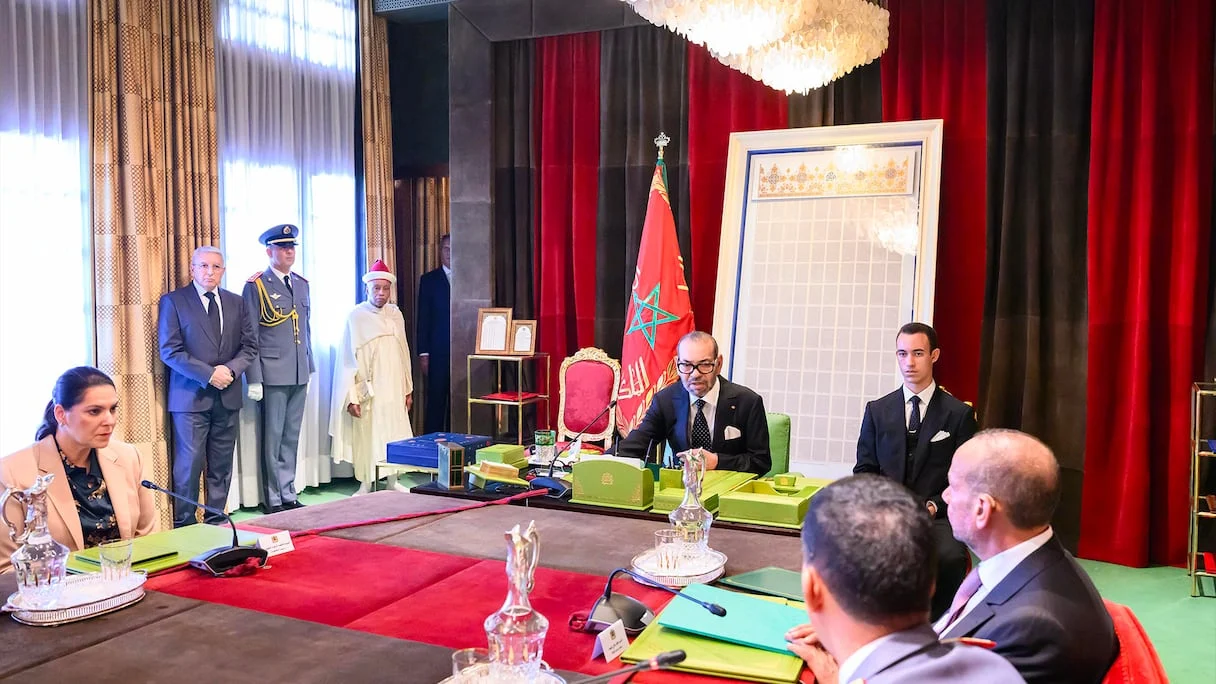
King Mohammed VI chaired a working session at the Royal Palace in Rabat on Wednesday 18 November 2026 to launch “Offre Maroc”, a roadmap that aims for Moroccan industry to meet about 40% of the equipment needs of the Royal Armed Forces (FAR) and security services by 2035, according to a Royal Cabinet communiqué reported by La Vie éco and the Maghreb Arabe Presse (MAP). The plan was presented by General Mohammed Berrid, Inspector General of the FAR and Commander of the Southern Zone, and Ali Seddiki, Director General of the Moroccan Agency for Investment and Export Development (AMDIE), in the presence of Crown Prince Moulay El Hassan.
Targets, money and institutions
The roadmap sets three goals for 2035: nearly 50,000 direct and indirect jobs, local production covering about 40% of FAR and security-service needs, and more than 65% of the sector’s revenue earned on international markets. The King instructed the Hassan II Fund for Economic and Social Development to contribute 4 billion dirhams (about US$401 million), The Rio Times reported.
Two new bodies will run the effort: a strategic agency to steer the strategy and support investors, and an industrial holding company to structure the sector, raise public and private finance and build Moroccan industrial champions. Two new defence industrial zones are planned at Benguérir and Benslimane, adding to two defence industrial acceleration zones already launched, and a specialised academy will train technical staff with industrial partners. The communiqué gives no timetable for the agency, the holding company or the academy.
Drones first
The priority sectors are drones and autonomous systems, land and naval equipment, defence electronics, cyber defence and artificial intelligence, and dual-use technology, across a value chain running from design and manufacture to testing, maintenance and storage.
Some of that base already exists. India’s Tata Advanced Systems opened a plant at Berrechid in September 2025 to assemble the WhAP 8×8 armoured vehicle, and Turkish drone maker Baykar announced a project at Benslimane in 2025. In November 2025, Abdeltif Loudiyi, the Minister Delegate in charge of the National Defence Administration, told a parliamentary committee that ten defence-industry projects worth about US$260 million and more than 2,500 direct jobs were authorised or close to approval, Le360 reported. At the Marrakech Air Show on 7 October 2026, Loudiyi pointed to dedicated industrial zones, incentives and foreign partnerships as the foundations of a national defence industry.
From Africa’s largest buyer to a producer
Morocco became Africa’s largest arms importer in the 2021-2025 period, overtaking Algeria, according to Stockholm International Peace Research Institute (SIPRI) data reported in March 2026, and it operates one of the continent’s largest military drone fleets. Its 2026 budget set aside 73 billion dirhams (about US$7.3 billion) for defence, against which the 4 billion dirham pledge is a one-off contribution rather than an annual sum. The communiqué gives no baseline for how much FAR equipment is made in Morocco today, so the distance to the 40% target cannot yet be measured.
Rivalry and Exports on the Maghreb Frontier
The plan places Morocco alongside Egypt, South Africa and Algeria among African states trying to build a domestic arms industry, and it is the most export-focused of them on paper. Its success will depend on how quickly the agency and holding company are set up, whether foreign partners such as Baykar, Tata and Israeli firms move from assembly to design work in Morocco, and whether export markets in Africa and the Middle East open to Moroccan products. In a region where Algeria’s 2026 budget again set a record for military spending, according to the North Africa Post, a home-grown drone and electronics base would also reduce Rabat’s exposure to foreign supply decisions in a crisis.