
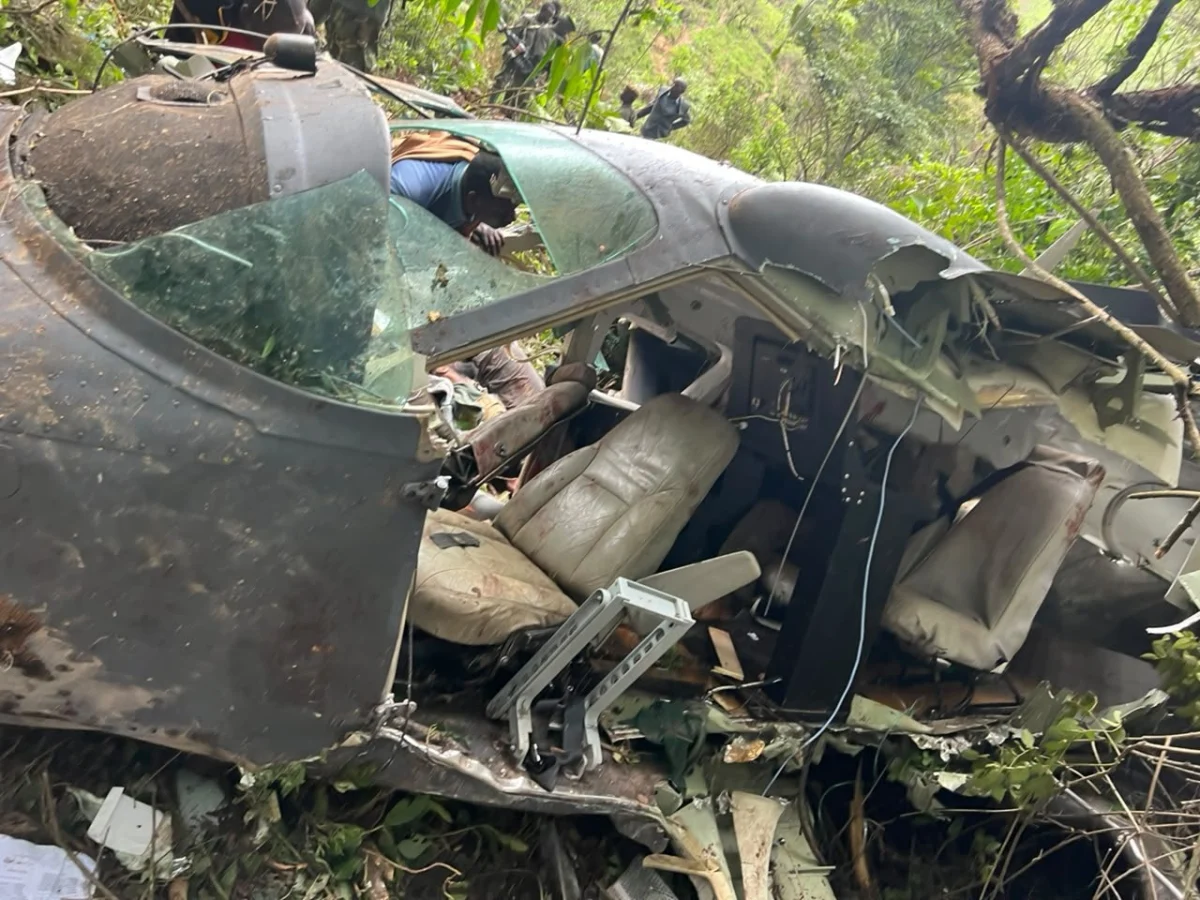
A Cessna 208 Caravan aircraft flying in support of the Armed Forces of the Democratic Republic of the Congo (FARDC) went down in the Kalongi area east of Minembwe, in South Kivu’s Fizi Territory, at about 06:00 on Sunday 22 November 2026, after rebels of the Front for the Refoundation of the Nation (FRN) said they had shot it down. Four people were reportedly on board. Two were killed and two survived, a South African pilot and a Ugandan national, and both are now held by the rebels, KT Press and the Mail & Guardian reported.
FRN spokesperson Lawrence Kanyuka said the group’s fighters had downed “a fighter jet that was flying over the Minembwe area and preparing to launch an attack against civilian populations”, and posted videos of the wreckage. The FRN is the movement that grew out of the Alliance Fleuve Congo and the March 23 Movement (AFC/M23), and is led by former president Joseph Kabila, The New Times reported.
Not a Fighter Jet but an Armed Caravan
The images do not show a fighter. Olivier Fourt of Radio France Internationale (RFI), who examined the photographs and videos, identified the wreckage as a Cessna 208 Caravan in a military configuration, according to a summary of the RFI analysis. KT Press described the aircraft as an AC-208, a civilian airframe modified to carry missile launchers and guided rockets for close air support. The Aviation Safety Network database lists it as a Cessna 208B Grand Caravan, possibly an AC-208B Combat Caravan, built in 2008 with manufacturer’s serial number 208B2060, and notes that an identification plate visible in the cockpit reads F-HDNT, a French civil registration. None of these details has been confirmed by Kinshasa.
The armed Caravan is a single-engine turboprop fitted with an electro-optical and infrared sensor turret and underwing pylons for laser-guided missiles or rockets. It has been used for surveillance and light strike by air forces such as Iraq’s and Lebanon’s, because it is cheap to buy and operate and can loiter for hours over a counter-insurgency area. Flying low and slow over the Minembwe highlands, however, it is exposed to heavy machine guns and shoulder-fired weapons.
The Congolese army has given a different account. In a statement attributed to FARDC spokesperson Major General Sylvain Ekenge Bomusa Efomi, the general staff said it had lost contact on 22 November with a Cessna 208 cargo aircraft of the Congolese Air Force flying from Beni in North Kivu to Kalemie in Tanganyika province, citing bad weather, and that the aircraft and its crew had not been found, Global News RDC reported. An FARDC officer on the Minembwe front separately denied that any army fighter jet had been shot down, MediaCongo reported. The army has not said whether the aircraft it lost is the one in the photographs.
Contractors in the Cockpit
The two survivors point to the private aviation network behind Kinshasa’s air campaign. The Mail & Guardian named the South African pilot as Alexander Villete, while KT Press reported that the FRN described both survivors as foreign contractors involved in aerial military operations. Citing the Congolese outlet Conspiracy Tracker Great Lakes, the Mail & Guardian and The New Times reported that the pilot worked for Contractor Airways (PTY) Limited, a company run by Steven Patrick Shaulis, a former United States Army Special Forces soldier, and South African businessman Craig Barry Munro. According to that investigation, the pair operate a Cessna Caravan out of Kalemie, on the western shore of Lake Tanganyika, for aerial surveillance and air strikes in support of the FARDC under a contract signed in February 2025, and also fly two Boeing 727s for army logistics. Military Africa has not been able to verify these claims independently.
The Ugandan survivor’s presence drew a quick response from Kampala. A video emerged in which he said he was a Ugandan officer deployed on his government’s orders. Chief of Defence Forces General Muhoozi Kainerugaba replied in a statement shared on X by spokesperson Chris Magezi: “UPDF had nothing to do with the aircraft that was shot down in Minembwe. We have penalized that company.” He did not name the company or explain the penalty. Uganda keeps troops in North Kivu under Operation Shujaa, a joint campaign with the Congolese army against the Allied Democratic Forces (ADF).
Kinshasa has leaned on foreign specialists before. In early 2025 more than 200 European contractors, many of them Romanian, who had supported the army around Goma crossed into Rwanda after the city fell to M23. Since then the government has expanded its own unmanned fleet, including Chinese CH-4 and Turkish Bayraktar TB2 drones, two of which M23 claimed to have shot down in South Kivu in November 2025, and has sought Wing Loong II drones from China.
The Battle for the Minembwe Highlands
The aircraft came down in the middle of an offensive. The FARDC, backed by Burundian troops and Wazalendo militias, has been trying to retake Minembwe from Twirwaneho fighters, a Banyamulenge armed group that forms part of the FRN coalition. The fighting has involved ground assaults, artillery and drone strikes, with control of hills and villages changing hands, and the FRN accused the army of bombing the Isoko school complex in Minembwe centre on 16 November. On the day of the crash, Kanyuka said government-aligned forces carried out kamikaze drone attacks on Bulambika and Kambale in Kalehe Territory, The Observer reported. Neither side’s claims could be independently verified.
Eastern Congo has become one of Africa’s busiest drone theatres. An ISS Today analysis published on 23 November said more drones had been used in the past year than in all previous years since the military began using them in 2022, and that M23 has fielded loitering munitions reported to be Turkish-made YIHA-IIIs as well as modified commercial drones. The rebels have also used fibre-optic first-person view (FPV) drones in South Kivu.
Air Support Under Fire in South Kivu
If the FRN’s claim holds, the loss shows that the rebels can still contest the low-altitude airspace that Kinshasa relies on for close air support in the highlands, and that contractor-flown aircraft carry political risk as well as military value. The fate of the two captured crew members, and whether Pretoria and Kampala become involved in efforts to free them, is likely to keep the incident in the news. Wreckage analysis of any weapons recovered from the aircraft, and a fuller FARDC statement on the missing Beni to Kalemie flight, would settle what the Caravan was doing over Minembwe at dawn.