

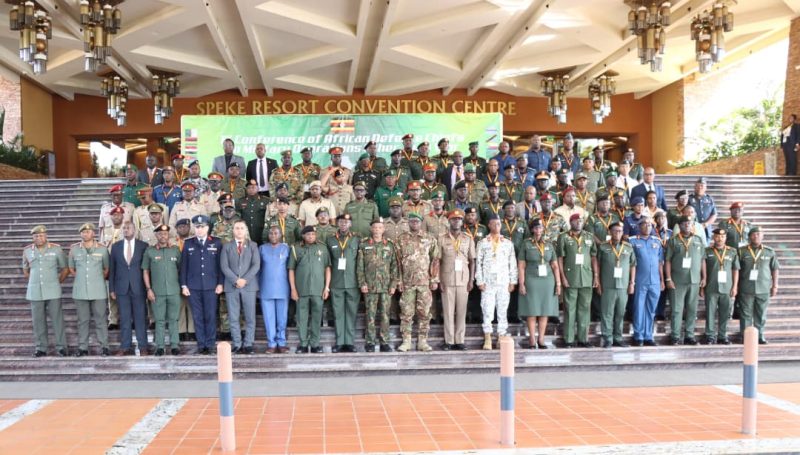
Uganda hosted the first African Chiefs of Defence Forces Conference on Military Operations Other Than War (MOOTW) from October 5 to 8, 2026, bringing defence chiefs from 18 African countries to Speke Resort Munyonyo in Kampala.
The four-day meeting was organised by Uganda’s Ministry of Defence and Veteran Affairs and the Uganda Peoples’ Defence Forces (UPDF). Its theme, “Strengthening Adaptive Noncombatant Military Response to Emerging Complex Security Threats in Africa,” set the agenda for four days of closed sessions and bilateral talks closing in a session where Museveni said Africa cannot effectively address emerging security threats without confronting the economic, political and geopolitical factors that determine the strength and stability of nations.

Gen Muhoozi Kainerugaba, Uganda’s Chief of Defence Forces and Senior Presidential Advisor for Special Operations, hosted the gathering. Alongside national defence chiefs, the conference drew commanders of the African Union Support and Stabilization Mission in Somalia (AUSSOM), the United Nations Organization Stabilization Mission in the Democratic Republic of the Congo (MONUSCO), the United Nations Interim Security Force for Abyei (UNISFA) and the United Nations Mission in South Sudan (UNMISS), along with representatives of the African Union, the African Peace and Security Architecture (APSA), and regional blocs including the Intergovernmental Authority on Development (IGAD), the East African Community (EAC) and the Economic Community of West African States (ECOWAS).
Opening the conference, UPDF Chief of Joint Staff Lt Gen Jack Bakasumba framed the gathering as a response to a security picture that no longer fits the old template of state-on-state war. “Across Africa and the wider global arena, the security landscape has evolved away from interstate warfare, shifting instead toward a challenging matrix of interstate conflict and complex non-traditional threats,” he said. He pointed to terrorism, organised crime, cyber warfare, public health emergencies and climate related crises as the threats now dominating planning, and said forces across the continent are often short on training, specialised equipment and functional early warning systems to meet them.
Bakasumba pressed delegates to move past communique language and into shared procedure. “We must establish mechanisms that extend beyond discussions and conferences and can be translated into concrete standard operating procedures, training, early-warning systems, joint communications, information sharing and deployable capabilities,” he said. His emphasis on standardised SOPs and rapidly deployable capability echoed through the week, including from Uganda’s Deputy Chief of Defence Forces, Lt Gen Sam Okiding, who told the Chiefs of Defence Intelligence and Security session that the point was not to introduce new concepts but to redefine how existing operations are run. He argued for intelligence-led planning across humanitarian crises, terrorism, transnational organised crime, irregular migration and climate related displacement.
For a semi-technical audience, MOOTW is worth defining precisely. It covers the set of military tasks that fall short of conventional combat: peace support and stabilisation operations, disaster and pandemic response, counter-terrorism and counter-insurgency support, protection of critical infrastructure, maritime and border security, and military assistance to civil authorities during emergencies. NATO and several Western militaries have used variants of the term for decades; Uganda’s pitch in Kampala was to build an African-owned version of the doctrine, shaped by its own record in Somalia, South Sudan and the eastern Democratic Republic of the Congo rather than imported from outside.
The conference agenda, as laid out by Uganda’s Ministry of Defence, ran wide: cybersecurity and artificial intelligence, unmanned aerial systems, gender mainstreaming, natural resource management, space and environmental security, disease pandemics, external influence operations and legal and ethical accountability for military forces operating in civilian spaces. That breadth reflects a genuine operational problem. African militaries are increasingly tasked with civil support missions, from Ebola and COVID-19 response to flood relief, without a shared framework for command, funding or legal mandate when troops operate outside a declared conflict.
Gen Muhoozi used the platform to advance his own formulation of the doctrine, describing it in UPDF materials as “Military Support to Peace and Security” and citing the army’s role in Uganda’s Ebola and COVID-19 responses, maritime patrols and humanitarian logistics as a working model other states could adapt. General Salim Saleh, addressing delegates virtually, argued that wealth creation is itself a pillar of peace.
Closing the conference on October 8, President Yoweri Museveni tied the whole exercise back to economics. “A country cannot have a strong and safe defence force without a strong economy,” he said, urging delegates to pursue wealth creation through commercial agriculture, manufacturing, services and ICT, and to widen markets through the African Continental Free Trade Area (AfCFTA) and deeper regional integration. “Security and prosperity go together,” he told the assembled chiefs, thanking them for taking part in what organisers billed as the first conference of its kind at the level of African defence chiefs.
Whether Kampala’s conference produces anything beyond a communique will depend on follow through that conference organisers themselves flagged as the hard part: converting discussion into standard operating procedures, interoperable communications and pooled early warning systems that can survive a change of government or a budget cycle. Uganda’s defence ministry has not yet announced a secretariat, working group structure or date for a follow-up conference. What is clear is that 18 African states have now put MOOTW on their agenda as a named doctrine rather than an ad hoc practice, setting up a test of whether the next deployment, whether to a flood zone, a disease outbreak or a counter-terrorism operation, looks any different on the ground.